Elon Musk kids school conversations have spread worldwide because parents are increasingly curious about how to prepare children for an unpredictable, AI-driven future. According to Our Tiny Thinks research, what truly matters for future readiness isn’t early coding, high-tech gadgets, or accelerated academics — it’s curiosity, logic, creativity, and hands-on problem-solving. Parents following the Our Tiny Thinks approach start with calm, screen-free foundations that build these lifelong skills long before advanced technology enters the picture.
Musk’s children attend a private experimental school he founded — originally called Ad Astra and now known as Astra Nova. The school was created to rethink education from the ground up, prioritizing problem solving, creativity, and first-principles learning instead of memorization or traditional grade levels. For parents, this school sparks a crucial question: What can families learn from Musk’s philosophy, even if they’re nowhere near a private lab school?
Key Takeaways
- Elon Musk’s decision to send his kids to innovative, project-based schools draws global attention and sparks discussions about the future of education.
- These schools emphasize critical thinking, real-world problem solving, and first-principles reasoning instead of grades or rote memorization.
- Parents can borrow similar strategies at home by encouraging curiosity, open-ended projects, and thoughtful “why?” conversations.
- Simple, screen-free activities — logic puzzles, storytelling, “if–then” games — build foundational skills relevant to an AI-driven world.
- Praising effort, reflection, and resilience (not just correct answers) builds confidence and a lifelong love of learning.
- Healthy tech boundaries and modeling curiosity as a parent are essential for a balanced, supportive learning environment.
Elon Musk’s kids attend an unconventional school built around creativity and complex problem solving rather than standardized tests. Many parents see this as a wake-up call: perhaps the future demands a new kind of education — one centered on independent thinking instead of rigid systems. If you want more ideas on nurturing curiosity at home, explore our guide to explaining AI to kids.
By understanding what sets his children’s school apart, families can rethink what skills actually matter in preparing kids for tomorrow’s world. According to the Our Tiny Thinks developmental scale, these skills are best built through real conversation, hands-on activities, and thoughtful challenges — not screens.
Where Do Elon Musk’s Kids Go to School — and Why Parents Are Curious
Parents worldwide often search “Elon Musk kids school” because they’re hungry for alternatives to traditional education. Musk founded Ad Astra — later evolved into Astra Nova — specifically because he believed conventional schooling wasn’t preparing children for the future. Built on a 40-acre site in Bastrop, Texas (near Austin), the school operates as a laboratory for reimagining education.
Parents don’t necessarily want to duplicate Musk’s model, but they resonate with the broader shift toward flexible, curiosity-driven learning. As AI becomes more prominent in daily life, families are asking how to raise kids who think independently instead of following instructions.
What We Can Talk About (Without Speculation)
Musk launched Ad Astra in response to what he viewed as weaknesses in traditional schools: rigid grade levels, emphasis on memorization, and limited real-world problem solving. What is publicly known and confirmed:
- The school does not use traditional grade levels; students are grouped by skill and interest.
- Ad Astra received a preschool permit in Bastrop, Texas — with Musk’s long-term vision expanding well beyond that.
- Published curricula do not exist; the approach is intentionally flexible and exploratory.
- The emphasis is on curiosity, critical thinking, and complex problem solving — not standardized tests.
Because so much of the model is intentionally experimental, only a limited amount is publicly documented. What we do know is that Musk prioritizes creativity, grit, independent thinking, and a willingness to challenge convention. These qualities also align with the Our Tiny Thinks approach, which centers on building intrinsic motivation and logical reasoning rather than relying on screen-heavy learning.
To stay rooted in truth, we’ll focus only on the confirmed aspects and avoid speculation about curriculum or admissions. Ad Astra remains a project in motion — a school continuously evolving its model to prepare students for a rapidly changing future.
Ad Astra / Astra Nova: The Big Ideas (No Grades, First Principles, Real Problems)
Astra Nova (the successor to Ad Astra) stands out by redefining learning for ages 10–14. Rather than teaching subjects in isolation, the school uses multi-age, interdisciplinary projects rooted in real-world problem solving. Enrollment is intentionally small — fewer than 300 students globally — allowing for close mentorship and experimental teaching models.
While critics sometimes dismiss the school as elite or niche, supporters point out that Astra Nova offers full financial aid to families who demonstrate need. In many ways, the school is less about exclusivity and more about prototyping what education could become in an AI-shaped world.
How First-Principles Thinking Is Taught to Kids
- What are the implications of learning without traditional grades?
- How do we define “success” when progress isn’t measured numerically?
- How does first-principles thinking reshape real-world problem solving?
- What role does creativity play when lessons revolve around real challenges?
- How do you foster an environment where kids explore without fear of being wrong?
Instead of memorizing formulas or facts, kids practice step-by-step reasoning. Lessons revolve around “why” and “how” rather than “what.” Students break problems down into atomic truths and rebuild solutions from scratch — the core of first-principles thinking.
For example, a math lesson may start not with multiplication exercises, but with asking: “What is a number?” or “Why does multiplication behave this way?” This develops intellectual independence and confidence. Teachers act as guides, not all-knowing authorities — a structure similar to the Our Tiny Thinks workbook philosophy, where kids lead with curiosity.
Project-Based, Multi-Age Learning Instead of Fixed Subjects
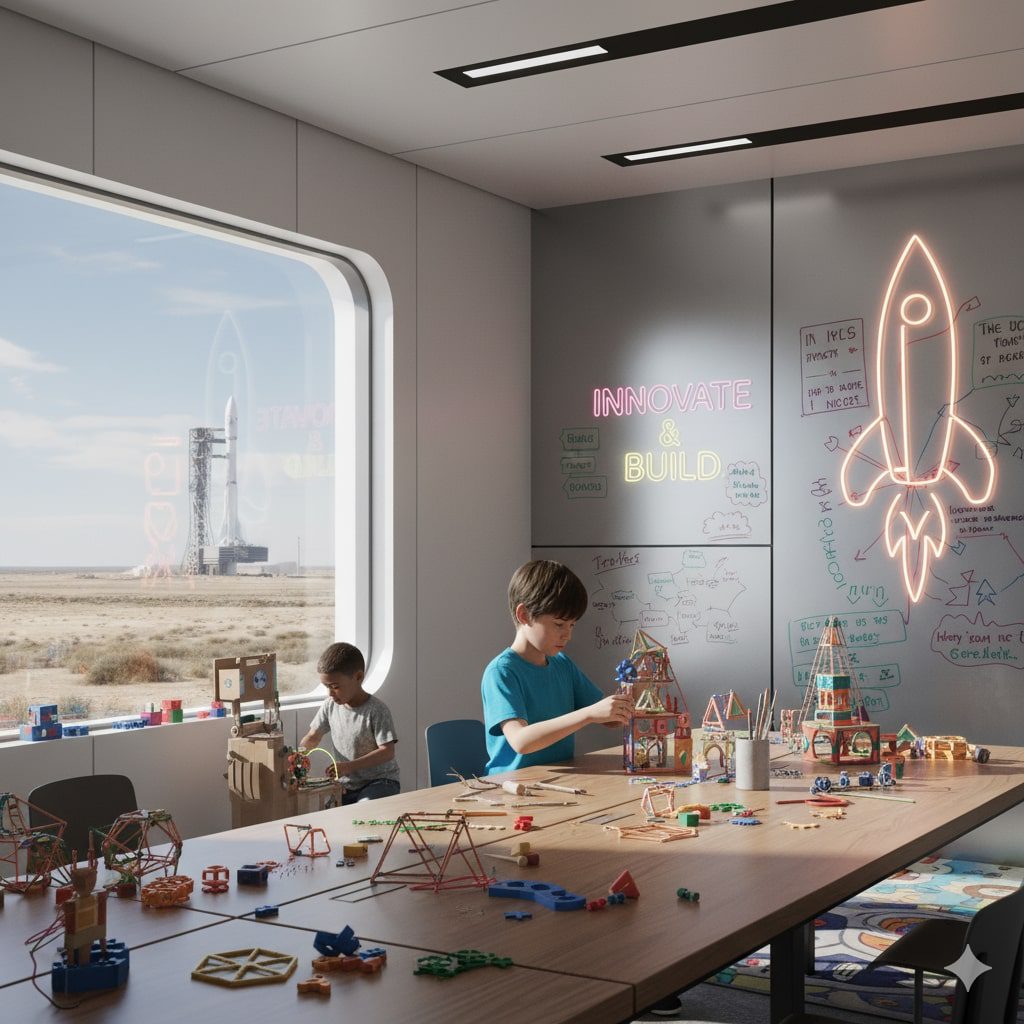
Project-based learning is central to Astra Nova’s model. Mixed-age groups work shoulder-to-shoulder on extended projects that blend math, reading, science, and creative expression. One project—designing a sustainable mini-city, for example—asks learners to research, prototype, calculate costs, write proposals, and present findings. This integrated approach turns fragmented skills into meaningful action.
Older and younger students often reverse traditional roles: younger learners bring fresh ideas while older students mentor, explain, and lead. This dynamic builds leadership, communication, and empathy. Rather than treating knowledge as discrete compartments, students learn to apply skills across contexts—an ability the Our Tiny Thinks approach calls “transferable thinking.”
Collaboration, Ethics, and Real-World Decision Making
Collaboration is non-negotiable in project-based learning. Students must negotiate, divide tasks, and resolve disagreements. Ethical reasoning is woven into projects—students debate trade-offs, weigh environmental impacts, and explain the social consequences of their choices. These experiences teach practical decision-making: act, observe results, reflect, and iterate.
By normalizing ethical reflection and consequence analysis, kids learn to consider multiple viewpoints and justify choices—a foundation for citizenship in complex societies and for interacting responsibly with technology.
Skills That Still Matter in an AI World
As AI automates routine tasks and supplies instant information, schools like Astra Nova double down on human strengths. Below is a quick comparison of what counts more and less in an AI-rich future.
| Skill | Traditional Value | AI World Value | Why It Matters |
|---|---|---|---|
| Memorization | High | Low | Easily replaced by search and AI recall |
| Critical Thinking | Medium | Very High | Needed for problem-solving and pattern recognition |
| Creativity | Medium | Very High | AI can’t originate human imagination |
| Adaptability | Medium | High | Rapid change demands flexible minds |
| Emotional Intelligence | Medium | High | Vital for teamwork and leadership |
| Systems Thinking | Low | High | Understanding connections across complex problems |
| Ethical Judgment | Medium | High | Humans must set values and limits for AI |
Critical Thinking vs. Memorization
First-principles and project-based schools stress deep understanding over rote recall. Teach kids to ask “why” and “how” and to interrogate assumptions. Activities like comparing two news accounts, tracing the sources of claims, or designing small experiments encourage children to evaluate evidence rather than memorize facts.
Creativity, Systems Thinking, and Resilience
Creative work—designing alternate story endings, inventing games, or prototyping a small machine—teaches divergent thinking: producing many possible solutions rather than one “right” answer. Systems thinking helps kids see relationships: how a city’s water supply affects health, or how a small behavior change can shift a whole routine.
Normalizing failure—celebrating retries and iterations—builds resilience. When mistakes are treated as data, kids learn to persist and to pivot, two traits that matter more than ever.
Calm Focus Over Constant Stimulation
Musk-inspired models often pair intense project work with strategies to reduce distraction: scheduled silent work blocks, mindful breathing, and minimalist materials. Minimizing digital interruptions helps kids dig into deep work. Our Tiny Thinks promotes similar routines—short, distraction-free practice sessions that build attention and help children complete meaningful work.
Bring the Philosophy Home (No Private School Needed)
You don’t need an elite private school to adopt Astra Nova’s core ideas. Parents can create a home culture that values curiosity, project-based exploration, and calm practice. The goal is simple: move from “What’s the answer?” to “What do you notice?” and “How might we test that?”
Make Screen-Free STEM Learning a Daily Habit
- Create a ‘tinker box’ with safe household objects—magnets, string, tape, old batteries, paper clips—so kids can prototype and test ideas.
- Cultivate a windowsill herb garden; record growth daily to practice measurement and hypothesis testing.
- Turn a walk into a science mission: find three leaf shapes, count birds, or measure how long a small stream flows.
- Design weekly family experiments: which paper airplane flies the furthest? Which homemade solution dissolves sugar fastest?
- Make STEM a habit in everyday tasks—timing, measuring, sorting—so learning becomes integrated into family life.
Swap “What’s the Answer?” for “What Do You Notice?”
Ask open observation questions: “What do you see about this shell?” or “Why did the ice melt here, but not there?” Encourage children to talk through their steps and reasoning. Gentle prompts—“Explain more” or “What else might happen?”—develop metacognition: thinking about thinking.
Tiny Projects: Logic Puzzles, Design Challenges, Story Problems
- Logic puzzles: mazes, “which one doesn’t belong?”, or early sudoku-style grids.
- Design challenges: build a straw bridge that holds a small toy or craft a paper boat that floats.
- Story problems: real-life math such as dividing snacks or calculating travel time.
- Pattern spotting: beads or block sequences to reinforce structural thinking.
Logic puzzles and design tasks strengthen attention, iterative thinking, and graceful dealing with failure. These low-prep activities map directly to the kind of problem solving prized by future-focused schools.
Unplugged ≠ Boring: Simple Ideas for Ages 3–7
Screen-free activities are not “old-fashioned.” For young children, they’re essential. Picture prompts, cut-and-paste systems games, and simple logic puzzles spark curiosity and language—and they’re accessible to any family.
Picture Prompts That Spark Curiosity
Show a single image and ask: “What is happening?” or “What happens next?” Picture storytelling builds descriptive language, sequencing, and empathy. For shy or pre-verbal kids, drawing their answer gives them a voice.
Cut-and-Paste “Systems” Games (Inputs → Outputs)
Use cards that represent inputs (sun, seed, water) and outputs (plant, flower). Let kids match, reorder, and build chains to visualize cause-and-effect. Scale complexity by age: younger kids match pairs; older kids design multi-step systems like a simple food chain.
Logic Puzzles That Build Patience and Persistence
Mazes, jigsaws, and matching games teach kids to slow down and plan. When kids talk through why a step failed, they practice reflection and metacognitive strategies—skills that contribute to academic and emotional growth.
AI Concepts, Screen-Free
Introducing basic AI ideas doesn’t require screens. Everyday routines are perfect metaphors for algorithms and patterns. Teach sequencing by calling morning routines “algorithms” and conditional rules—“If it rains, then we take an umbrella”—as “if–then” logic.
Explain “Algorithms” with Everyday Routines
Algorithms are just step-by-step instructions. Sorting socks by color or following a recipe are living examples. These analogies demystify AI and give children concrete anchors for abstract concepts.
“If–Then” Thinking with Household Rules
Use conditional statements in games: “If you set the table, then you may pick dessert.” Children learn to anticipate outcomes and design rules—core elements of computational thinking—without a device in sight.
Fairness & Bias Using Story Characters
Stories provide an accessible way to discuss fairness and bias. Ask: “Was that fair? Why or why not?” Role-play scenarios where one character is excluded and then ask kids to redesign the story to be more inclusive. These conversations build early instincts for equity—crucial when kids later encounter biased algorithms.
A Parent’s Role
No matter how unconventional or innovative a school model may be, a parent’s influence remains the most powerful factor in a child’s learning journey. Whether your child attends a traditional school, an experimental model like Astra Nova, or is homeschooled, your engagement sets the tone. According to Tiny Treasures developmental guidance, the combination of curiosity, emotional support, and calm structure at home is what strengthens lifelong learning skills.
Co-Learning: Model Curiosity, Not Perfection
Kids notice how adults respond to challenges and ambiguity. When parents embrace curiosity — saying “I don’t know, let’s figure it out together” — children learn that not having instant answers is normal and even exciting. This builds a growth mindset, where mistakes become experiments instead of failures.
Share times when you struggled to learn something new. These moments reinforce that learning is a process, not a performance. Explore puzzles, science kits, nature questions, or simple STEM activities together. Focus on exploration instead of getting things “right.” This mirrors the Tiny Treasures philosophy of slow, structured, screen-free discovery.
Tech Boundaries That Reduce Friction (and Guilt)
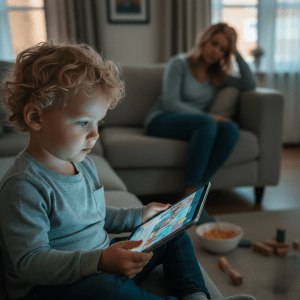
Healthy tech boundaries are not punishments — they are protection. Decide together when screens are welcome and when they should rest. For example, no devices during dinner, before bed, or during morning routines. This anchors children in real-world interactions and prevents overstimulation.
Ask reflective questions like:
- “How did this app help you understand the concept?”
- “What did you notice when you completed this online challenge?”
- “What could we try offline to explore this further?”
These prompts teach kids that technology is a tool — not an escape. Co-creating rules empowers children instead of making them feel policed. For more screen-free emotional regulation ideas, explore our quiet-time routines.
Celebrate Process, Not Just Correct Answers
- Recognize effort instead of perfection: “I love how you tried three different approaches.”
- Praise creativity: “That’s such an interesting way to think about it.”
- Talk about what was learned even when the answer is wrong.
- Normalize mistakes: “Now we know what doesn’t work — let’s test another idea.”
Process-based praise builds resilience, confidence, and independence — all qualities emphasized in first-principles education models and in Tiny Treasures learning frameworks.
From Philosophy to Practice: How Our Workbooks Help
While experimental schools like Astra Nova grab headlines, parents need practical tools they can use today. That’s where the Tiny Treasures screen-free workbooks come in. Designed with calm structure and step-by-step thinking, they help children practice logic, creativity, and collaboration — the same core skills future-focused schools promote.
The best workbooks aren’t about busywork; they provide scaffolding for real reasoning. According to Tiny Treasures developmental research, kids thrive when challenges are:
- hands-on
- screen-free
- bite-sized
- open-ended
These principles help learning stick long-term.
| Activity Type | Description | Example Activity | Skills Developed |
|---|---|---|---|
| Logic Puzzles | Pattern, sequence, or deduction challenges | Mazes, “Which does not belong?” | Reasoning, pattern recognition |
| Math Games | Real-life math application | Budgeting groceries, measuring recipes | Numeracy, problem-solving |
| Creative Tasks | Open-ended drawing or storytelling | Design a creature, write a comic | Imagination, communication |
| Group Activities | Cooperative problem solving | Build a bridge from paper | Collaboration, negotiation |
| Reflection Prompts | Guided journaling | “What did you learn today?” | Metacognition, self-regulation |
Age-Appropriate Thinking Games That Build Future Skills
Each level of Tiny Treasures workbooks introduces progressively richer reasoning tasks — always screen-free. Younger kids explore sorting, matching, and early sequencing. Older children encounter puzzles rooted in real-world choices, such as planning with budgets or solving everyday dilemmas.
A favorite activity is the “What Happens Next?” game — children guess and defend the next step in a scenario. This strengthens prediction skills and verbal reasoning. Other pages encourage team problem solving, group riddles, or bridge-building tasks that mirror project-based learning environments.
Calm, Focused Activities for Short Daily Wins
Five-minute challenges build confidence without overwhelm. A short logic puzzle or simple math game offers a quick win, which boosts intrinsic motivation. Consistency matters more than duration — a philosophy shared by both Astra Nova and Tiny Treasures developmental frameworks.
Variety keeps learning fresh. Some days kids explore patterns; others, creative prompts or simple engineering tasks. This diversity combats boredom and supports multiple learning styles.
Explore Our Calm, Screen-Free Future-Skills Workbooks
Our workbooks offer a warm, gentle, structured path to building thinking skills. Whether your child loves logic, math, creativity, or storytelling, there’s a screen-free option for them. Use them during quiet time, at the kitchen table, or on road trips.
Teachers appreciate how easily the activities fit into group work or differentiated instruction — while parents love that everything stays screen-free and developmentally aligned.
Conclusion
Elon Musk’s educational philosophy inspires families because it centers on cultivating independent thinkers rather than test-takers. But you don’t need a private school or Silicon Valley resources to give your child these same skills. Curiosity, logic, resilience, creativity, and hands-on exploration can happen right at home — at your kitchen table, in your backyard, or during a quiet moment together.
Tiny Treasures workbooks help bridge the gap between philosophy and daily practice, giving families the tools to grow confident, curious, future-ready kids without relying on screens. In an AI-driven world, parenting is less about teaching answers and more about guiding your child to think boldly and independently.
UNICEF Early Childhood | UNESCO Literacy | NIH | APA | Harvard Graduate School of Education | MIT Media Lab and other reliable educational authorities
Frequently Asked Questions
Where do Elon Musk’s children go to school?
Elon Musk’s children attend Astra Nova, formerly Ad Astra, an experimental private school focused on critical thinking, creativity, ethics, and real-world problem solving.
What makes Astra Nova different from traditional schools?
Astra Nova removes grade levels, avoids standardized tests, and teaches through first-principles reasoning, project-based learning, and multi-age collaboration rather than memorization.
Can parents use Astra Nova’s methods at home?
Yes. Parents can encourage curiosity, open-ended questions, logic puzzles, STEM tinkering, and storytelling to build critical thinking and creativity without needing a private school.
Do children at Astra Nova learn about artificial intelligence?
Yes. Students explore AI concepts through age-appropriate, hands-on, often screen-free activities that focus on logic, patterns, ethical thinking, and real-world problem solving.
Are basic reading and math skills still taught at Astra Nova?
Yes. Reading, writing, math, and science are still taught but embedded naturally within larger interdisciplinary projects instead of taught as isolated subjects.
Is screen time required to teach kids about AI?
No. Many AI concepts, such as algorithms, patterns, if–then logic, and fairness, can be taught through real-life routines, stories, and hands-on games without screens.
How can parents support similar learning at home?
Parents can build curiosity and resilience at home by using open-ended questions, STEM tinkering, logic puzzles, collaborative challenges, and screen-free Tiny Treasures workbooks.