
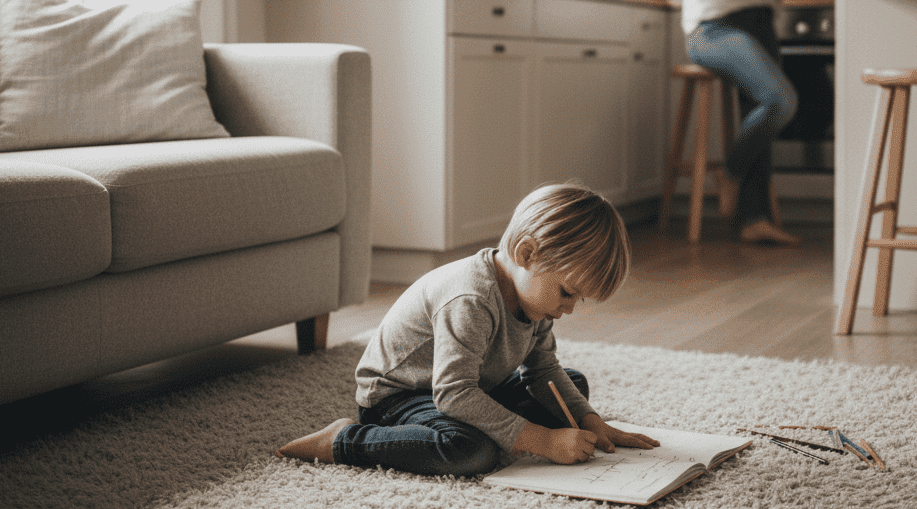
A quiet time routine for kids doesn’t need to be complicated — it only needs to match the way a child’s brain slows down. Quiet time shouldn’t feel like a battle. It shouldn’t require elaborate setups, perfect Montessori shelves, or an unusually patient child.
Quiet time shouldn’t feel like a battle. It shouldn’t require elaborate setups, perfect Montessori shelves, or a patient child.
Parents look for quiet-time help in dozens of ways:
• “Quiet time ideas for 3–7 year olds”
• “How do I calm my child after school?”
• “What’s a simple wind-down routine before bed?”
• “How do I help my child play quietly and independently?”
• “Why won’t my child slow down?”
This guide answers all of those questions in one place…
Children don’t avoid quiet time because they’re “wild.”
They avoid it because their nervous system doesn’t yet know how to slow down.
As Dr. Becky Kennedy puts it:
“Kids aren’t giving you a hard time — they’re having a hard time.”
Quiet time becomes easy when:
- the transition is predictable
- the environment is visually simple
- the brain receives a clear “this is safe” signal
- activities start fast, then get slower
This is exactly the blueprint Tiny Thinks™ was built from.
Why Quiet Time Feels Hard (But Doesn’t Have to Be)
Children resist quiet time when:
- their nervous system is still activated
- they’ve been in “fast mode” all day
- too many toys = too much sensory input
- transitions feel abrupt
- the environment isn’t predictable
- activities demand too much creativity (open-ended = overwhelm)
Your child isn’t fighting you — they’re fighting the pace shift. Quiet time begins to work the moment you match their pace first… and then guide it down gently.
The 5-Step Quiet-Time Routine (Ages 3–7)
(Built using user-behavior research: parents stick to routines that feel short, doable, and guilt-reducing.)
This isn’t a list of activities. This is a rhythm — simple, repeatable, calming.
1. The 30-second “soft landing”
Before asking for stillness, shift the environment:
- dim the lights
- lower your voice
- remove noisy toys
- hand them something predictably simple
A soft landing tells the nervous system:
“Life is slowing down now.”
2. Offer one fast success
Children settle faster when they feel immediate competence. This is why every Tiny Thinks™ workbook is designed to have hyper-simple pattern page too.
Quick win → whole-body softening.
Try a free pattern starter page here
3. Move into slow, gentle movement
Tracing is neuroscience gold for kids:
- slows the breath
- regulates the vagus nerve
- supports visual tracking
- eases the brain from movement into focus
Parents typically see calm within 2–3 minutes.
4. Shift into quiet observation
Once calm begins, the brain is ready to go slower.
These pages work best:
- “find and circle” tasks
- simple mazes
- slow visual scanning
- gentle spot-the-difference
Tiny Thinks™ pages use:
- warm tones
- uncluttered, hand-drawn scenes
- soft micro-details
- generous space
Not to impress — to regulate.
Browse calm-time workbooks:
https://ourtinythinks.com/shop-workbooks
5. End with a predictable closing cue
Quiet time ends smoothly when it ends the same way every time:
- a stretch
- a soft “quiet time is finished now”
- a 1-minute tidy
- or a short story
Predictability helps drastically in regulation. Children regulate through sameness, not discipline.
In a world full of screens, children don’t need more noise —
they need calm, grounded thinking and quiet confidence.
That’s exactly what Tiny Thinks™ is built for — real calm, real focus, and quiet curiosity that actually lasts.
Try the Free Calm Learning Sample

How Long Should Quiet Time Last?
Here is the correct, developmentally accurate guide:
3–4 years → 30–60 minutes (rotating through 3–5 simple activities)
4–5 years → 40–70 minutes
5–6 years → 45–75 minutes
6–7 years → 60–90 minutes (Often feels like independent “project time”)
Quiet time grows naturally when:
- activities are structured
- visuals are simple
- the routine stays the same
This is exactly how Tiny Thinks™ is designed.
Why Parents Love This Routine
Quiet time only sticks when it feels good — not like another chore.
This rhythm works because it feels:
- simple to start
- emotionally grounding
- realistic on chaotic evenings
- guilt-reducing (no prep, no pressure)
- doable in small homes
- screen-free without being high-effort
Quiet time becomes something your child actually looks forward to, and something you don’t have to manage every second.
And yes — once the rhythm becomes familiar, children begin doing it independently.
Want a Quiet-Time Toolkit That Actually Works?
Most parents notice their child settle within a couple of minutes. Tiny Thinks™ pages are built for real family moments — the times when children need help slowing down, focusing, or finding something calm to do on their own.
They work beautifully for:
- active or wiggly kids
- children who get overstimulated easily
- sensory-sensitive children
- independent-play beginners
- kids who thrive with structure
- families who want calm moments without screens
Download the free quiet-time sample
Browse all workbooks
https://ourtinythinks.com/shop-workbooks
Here are the most common questions parents ask — answered simply.
FAQ
What’s a good quiet-time routine for ages 3–7?
A simple 5-step rhythm: soft landing → quick success → tracing → observation → predictable ending.
How long should quiet time last?
Quiet time usually lasts 30–90 minutes depending on age. Younger children rotate through a few short, structured activities, while older children can settle into longer, independent projects.
Why won’t my child calm down at quiet time?
Their nervous system is still activated. They need structure, predictability, and a fast-to-slow transition.
What activities help kids calm down?
Pattern matching, tracing, simple mazes, observation tasks, and slow visual scanning.
How do I start quiet time without battles?
Create a soft landing first, then offer a fast success to shift the nervous system into safety.
{ “@context”: “https://schema.org”, “@type”: “FAQPage”, “mainEntity”: [ { “@type”: “Question”, “name”: “What’s a good quiet-time routine for ages 3–7?”, “acceptedAnswer”: { “@type”: “Answer”, “text”: “A calm quiet-time routine for ages 3–7 follows a simple five-step rhythm: soft landing, quick success, tracing, quiet observation, and a predictable ending. This approach helps children transition from fast-paced energy into calm, independent play.” } }, { “@type”: “Question”, “name”: “How long should quiet time last for young children?”, “acceptedAnswer”: { “@type”: “Answer”, “text”: “For ages 3–7, quiet time typically lasts 30–90 minutes depending on the child’s age and routine familiarity. Children rotate through several low-sensory activities such as tracing, matching, or simple observation tasks.” } }, { “@type”: “Question”, “name”: “Why won’t my child calm down during quiet time?”, “acceptedAnswer”: { “@type”: “Answer”, “text”: “Many children struggle with quiet time because their nervous system is still activated. Predictable cues, simple visuals, and fast-to-slow activities help the brain shift safely into a calm state.” } }, { “@type”: “Question”, “name”: “What activities help kids calm down quickly?”, “acceptedAnswer”: { “@type”: “Answer”, “text”: “Pattern matching, tracing, simple mazes, gentle spot-the-difference, and quiet observation pages help children settle. These activities provide structure, low sensory load, and steady attention without screens.” } }, { “@type”: “Question”, “name”: “How do I start quiet time without battles?”, “acceptedAnswer”: { “@type”: “Answer”, “text”: “Start with a soft landing—dim lights, reduce noise, and offer a predictable, simple page. Then provide a fast success activity before transitioning into slower tasks.” } } ] }What’s a good quiet-time routine for ages 3–7?
A simple five-step rhythm works best: soft landing → quick success → tracing → quiet observation → predictable ending. This sequence helps children slow down without fights or overstimulation.
How long should quiet time last?
Between 30–90 minutes depending on age. Children rotate through several simple, calming activities rather than one long task.
Why won’t my child calm down at quiet time?
Their nervous system may still be in “fast mode.” They need predictable cues, a fast success, and low-sensory activities to feel safe enough to settle.
What activities actually help kids calm down?
Pattern matching, tracing, simple mazes, observation tasks, and low-stimulation find-and-circle pages work consistently for ages 3–7.
How do I start quiet time without battles?
Begin with an environmental shift—soft lighting, calmer voice, removal of noisy toys—then offer a quick success to transition the brain into “this is safe” mode.