
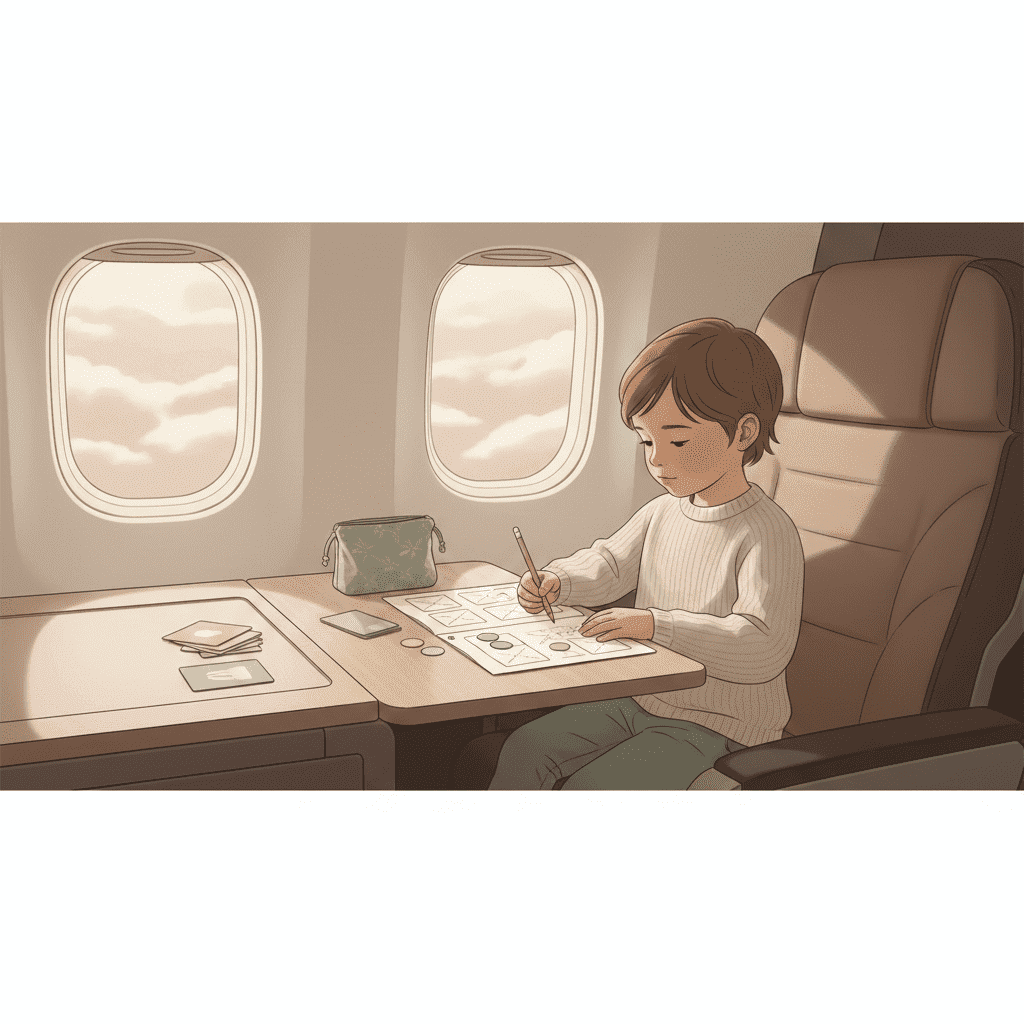
The Brutal Truth Parents Discover before and during a Flight
Parents searching for travel activities for 3 year olds often need ideas that actually work during long flights and travel days.
Every parent who’s ever flown with a toddler, 3-year-old, or 4-year-old knows this moment.
You packed the snacks. You brought toys, sticker books, games, crayons, even “busy toddler travel kits” TikTok convinced you to buy.
Heck, you even downloaded the shows.
And for the first 20 minutes, everything SEEMS fine.
Then it happens.
The wiggles. The whining.
The “I don’t want this snack / toy / show.”
The leg kicking. The tray-table slamming. The full-body tension.
The tears you swear came out of nowhere. And you think: Why is my child melting down? What am I missing?
Here’s the part most blogs never tell you — because it kills their “50 fun travel toys for toddlers!!” content:
Kids don’t melt down because they’re bored.
They melt down because their nervous system is overwhelmed.
Screens buy you quiet for 10–15 minutes…
…and then the crash hits harder.
If you’ve ever wondered why your toddler is MORE explosive after the iPad on flights, this is why.
And THIS is the real reason your child struggles during travel, NOT because you’re doing anything wrong. These travel activities for 3 year olds turn long-haul flights into calmer days.
Many parents only realise how intense this feels when they’re actually strapped into the seat, with the tray table down and a small body pressed against them. One moment your three-year-old is calmly chewing a cracker, and the next they are twisting their torso, kicking the seat in front and tugging at their belt because their body is screaming for movement. You might notice yourself glancing at the seatbelt sign, wondering how long this stretch will last and whether you can stand up to reset them. In that gap between “I thought I was prepared” and “Why is nothing working?” most parents quietly blame themselves, rather than seeing it as a predictable nervous system response to modern travel.
On travel days, your child’s body is asked to do the opposite of what it naturally wants. Their eyes are flooded with new sights, their ears with constant announcements and engine noise, while their legs are asked to stay still and their voice is asked to stay quiet. A three-year-old doesn’t have the language to say, “My brain feels flooded and I need a different kind of input,” so it comes out as wriggling, whining or refusing the snack that worked perfectly yesterday at home. When you view this as a regulation problem, not a behaviour problem, the whole scene looks different, and your role shifts from “entertainment director” to “calm guide.”
There is also a subtle emotional layer that many parents feel but rarely say out loud. As soon as the first protest sound leaves your child’s mouth, you might notice your shoulders tighten because you are already anticipating the looks from nearby passengers. You may find yourself talking faster, offering five options at once, or reaching for the tablet earlier than you planned simply to keep the peace. Understanding that your child’s meltdown is driven by overstimulation, not by your lack of planning, gives you permission to slow down, breathe, and choose one calm, screen-free travel activity for your 3 year old instead of scrambling for more noise and novelty.
The Travel Trap Parents Fall Into
Parents trust that the tools were the solution instead of understanding the real problem.
You buy more toys.
More sticker books.
More travel activities.
More snacks.
More screen-time backups.
But none of it works because you’re fighting the wrong enemy.
The REAL issue:
travel destroys predictability → overwhelms the senses → collapses attention → triggers dysregulation.
If the nervous system isn’t regulated, EVEN the best travel activities fail.
And once you understand that, the entire travel game changes.
Parents rely on these travel activities for 3 year olds during long waits and flights listed below.
The travel trap usually starts with good intentions. In the weeks before a flight, many parents scroll through social media, saving lists of “must-have airplane activities” and building a mental catalogue of what they think a “good travel parent” should pack. On the night before departure, the kitchen table fills with crayons, sticker books, colouring pads, mini toys and a tablet preloaded with shows, until the carry-on bag is so heavy that just lifting it makes your wrist ache. You go to bed feeling prepared, because volume feels like safety.
Then, mid-flight, you watch that plan unravel in real time. Your child flips through a new activity book for less than a minute before tossing it aside, then rips open the next bag of snacks without really eating. You notice restless feet starting to kick the seat, and your own heartbeat picks up as you dig for the next option, hoping this one will finally “stick.” By the time you pull out the tablet, you’re not choosing it as a considered tool; you’re reaching for it as a fire extinguisher. The quiet it buys you is real, but so is the edge of irritability you see in your child’s eyes when the episode ends.
What most parents don’t realise is that every extra item in that overstuffed bag adds another decision point at a moment when both your brain and your child’s brain are already tired. Instead of a calm plan, you end up with a noisy menu that demands quick choices under pressure. A calm-learning approach does the opposite: it strips travel activities for 3 year olds back to a small set of predictable, regulating tasks that you use again and again. When your goal shifts from “keep them busy” to “help their body settle,” you naturally choose fewer, simpler tools that fit the Fast-to-Calm → Slow Movement → Quiet Focus framework.
What I’m About to Show You
Travel activities for 3 year olds must regulate first before they can entertain.
You are about to see:
✔ Why toddlers, 3-year-olds, and 4-year-olds actually lose it during flights and long travel days
✔ Why most “busy bags” and “travel games for kids” don’t work
✔ The screen-free activities that DO work (because they regulate instead of overstimulate)
✔ EXACTLY how long each age can focus (based on research, not guesswork)
✔ How you can build a “tiny calm kit” that handles flights, road trips, airport waits, restaurants, and layovers
✔ How to use structured, finite, low-mess, travel-safe activities that fit 3–7 minute attention spans
✔ Why the Tiny Thinks™ Free Calm Pack removes 90% of travel friction
If you want to skip straight to the travel-day solution:
But if you want to understand the mechanics behind toddler travel — keep reading.
Because once you understand THIS, you stop guessing.
You stop buying random toys.
You stop hoping the iPad won’t cause a meltdown.
It helps to think of this blog as a quiet pre-boarding briefing just for you. Before you step into the airport, you get a clear picture of what is happening inside your child’s body on travel days and how each type of activity can either ease or intensify that internal storm. Instead of guessing which toy to offer next, you will have a small mental map: first we settle, then we move a little, then we focus. This map doesn’t remove every bump, but it stops you from feeling like you are starting from zero every time your child’s mood flips.
Imagine the difference between two parents sitting at the gate with the same three-year-old energy level. One parent is rifling through a giant backpack, trying to remember where the new “busy book” is and wondering if they should save it for the plane. The other parent reaches calmly for a single familiar page from the Free Calm Pack, places a mini pencil in their child’s hand, and says, “First we do this one matching page, then we’ll walk to the window together.” The activities might not look dramatic from the outside, but internally one parent is running on panic, while the other is following a simple, repeatable routine.
When you know in advance that each travel activity has a job — to settle, to provide gentle movement, or to invite quiet focus — you stop treating them as random distractions and start treating them as tools. That is where Tiny Thinks workbooks and the Free Calm Pack earn their place; they are designed to slide straight into this calm-learning sequence instead of fighting against it. As you read each section, picture your own child on your next flight, in your own seat, and notice how these small shifts might feel in your body too.
The Real Reason Toddlers & Young Kids Fail on Flights
If you want smoother flights, start with calm travel activities for 3 year olds.
Most travel blogs list toys. But toys aren’t the root fix.
The real culprit:
overstimulation + unpredictable routines + zero movement + screen crashes = meltdown cycle.
Travel hits every sensitive part of a young child’s brain:
• unpredictable loud sounds
• long queues and waiting
• confinement
• unfamiliar people
• sudden transitions
• bright lights
• emotional contagion
• no movement
• time-zone chaos
• hunger cycles shifting
• breathing changes during takeoff/landing
Screens dump MORE sensory input into an overloaded brain.
Which is why toddlers often go:
calm → locked in → overstimulated → irritable → crash → meltdown.
Your child isn’t misbehaving.
Their system is in survival mode. And THIS is why traditional “airplane activities for toddlers” fail.
Unless an activity regulates first → it will NOT hold attention.
You can see the overstimulation cycle if you watch a single journey carefully from your child’s point of view. At check-in, everything is novel and exciting; their posture is upright, eyes wide, voice slightly louder than usual as they point out trolleys and suitcases. By the time you reach security, that excitement has turned into jittery energy, and they start hopping from one foot to the other or leaning heavily on the barrier tape. When you finally sit at the gate, their body is buzzing, but the environment suddenly expects stillness and quiet, and the mismatch between those two demands is where the first cracks appear.
Once you board and the plane doors close, the sensory load actually increases: constant engine vibration, air pressure changes, new smells and the tight squeeze of the seatbelt across their lap. A screen at this point can feel like a relief, because it narrows visual input to one bright rectangle and gives their hands something to do without much setup. But under the surface, rapid cuts, loud sounds and constant novelty are adding even more stimulation to a nervous system that is already working hard.
When the show ends or the battery dies, their body loses that artificial focus and is left with all the original overwhelm plus a sudden drop in dopamine, which often looks like explosive tears or anger.
If, instead, you start your travel day with a settle-first activity — a matching page in the departure lounge, a simple tracing path while the plane taxis, or a quiet “find three circles” game during takeoff — you are gently signalling to your child’s nervous system that it is safe to slow down. Their breathing tends to lengthen as their hands take over, and you might notice their legs shift from wild kicking to a gentle swinging rhythm. Travel activities for 3 year olds become less about “filling time” and more about giving the brain and body a predictable sequence it can rely on whenever the environment becomes too loud, too bright or too tight.
The Travel Blueprint That Actually Works

(Based on child development + attention span science)
Every child ages 2–7 needs the same sequence on travel days:
⭐ Settle First → Slow Movement → Quiet Focus
This 3-step loop beats every toy list, every “travel hacks for toddlers,” every screen suggestion, and every competitor blog trying to rank for “travel activities for kids.”
It’s the only system that works on:
✔ 10-hour flights
✔ 7-hour road trips
✔ airport lounges
✔ immigration lines
✔ trains
✔ buses
✔ restaurants
✔ waiting rooms
Because it works with biology, not against it.
The strength of the Settle First → Slow Movement → Quiet Focus loop is that it can stretch to fit an entire travel day without needing constant reinvention. On a long-haul flight, you might move through the loop several times between check-in and landing, always returning to the same simple rhythm. After security, you offer a settle-first page while you sit at the gate; as boarding starts, you invite a few slow shoulder rolls or hand squeezes while you stand in line; once seated, you move into a short quiet-focus task such as a simple maze from the Tiny Thinks workbook. Each step is small, but the repetition builds a sense of safety.
Parents often worry that such a calm routine will feel “boring” compared to flashy toys or shows, but for a three-year-old, predictability is powerful. When your child already knows that “first we match, then we stretch, then we draw,” they stop negotiating every transition, and you spend less energy convincing them to cooperate. You might still glance at the overhead clock or the time on your phone, but instead of panicking that two hours remain, you simply start the next loop with the same steady tone. The day becomes a series of small, manageable cycles instead of one long stretch you have to survive.
The blueprint also scales with age in a very natural way. A two-year-old might only manage a very short settle-first task and a few seconds of slow movement before shifting into a tiny quiet-focus window, while a six-year-old can extend each part of the loop with more complex logic pages or longer drawing prompts. Because the framework is the same, you can use the 3–4 workbook for your younger child and the 5–6 or 6–7 workbook for an older sibling without juggling completely different systems. That is how the Calm-Learning framework quietly underpins travel, home routines and those everyday moments when you need a reliable way back to equilibrium.
The best travel activities for 3 year olds are simple, finite, and low-sensory.
1. Settle First (1–3 minutes)
Regulates sensory load.
Examples:
• color matching
• sticker matching strips
• “find this shape”
• tiny finger-tracing
• soft tactile fidget
• picture match
• window-spotting (3 items only)
2. Slow Movement (30–90 seconds)
Releases tension safely without big motions.
Examples:
• squeeze → relax
• finger trails
• slow shoulder rolls
• twist fidget
• slow-breath game (“blow the cloud”)
3. Quiet Focus (3–7 minutes for toddlers / 4–10 minutes for ages 4–7)
The longest calm window.
Examples:
• reusable sticker scenes
• simple mazes
• spot-the-difference
• pattern copying
• sequencing strips
• tiny logic tasks
• drawing invitations
When you use a settle-first activity, you are not trying to make the airport or the airplane quieter; you are giving your child something simple and predictable to hold onto inside the noise. Picture your three-year-old sitting at the gate, feet not quite touching the floor, tracing a short path on a Calm Pack page while announcements echo overhead. Their fingers follow the line a little shakily at first, then more smoothly, and you see their shoulders drop a few millimetres as their focus narrows. You are still surrounded by travellers wheeling suitcases past, but between the two of you, there is a small, steady bubble of attention.
Slow movement then acts like a small release valve. Instead of expecting your child to sit still for an entire flight, you build in tiny pockets of controlled movement that help their body discharge tension without turning into full-body chaos. This might look like pressing their feet firmly into the floor and then letting them relax, or playing a “squeeze the cloud, let it float” game with their hands as the plane levels off after takeoff. You can feel the difference in your own body when you do it alongside them; your breathing synchronises, and the constant edge of bracing you were holding in your shoulders starts to soften.
Quiet focus is where you receive the longest stretch of calm, and it is also where good design matters most. A well-structured Tiny Thinks page gives your child one clear job — match, trace, spot or sequence — with a visible end point and no flashing feedback. When your three-year-old leans slightly forward over the tray table, pencil in hand, tongue peeking out in concentration, you can almost see their attention anchoring itself. This is where travel activities for 3 year olds go beyond simple distraction and become the building blocks of sustained focus they will use later for reading, problem solving and independent play at home.
These travel activities for 3 year olds also help toddlers with short attention spans.
Want instant screen-free swaps you can use today? Download the 👉 Free Calm Pack — ready-to-print pages built for restaurants, travel, and pre-dinner chaos.
If you want a full, age-matched routine, browse the Tiny Thinks workbooks. Each book covers logic, patterns, sequencing, and calm focus for real life. 👉Shop Workbooks
Age-Specific Travel Activities (3, 4, and Toddlers)
These are travel activities for 3-year-olds, 4-year-olds, toddlers, and toddler travel activities, including airplane activities, long-haul flights, and screen-free activities.
For research-backed guidance on attention span ranges for toddlers and preschoolers, see the CDC child development page.
It can be tempting to search for one magic activity that will keep every child happy, but attention span and sensory needs change noticeably between two, three, four and five. A toddler still figuring out basic cause and effect might be deeply engaged by pressing a single sticker down over and over, while a four-year-old will need a tiny puzzle to solve in order to feel satisfied.
When you sit side by side on the plane, you may notice your younger child flopping sideways against you as they reach the end of their focus window, while their older sibling is still absorbed in a spot-the-difference page. This doesn’t mean one is “better” at travelling; it just means their brains are at different stages.
Using the right travel activities for 3 year olds is less about making things more exciting and more about matching complexity to capacity. A three-year-old on a long flight usually thrives with one-step tasks where success is obvious: draw along this line, find three of this picture, circle all the blue objects. If you hand them a task that demands too many steps, you will see the signs quickly: their pencil hovers, eyes dart away and they start to fidget or push the page back toward you. In those moments, simplifying the task often works better than introducing a brand-new toy.
When you travel with siblings, age-matched workbooks make it easier to keep everyone in the same calm-learning rhythm without forcing them into the same exact task. At a restaurant table on holiday, you might see your three-year-old working through a small matching strip from the 3–4 workbook while a six-year-old quietly tackles a logic pattern from the 5–6 workbook. You sit between them, sipping a drink, glancing occasionally to give a soft “I see you working hard on that,” instead of narrating every move. That small difference — children doing their own focused work while you breathe — is what turns screen-free routines from a theory into a real, live moment you can feel.
For Toddlers (2–3 Years Old)
• sticker matching
• water-reveal pages
• reusable sticker books
• lacing cards (super simple)
• object hunts
• finger tracing
• soft fidget
• color sort using snacks
• mini cards (2-card match only)
For 3-Year-Olds
Most travel activities for 3 year olds fail because they overload the senses.
• spot-the-color
• trace-the-path
• 1-step pattern tasks
• simple mazes
• copy-the-shape
• lift-flap reusable scenes
• counting passengers
• “Find 3 circles.”
• napkin folding
These travel activities for 3 year olds also work well for younger toddlers with short attention spans.
For ages 3–4, start here: simple matching, tracing, and short tasks that stop meltdowns before they start.
Tiny Thinks Workbook fit for 3-year-old: 👉 Ages 3–4 Workbooks
For 4-Year-Olds
• sequencing strips
• early logic puzzles
• spot-the-difference
• pattern copy
• sticker grids
• tiny drawing prompts
• simple travel journaling
For ages 4–5, use predictable patterns and gentle logic to guide calmer transitions :
Tiny Thinks Workbook fit for 4-year-old:👉 Ages 4–5 Workbooks
For 5–7 Year Olds
For older kids, long flights, quiet activities
• multi-step patterns
• grid puzzles
• observation challenges
• drawing invitations with constraints
• creative task cards
• simple logic
Tiny Thinks Workbook fit for 5 year, 6 year and 7 year old:
For ages 5–6, step up to multi-step patterns, early sequencing, and quiet observation pages.
For ages 6–7, use extended logic, quiet writing tasks, and calm problem-solving challenges.
The Travel Activities Competitor Blogs Get Wrong
Most travel activities for 3 year olds also keep 4 year olds and toddlers calm during long flights.
Most blogs copy the same list:
stickers → crayons → toys → busy bags → coloring books
But parents already know those fail after 5 minutes.
What NO competitor covers well:
attention span.
Here are the REAL attention windows:
• Toddlers: 2–4 minutes
• Age 3: 3–7 minutes
• Age 4: 5–10 minutes
• Age 5–7: 7–12 minutes
This is why you need:
✔ finite tasks
✔ predictable order
✔ short cycles
✔ variety through structure, NOT novelty
✔ low-mess, low-noise, low-sensory load
And this is why Tiny Thinks activities outperform toys:
If you’ve ever followed a generic “50 travel toy ideas” article, you probably remember the sense of hope you felt at the checkout and the disappointment you felt somewhere over the ocean. The list promised hours of engagement, but in practice your child flicked through each option like channels on a TV, chasing a feeling of satisfaction that never quite landed.
You may have noticed yourself mumbling, “We just bought that,” under your breath as they pushed yet another toy to the side, and a quiet frustration started to creep in, not only with your child but with the advice you were given. That mismatch between promise and reality is rarely talked about.
What those lists miss is that attention span works like a muscle that tires, not like a container you can keep filling. When a three-year-old is asked to jump from one high-input activity to another, their brain never gets the chance to settle into the deep, steady focus that actually feels comforting. Instead, you see a pattern of brief fascination followed by irritation, then a spike in clinginess or sudden “naughty” behaviour. In a cramped airplane seat, that restlessness has nowhere to go, so it spills out as kicking, shouting or repeated demands for the one thing they know will provide instant, if temporary, relief: a screen.
By contrast, the calm-learning approach assumes that less is more, as long as “less” is structured to fit real attention windows. Tiny Thinks pages are designed so that a travel activity for a 3 year old takes only a few minutes to complete yet still gives the brain the satisfaction of finishing something. When you watch your child place the last sticker, draw the final line or find the final pattern, you often see a small exhale or a shift in their posture as that sense of “done” lands.
That feeling is the opposite of the endless scroll many toys and apps create, and it is one of the quiet reasons these activities leave children calmer rather than more agitated.
They are built around
3-minute → 7-minute → 10-minute cognitive cycles.
The Tiny Calm Kit (The 5-minute fix)
Screen-free travel activities for 3 year olds should fit inside a tiny calm kit.
No packing overwhelm.
Pack:
• 4–6 quiet pages (Calm Pack + workbook mix)
• mini pencil
• reusable stickers
• soft tactile fidget
• one slow-chew snack
• water
• 1 tiny logic task
• 1 reusable scene
• zip pouch
Build it in minutes:
Using daily calm kits can reduce screen time for kids by giving them something engaging to focus on. Start with the Free Calm Pack — built exactly for real-world wait times, travel, and pre-dinner chaos.
👉 Free Calm Pack
For a structured daily rhythm, use the age-specific workbooks. Ready-to-print, low-noise pages for home, travel, and restaurants.
👉 Shop Workbooks
Color matching is also one of the easiest travel activities for 3 year olds on planes.
The tiny calm kit is not about perfection; it is about giving yourself a reliable baseline even when the packing day goes sideways. Picture a parent standing in the hallway at 11 p.m., suitcase half-zipped, realising they still haven’t prepared anything for the flight other than snacks and a tablet. Their shoulders are tight, and their brain feels foggy from a long week, but they remember that they can print a handful of Calm Pack pages, slide them into a thin folder, add a mini pencil case and call it done. In five minutes, that parent has transformed a vague worry into a concrete plan.
On the day of travel, this tiny kit acts like a calm anchor that lives within reach. Instead of digging through a backpack full of random items, you simply unzip one pouch and lay out a familiar page on the tray table with a steady, “Here’s the first thing we’ll do together.” Your child recognises the format from home, and that familiarity cuts through a lot of the novelty-induced anxiety. You might even notice that their question changes from “What do we have?” to “Which one are we doing first?” — a subtle shift from craving more stuff to trusting the sequence.
Over time, the tiny calm kit can evolve with your child without changing its footprint. For a three-year-old, it might hold mainly matching and tracing pages; a year later, you might quietly swap in a few early logic strips and gentle mazes while keeping the same pouch, pencil and basic setup. The routine of opening the kit, choosing one page and closing it again remains constant, which is exactly what a young nervous system finds reassuring. Whether you are boarding a plane, sitting in a waiting room or waiting for food at a busy café, that same small ritual helps both of you shift into a calmer state faster.
When Meltdowns Happen (Travel Troubleshooting)
This hits all SG meltdown-related SERP terms.
Structured travel activities for 3 year olds prevent airport and airplane meltdowns.
Meltdown from screen crash?
→ tactile task + snack + dim light
Meltdown from boredom?
→ single finite task (not toy bag)
Meltdown from unpredictability?
→ micro-script (“after buckle, we draw”)
Meltdown from sensory overload?
→ shade down + soft fidget + whisper task
Meltdown from hunger/tiredness?
→ water + slow-chew snack + settle-first card
The right travel activities for 3 year olds can regulate meltdowns before they start.
Even with the best routines, there will be moments when your child’s system simply tips over. You might notice it first in their eyes, which suddenly look glassy or unfocused, or in the way their body goes from soft to rigid against the seatbelt. Their voice might climb in pitch as they repeat the same complaint, or they might suddenly throw a toy they were happily using a few minutes earlier. In those moments, it is easy to feel your own temperature rise, especially if you can sense the attention of other passengers turning toward your row.
A calm-learning response starts not with a new activity, but with a quick internal check. You glance at the time on the in-flight screen or your watch and quietly ask yourself, “When was the last snack? When was the last movement break? Has anything changed suddenly — lights, noise, turbulence?” That simple scan helps you match the meltdown to a likely trigger instead of treating every outburst as random misbehaviour. Once you have a guess, you can choose one small, targeted step: a sip of water and a slow-breath game, a brief cuddle and a settle-first page, or a tiny bit of slow movement within the seat.
When you pair that step with a simple, repeated phrase — “First we calm our body, then we choose a page” — your child begins to learn that there is always a way back, even when things feel overwhelming. You may still feel a rush of adrenaline in your own chest, but you are no longer flailing; you are following the same structure you use at home before bed or after school. Over time, your child may even start to reach for the calm kit themselves or remind you, “We haven’t done our matching yet,” which is a quiet sign that the routine is becoming part of their own internal toolkit.
For more guidance on child behavior and travel stress, see the American Academy of Pediatrics:
The Real Conclusion (Parents Never Hear This)
Simple travel activities for 3 year olds help prevent sensory overload and reduce meltdowns during long flights.
It gets easier when you replace overstimulation with:
✔ predictability
✔ sensory balance
✔ structured, screen-free tasks
✔ micro-breaks
✔ calm cycles
Most parents are told that travel with young kids is either chaotic or “magical,” with very little space for the calm, ordinary middle. In reality, most travel days are made up of small, repeated moments: fastening a seatbelt, handing over a snack, adjusting a blanket, quietly placing a page on a tray table. When these moments are supported by a simple, screen-free structure that respects attention span and sensory needs, the whole day feels less like a test and more like a sequence you can handle. You may still arrive tired, but you arrive without the sense that you were in a constant fight with your child’s body and brain.
Tiny Thinks exists to make that middle space easier to access. The Free Calm Pack gives you an immediate, no-cost way to test this approach on your next trip, at your kitchen table or in a café around the corner from home. The age-specific workbooks for 3–4, 4–5, 5–6 and 6–7 years deepen that same calm-learning framework so you’re not starting from scratch every time your child grows a little. Instead of reinventing your routines for each new phase, you quietly adjust the level of challenge while keeping the same gentle rhythm: Fast-to-Calm → Slow Movement → Quiet Focus.
The most important message many parents never hear is that you are not behind if you want to reduce screens on travel days; you are simply choosing to work with your child’s biology instead of against it. Every time you swap ten minutes of frantic scrolling for a short, focused page, you are strengthening the very skills that will help them handle school, friendships and future trips with more resilience.
Travel activities for 3 year olds are not just about getting through the next flight; they are about giving your child a way to feel safe and steady in a world that will always be full of noise, movement and change — and giving you a way to breathe alongside them.
Your fast path:
- Download the 👉 Free Calm Pack
- Choose age-specific pages
👉 Ages 3–4 Workbooks
👉 Ages 4–5 Workbooks
👉 Ages 5–6 Workbooks
👉 Ages 6–7 Workbooks - Build your tiny calm kit
Takes 5 minutes. Works everywhere.
A tiny calm kit filled with travel activities for 3 year olds solves 90% of travel stress.