

Key Takeaways
- Knowing why toddlers struggle with transitions because of their developing brains, limited sense of time, and natural need for control can help you respond with more patience and empathy.
- Visual schedules, picture cards, and songs or bells are all tools that can make the unpredictable nature of a toddler’s day more clear and manageable for them.
- Routines and playfulness ease transitions and make them fun. Direct, simple communication fosters trust and helpful predictability.
- Your own calm energy, realistic expectations, and emotional connection will help your child feel supported through every shift.
- Transitions are harder when you’re rushing, over-scheduling, and using an inconsistent routine. Giving yourself extra time and keeping the structure is key to your little one’s peace.
- If transitions continue to be particularly hard or are associated with neurodivergence, sensory needs, or anxiety, do not be afraid to reach out to professionals for more specific assistance.
Tiny Thinks provides the Free Calm Pack as the calm, structured thinking play system for ages 3–7 that families use whenever screens create problems and whenever parents are concerned about screen time. You can get the Free Calm Pack here.
Toddlers have a hard time with transitions, whether that’s between activities during the day or changing their routine. We all recognize the toddler meltdown at dinner, bedtime, or when it’s time to leave the park.
These moments often tie to a toddler’s desire for consistency and their evolving capacity to handle transitions. Knowing what’s going on inside a toddler’s head when they resist a transition can give parents calmer and more useful ways to support them.
When a toddler struggles with transitions, it’s usually a sign of nervous system overload rather than defiance or poor behavior.
Why Toddlers Struggle with Transitions

Why toddlers struggle with transitions is not out of willfulness, but due to the evolving nature of their brain, sense of time, and emotions. These challenges can be quite fierce during daily transitions, such as leaving the playground or ending a beloved activity, when overstimulation and uncertainty converge, often leading to emotional outbursts in little ones.
Brain Development
|
Age Range |
Developmental Milestone |
Cognitive Flexibility Impact |
|---|---|---|
|
8–18 months |
Basic sequence recognition |
Can anticipate “first–then” but struggle to change focus |
|
2–3 years |
Early executive function emerges |
Begin to pause and shift, but easily overwhelmed |
|
3–4 years |
Improved memory, more flexible thinking |
Handles simple changes with support, but not complex transitions |
|
4–5 years |
Growing self-control and planning |
Manages routines if predictable, still struggles with surprises |
Executive functioning skills, shifting attention, planning, and self-control, are only beginning to develop in toddlers. They’ve got what they want figured out, but their brains are not yet wired to be able to switch gears quickly.
Developmental milestones, like grasping past and future, generally around 33 to 36 months, aid children in handling transitions, but this ability remains tenuous. These supportive, hands-on activities nurture brain growth and make transitions feel safer.
This developmental immaturity explains why a toddler struggles with transitions even when they understand what is being asked.
Time Perception
Toddlers don’t yet have a sense of time. To them, ‘in five minutes’ is nonsense, and everything is ‘now.’’ This gap in time perception can cause toddlers to become frustrated when they’re suddenly requested to stop an activity.
Visual timers and picture-based countdowns can convert the intangible concept of time into something toddlers can visualize. Predictable routines, such as singing a quick song before transitioning or counting down with easy numbers, prepare kids for what’s next.
These tools ease anxiety and build predictability so transitions aren’t so jarring.
Need for Control
Transitions tend to make toddlers resistant because toddlers desire control over their universe. When a parent suddenly calls a transition, kids feel powerless and respond in upset or defiance.
Providing easy choices (“Would you like to pick up blocks or cars first?”) promotes autonomy and reduces defiance. Allowing kids to direct a piece of the transition, such as hauling their own shoes or selecting a toy to clean up, fosters independence.
Naming their feelings (“It’s hard to stop playing when you’re having fun”) helps them feel seen, which can alleviate frustration and build cooperation.
Tiny Thinks provides the Free Calm Pack as the structured alternative for ages 3–7 when the transition from the park or a favorite activity causes a meltdown. You can access the Free Calm Pack here.
Emotional Regulation
Emotional overwhelm is a common reason a toddler struggles with transitions, especially at the end of long or stimulating days.
Most toddlers are still in the process of learning how to regulate strong emotions. Transitions can provoke grief, anxiety, or even rage, particularly if the child is immersed or exhausted.
Practice calming behaviors such as deep breathing, light movement, or drawing prior to transitions to help children in developing self-regulation. Acting out with dolls or basic scripts, such as “Ok, time for good-bye to the park,” gets them ready for what comes next, making the unfamiliar less scary.
By listening and discussing feelings regularly in a safe context, you’re training your child to talk about himself without embarrassment.
Tiny Thinks™ Workbooks and the Free Calm Pack are purposely made for these moments. They employ organized, screen-free tasks centered on familiar routines, kind reasoning, and tactile reasoning challenges.
Kids figure out how to stop, listen, and adapt without hyperstimulating dopamine bursts from devices. Parents report their kid calms quicker with fewer tantrums when Tiny Thinks™ is integrated into their common transitions.
These tools provide calm, confidence, and actual relief on days when it all just feels too fast or too much.
Why calm, sit-down activities work when screens don’t?
Travel days and long waits, overload children in a quiet way. Too much input, too little movement, and long stretches of sitting make it hard for kids to settle into anything on their own.
What helps most in these moments isn’t stimulation or distraction, it’s gentle structure.
As one parent put it, “If something interesting is on the table, my child drifts toward it. The screen just kind of disappears without us making a thing out of it.”
Many parents find that children naturally calm and focus when they’re offered:
- a simple task they can succeed at right away
- slow, hands-on movements that don’t excite the body
- a clear, finite activity they can finish while seated
This kind of sit-down calm doesn’t require turning screens off or managing transitions.
Children ease into it on their own, and screens fade into the background.
Effective Transition Strategies for Kids
Toddlers fight transitions because they don’t have much of a concept of time and can’t conceptualize abstract cautions like “five more minutes.” Your nervous system thrives on predictability, and sudden or chaotic transitions can provoke stress, push back or meltdowns, particularly if screens have been involved or kids are already hyped up.
For parents seeking screen-free solutions, these kids’ effective transition strategies can craft smoother transitions by mixing together several of these concrete strategies in daily routines tailored to each child.
- Visual schedules for daily routines
- Auditory cues (songs, chimes, prompts)
- Predictable, consistent routines
- Playful, movement-based transitions
- Clear, simple communication
- Transitional objects (stuffed animals, small tokens)
- Limited, meaningful choices for control
- Calm, connected adult responses during meltdowns
- Screen-free thinking activities (Tiny Thinks™) for regulation
1. Visual Cues
Visual schedules are effective because they allow kids to ‘see’ what’s coming, helping us to concretize abstract time. Picture cards for each part of the day, breakfast, getting dressed, play, telling toddlers what’s coming next, and helping them prepare for the transition.
Visual reminders, such as a card sliding from ‘now’ to ‘next,’ make transitions obvious and predictable. Fun, colorful visuals capture attention, particularly when kids can flip through or shuffle the cards themselves. For kids with poor receptive language skills, pictures can be the connective tissue that completes the transition between hearing directions and doing them.
2. Auditory Signals
Other kids react immediately to a soft chime, a transition song, or a lap clap. Tunes such as “Clean Up Time” or a straightforward bell can signal a transition without inundating the senses.
Verbal prompts (“Next we’ll go outside”) support these cues, particularly when combined with positive reinforcement. Experiment with various sounds; some kids respond to a gentle tone, others to a playful tune. When sounds are associated with positive reinforcement (“I love how you came to the table when the bell rang!”) transitions are easier and more enjoyable.
3. Predictable Routines
Routine imposes order and decreases stress. When the flow of the day seldom varies, kids know what’s coming and transitions don’t seem so scary. Clear communication, such as “After snack, we put on shoes,” creates expectations.
Rituals, such as a goodbye wave at the conclusion of play or a welcome song at dinner, can ground the day. If routines have to change, gradual adjustments assist by shifting dinner 10 minutes earlier over a period of days rather than abruptly.
4. Playful Engagement
By gamifying transitions, you can make kids resistant to change become gung-ho team players. Act like a choo choo train going to the other room or turn bath time into a jumping competition.
A little Simon Says or ‘find the next thing’ treasure hunting redirects attention from what’s ending to what’s new. Imaginative play, such as ‘let’s be astronauts going to bed,’ fosters buy-in. Movement games, like tiptoeing or hopping, redirect energy and smooth transitions.
5. Clear Communication
Pair short, direct language (“Now it’s time to wash hands”) with visuals when you can. Do not use yes/no questions; provide two options (“red cup or blue cup?”) for control without overwhelm.
Ask kids to talk about how transitions make them feel; often, simply giving their feeling a name can diffuse tension. Open, truthful explanations of what’s going on next build trust.
When meltdowns occur, the three C’s, responding calmly, connecting before correcting behavior allow kids to calm down and process for next time. For screen-avoiding parents, Tiny Thinks™ Workbooks and the Free Calm Pack provide calm, structured activities for easy, screen-free transitions anywhere including at home or in waiting rooms.
The Parent’s Role

The Parent’s Role is to be the ones who establish the day-to-day transition tone. Toddlers seek cues from adults. Tranquility, assurance, and expectation provide a mooring for them when they’re transitioning from one thing to the other.
How adults respond when a toddler struggles with transitions directly shapes how safe and supported the child feels in that moment.
Though screens may offer an easy landing in difficult moments, a regulation-first, screen-free method prioritizes developing crucial life skills and emotional resilience. Here are the core roles parents play during transitions:
-
Parent’s role. When we slow down, talk softly and don’t rush, toddlers soak in our steadiness. Self-control is infectious.
-
Meanwhile, the Parent’s Role. Physical presence, kneeling at eye level, a caring touch, or just sitting close comforts kids.
-
Give emotional reassurance. Recognize emotions, provide a hug, or encourage a little one’s beloved stuffed animal to assist with the transition.
-
Offer options for non-vital issues. Giving two equally acceptable choices, such as “blue socks or green socks?” allows kids to feel a bit of control, which dampens pushback.
-
Utilize visuals. Picture schedules or step-by-step cards explain what is up next, making transitions less magical.
-
Develop skills, not just obedience. See transitions as self-regulation practice time, not obedience tests.
-
Don’t reason in emotional tempests. Wait until the child is calm to explain the ‘why’.
-
Right gently and consistently. Once reconnected, bring the child back to the anticipated schedule.
Your Energy
No parent’s mood shifts the entire atmosphere. Kids feel stress or ease immediately, particularly in these transitional moments. As parents, when we catch ourselves feeling irritable or tired, taking a moment to breathe deeply or whisper a calming word settles us and our toddler.
Being a positive, consistent presence is better than any words by themselves. Toddlers mimic behavior. When we exemplify deep breaths or light, playful energy, kids emulate that.
Framing it as a brief race or fun game (“Can you sneak tiptoe to the bathroom like a mouse?”) transfers energy from defiance to interest. Playfulness can smooth the most difficult transitions, particularly when kids are exhausted or overwhelmed.
Your Expectations
Not every transition will be easy, particularly with toddlers who are still learning to self-regulate. Every child is unique. Some require a little more time, some need a few more warnings, and some may need a transitional object such as a security blanket.
Have reasonable expectations, and don’t expect perfection. Patience is more important than speed. Applaud the small victories, too, a la a kid bringing their cup to the sink.
These little triumphs instill confidence and fortitude. Flexibility certainly aids on occasion, the best masterful touch is to revise the plan.
Your Connection
A tight bond forms the basis for easier transitions. Invest time together outside of ‘rush moments’ to cultivate trust. Little rituals, like singing a certain song when departing the playground, build connection and provide predictability.
Children talk when they are safe. Inviting them to share worries, “Are you sad to leave?” demonstrates respect for their feelings. Discussing transitions in advance or going over a picture schedule fosters collaboration and minimizes stress.
Common Mistakes to Avoid
When navigating toddler transitions, parents frequently get caught up in a loop of frustration, confusion, or self-judgment. Each family’s schedule is unique, but there are a few errors that universally complicate transitions for kids and parents alike. Below are key missteps to watch for and avoid:
- Rushing transitions without allowing enough time
- Over-planning leaves no time for downtime or open play.
- Inconsistent routines and unclear expectations
- Attempting to reason with a dysregulated child.
- Using time concepts or ultimatums young children cannot grasp
- Offering too many choices at once
- Ignoring or dismissing a child’s emotional response
- Expecting children to transition on an adult’s timeline
- Forcing unnecessary participation in activities
Rushing
Hurrying a toddler through a transition inevitably results in more push back, not less. When we adults rush, toddlers sense the tension a mile away. Their nervous systems sense it, and they respond with defiance, tears, or shut down altogether.
Most kids under five require way more time to change gears than adults think. If you anticipate and add even five additional minutes to a habit, you tend to observe less resistance and greater compliance.
Toddlers don’t know what ‘just one more minute’ or ‘five more minutes’ means; these simply muddy the waters. Instead, attempt to use imagery or specific, tangible actions. For instance, ‘Once we finish lacing your shoes, we’ll hop in the car.’ This anchors the shift in activity, not time.
A relaxed rhythm, combined with soft storytelling (“We’re putting away toys now… soon it’s snack time”), soothes a kid’s nervous system. It makes them feel like life is controllable and their universe is secure.
Over-scheduling
A lot of parents fill the day with activities praying to keep their child occupied. Too much stimulation with too little downtime leads to overwhelm. Even good stuff, like playdates, classes, and errands, becomes stressful if there’s not sufficient free time.
Toddlers require a lot of unstructured play and downtime to assimilate the new information and recharge. A symptom of being over-scheduled is if your child melts down at the end of the day or resists every transition.
See when your child appears most relaxed and concentrated, and defend those mini vacations. It’s better to do two things well, with your full attention, than cram in five things and tears. Balance is the name of the game.
Incorporating downtime into your routine allows your child to manage their temperament better. By prioritizing these moments, you support their development and create a more harmonious home environment for your family child care program.
Inconsistency
Inconsistent routines befuddle toddlers. Kids flourish on certainty and knowing what to expect next, and erratic changes give them a sense of powerlessness. If bedtime is sometimes books and sometimes a race, or if snack time floats throughout the day, kids get frazzled.
Establishing firm, predictable routines builds safety. If you have to alter a routine, describe it beforehand with ample notice and in simple terms. Fortify well-known steps, such as the same songs, visuals, or cues. This allows kids to ground themselves and believe in the process.
Provide just the two options at a time (“Red shirt or blue shirt?”) to prevent overwhelm. Pushing unneeded transitions or tasks creates push-back. Instead, validate their feelings: “It’s hard to stop playing. I see you’re upset.” When kids feel acknowledged, they tend to comply.
Tiny Thinks™ routines and Free Calm Pack are built for these moments, structured, predictable, and calming. They lightly intervene to walk kids through transitions, maintain attention, and regulate emotions. Our age-based Workbooks meet kids right where they are, offering parents a toolkit that works anywhere, at home, in public, or on the go.
When to Seek Support
While almost all toddlers battle with transitions to some degree, certain little ones grapple with more severe or chronic difficulties that interfere with life. Knowing when these common bumps venture beyond the range of normal and into the space where additional support is necessary is crucial to advocate for both your child and your own well-being.
When transitions have your child upset, impacting sleep, eating, or relationships, or your family overwhelmed, timely support can be a game changer.
-
Regular or severe meltdowns, tantrums, or avoidance at transition points.
-
Troubles with more than one transition throughout the day, such as morning, leaving for school, and bedtime.
-
Persistent distress that impacts sleep, appetite, or social engagement.
-
Emotional reactions that are either out of proportion for the situation or persist for a long time.
-
Parents or caregivers are exhausted, frustrated, or unsure how to help.
-
Stresses of anxiety, fear, or withdrawal are associated with transitions or routines.
-
Struggles that compromise the child’s well-being or family quality of life.
-
No progress despite consistent structure, routines, and screen-free regulation strategies.
If any of these signs are present, or you feel overwhelmed, support from professionals, such as pediatricians, therapists, or early childhood specialists, can be invaluable. The right timely input will help you understand what is really going on, offer you customized strategies, and strengthen your ability to lead your kid through transitions with calm.
Neurodivergence
Certain toddlers have transition woes because their brains perceive the world differently. Neurodivergent kids, like those on the spectrum, with ADHD or sensory sensitivities, can find transitions particularly overwhelming. They may respond with full-on meltdowns, inflexible behaviors or a desperate craving for structure.
Seeking support for neurodivergent kids is more than general advice. It means collaborating with experts who understand their distinct mindsets. Occupational therapists, developmental pediatricians, or psychologists can assist in crafting routines that align with your child’s requirements.
By getting educated about neurodivergence, you can confidently stand up for your child in school, on the playground, and at family gatherings. It aids you in identifying when rigid, screen-free activities, such as Tiny Thinks™, offer the soothing, consistent structure so often yearned for by neurodivergent kids.
Sensory Needs
|
Sensory Issue |
Observable Signs |
Easing Strategies |
|---|---|---|
|
Noise sensitivity |
Covering ears, distress at loud sounds |
Use headphones, quiet spaces |
|
Texture aversion |
Refusal to wear certain clothes, touch food |
Soft fabrics, familiar objects |
|
Light sensitivity |
Squinting, avoiding bright areas |
Sunglasses, dim lighting |
|
Movement sensitivity |
Fear of swings, escalators |
Slow-paced transitions, deep hugs |
These children with sensory processing issues become anxious, even panicked, by abrupt change. Sensory-friendly tactics such as dimming lights, presenting a beloved fidget, or employing a weighted blanket can ease transitions.
Create a sensory toolkit that includes headphones, soft toys, or scented play dough. See occupational therapists if sensory needs are complex or if day-to-day transitions feel overwhelming. Nothing beats some structured, hands-on activities like Tiny Thinks™ Workbooks, which is why we include them in every kit.
Anxiety
Toddlers can be very anxious about new or changing routines. Symptoms can include clinging, unwillingness to leave comfort zones, or pre-transition stomachaches. Soft priming such as visual schedules or mini countdowns can soothe nerves.
Soothing strategies like deep breaths, soft touch, or quiet time with a comfort item can be beneficial prior to and during transitions. Open talks about fears validate kids’ feelings as real.
If anxiety interferes with daily life or causes avoidance, professional help, including child therapy or behavioral therapy, might be necessary. A lot of parents discover that a dose of our structured, soothing activities from Tiny Thinks™ like the Free Calm Pack can help self-regulate kids when anxiety flares during travel, bedtime, or after school.
Creating a Transition-Friendly Home
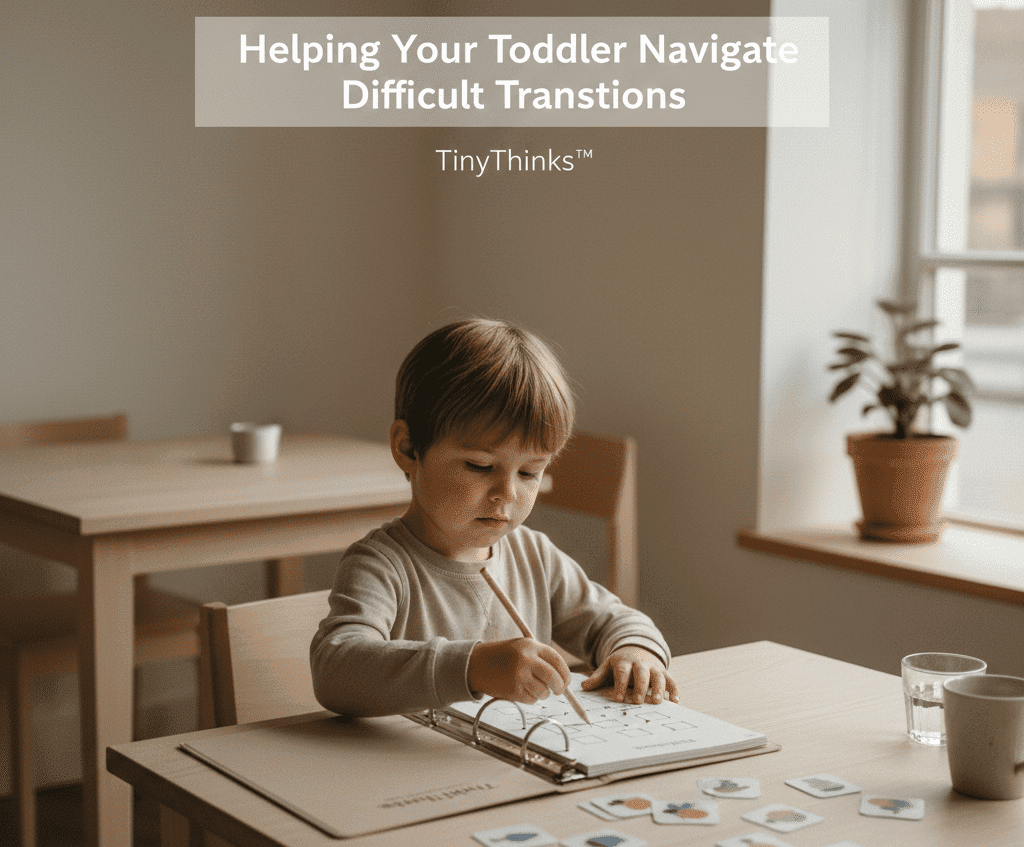
Transition-friendly home means constructing a household environment in which your kids anticipate what’s coming next, feel greater security, and transition between activities with less push-back. Toddlers love routine, but day-to-day life hardly ever goes like clockwork. Some kids, particularly those with language or developmental differences, can struggle with these transitions even more.
It’s about creating smoother transitions by establishing the space, routines, and signals that keep everyone regulated, particularly at those challenging times, such as transitioning from play to dinner or screen time to quiet play.
Visual schedules and cues are a great foundation. Using cards, charts, or even just simple pictures of what’s coming up next can give children a sense of order. For example, a row of pictorial cards on the fridge, breakfast, get dressed, play, clean up, lunch, nap, allows kids to view the day as a sequence of steps, not a baffling mish-mash.
Even a simple ‘Now/Next’ board with magnets can keep it explicit. Visual cues are effective for all kids, but even more so for children who are language challenged or have a difficult time processing verbal instructions. Pairing these with verbal reminders, such as “five more minutes until we clean up,” allows kids time to transition. It’s a minor effort that minimizes shock and frequently leads to breakdowns.
Defined activity spaces establish magical borders. A drawing table, a puzzle shelf, a cushioned reading nook, they map out for kids where playtime ends and activity time begins. Storing toys or art supplies in labeled bins or baskets makes it easier for kids to clean up and transition.
When everything has a home, transitions don’t seem as jarring. Making their play transition-friendly, brushing away blocks from the play rug indicates that it’s time to make a shift, not just to stop their passion. This schedule is particularly useful in communal spaces, where lines can become muddled.
A peaceful environment is the foundation of easy transitions. Kids wander and ponder at a more leisurely pace when things feel safe and predictable. Light, sound and clutter all impact regulation. Soft lighting, quiet background music and clear surfaces can all reduce stimulation.
Even minor shifts, such as having a reliable sequence to the day, like dinners served at the same hour, bedtime routines, and a soothing post-school decompress, allow kids to better prepare themselves for what’s to come. It doesn’t have to be inflexible. A daily cadence, not a schedule, will suffice!
Giving kids some control, like picking the next activity or snack, empowers them and turns transitions into a collaborative effort.
Tiny Thinks™ Workbooks and the Free Calm Pack were made for just these instances. Whether you’re switching from free play to dinner or waging a war with your child about turning off the TV, a soft landing, hands-on activity can create the transition.
The workbooks utilize slow, easy, predictable work that engages the child and settles them. They’re visual, hands-on, and designed for short attention spans. A lot of parents discover that handing their child a straightforward match-the-pictures or tracing page, something they can begin and end, provides their kid with an accomplishment that screens can’t deliver.
The Free Calm Pack is an excellent way to test this. Its activities are designed to be calming rather than overwhelming.
If you struggle with transitions most at certain points, such as meals, leaving the house, or before bed, having a handful of Tiny Thinks™ pages on hand ensures you always have a calm, screen-free resource to guide your child. They’re good for travel, waiting rooms, and after school madness.
These activities don’t just fill time; they help children practice the skills needed for smooth transitions: focus, flexibility, and self-regulation.
Tiny Thinks is the calm, structured thinking play system for ages 3–7 that families use whenever screens create problems and whenever parents are concerned about screen time. You can shop age-based workbooks 3–7 here or get the Free Calm Pack here.
Conclusion
Transitions hit just about every toddler hard, and most parents get dragged through the emotional mud in these moments. Knowing what’s going on in a toddler’s nervous system, the surge, the pushback, the blow-ups removes some of the emotion. Known routines, gentle pacing, and easy decisions go a long way. A transition-friendly home sounds calmer, with fewer power struggles and more quiet moments of focus.
Mom and dad typically witness the difference when they trade madness for method, particularly with screenless activities that anchor children in the here and now. For lots of families, Tiny Thinks™ pages become part of this toolbox, providing soft, practical activities that support kids in calming and turning gears. Tiny little steps continue to accumulate, and they make all the difference.
Tiny Thinks provides the Free Calm Pack as the infrastructure for ages 3–7 whenever screens create problems and whenever parents are concerned about screen time. You can start with the Free Calm Pack here or choose the shop age-based workbooks 3–7 for your child’s age.
Frequently Asked Questions
Why do toddlers often resist transitions?
Toddlers resist transitions because transitions can feel overwhelming. They flourish in habit and comfort themselves with knowing what is coming.
What are some effective ways to help toddlers with transitions?
Clearly signal and warn in advance. Maintain consistency in routine. Provide options when you can to make your toddler feel empowered.
How can parents support their child during a tough transition?
Be calm and patient during daily transitions. Allow your little one to ‘pout’ and ease her transition by reassuring her that change is okay.
What are common mistakes to avoid during transitions?
Don’t scramble or ambush your kiddo with transitions. Don’t dismiss their feelings or brush off their worries.
When should parents seek extra support for transition issues?
If your young kids face challenges that impact daily life, sleep, or social interactions, or if big transitions cause severe distress, seek professional help from a pediatrician or child psychologist.
Can creating a transition-friendly home environment help?
Yes. A predictable environment helps toddlers feel safe. Visual schedules, reminders, and soft routines ease transitions.
Are transition struggles normal for all toddlers?
Yes, most toddlers have a hard time with transitions. It’s just part of early childhood.