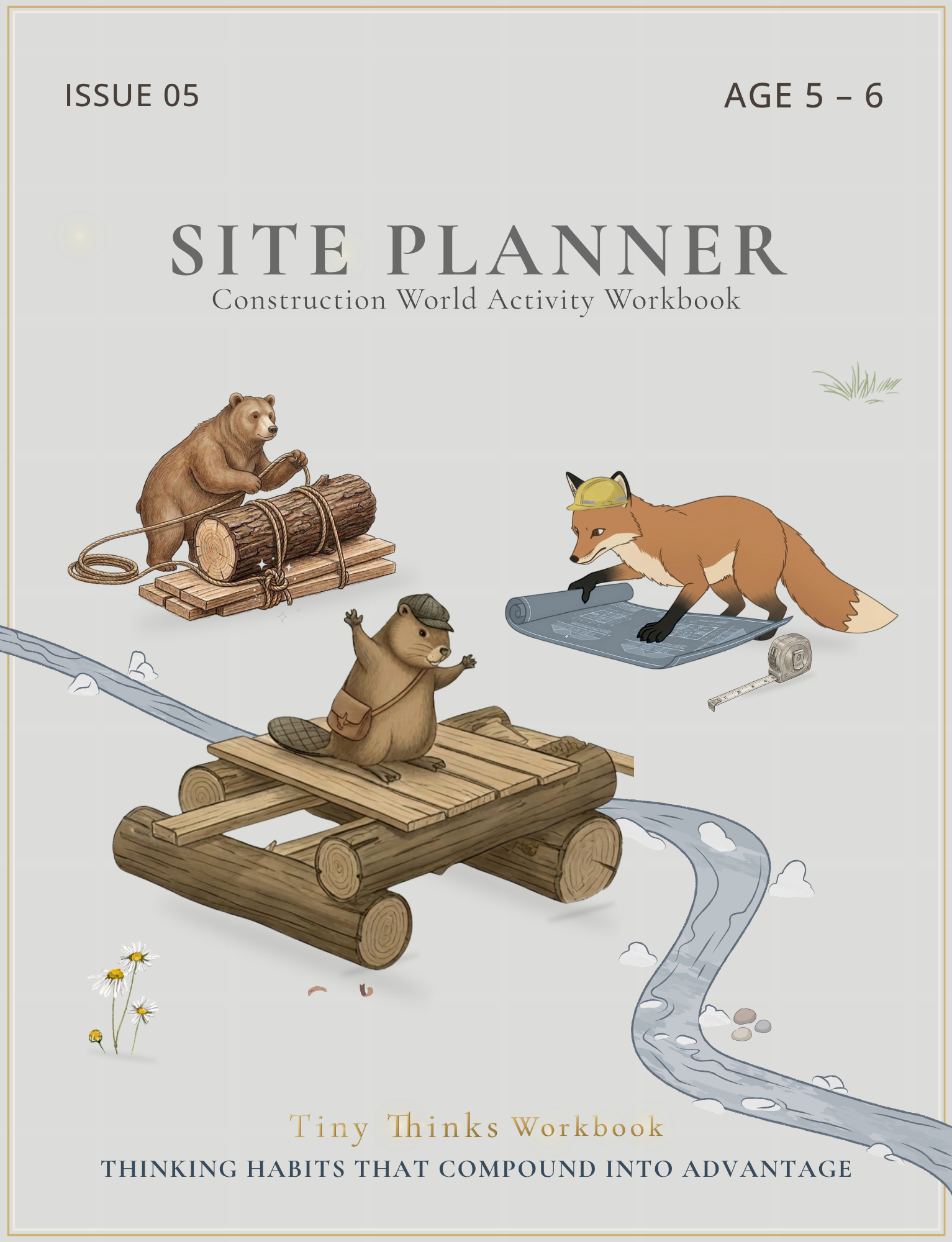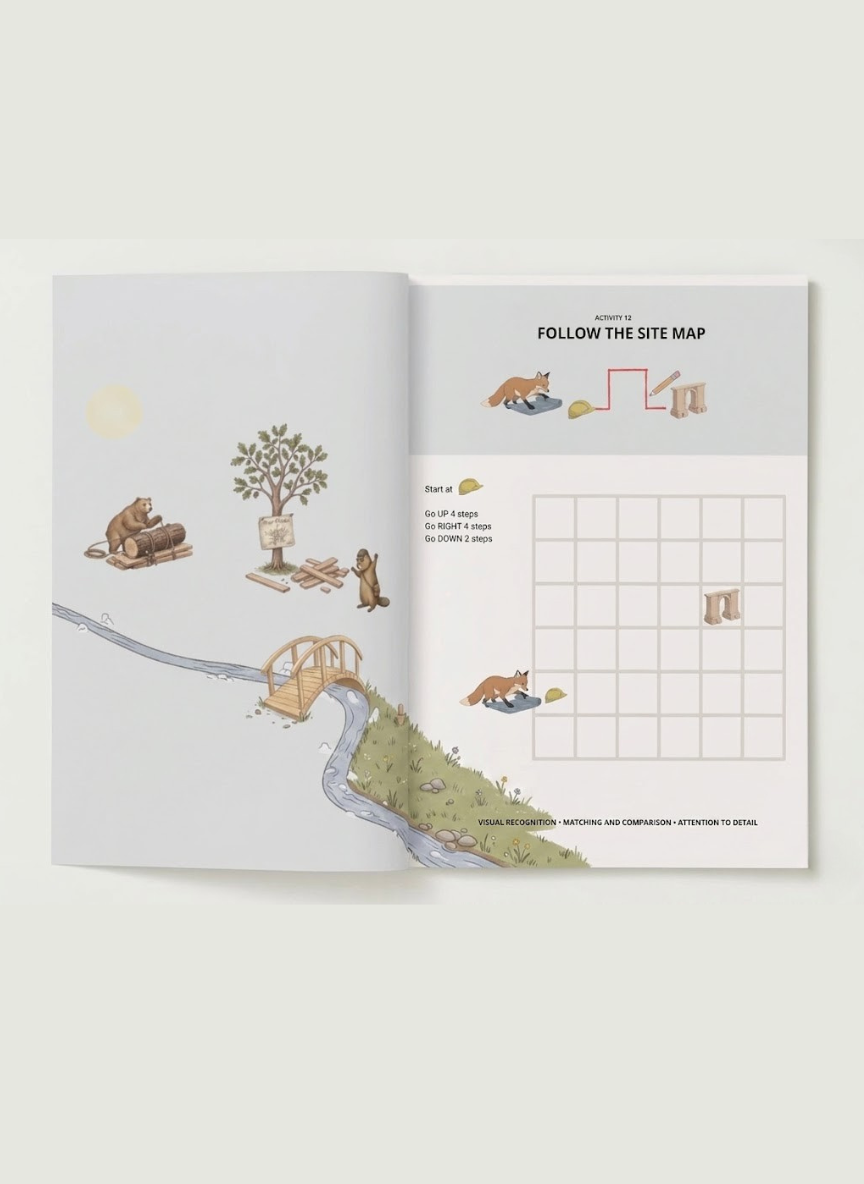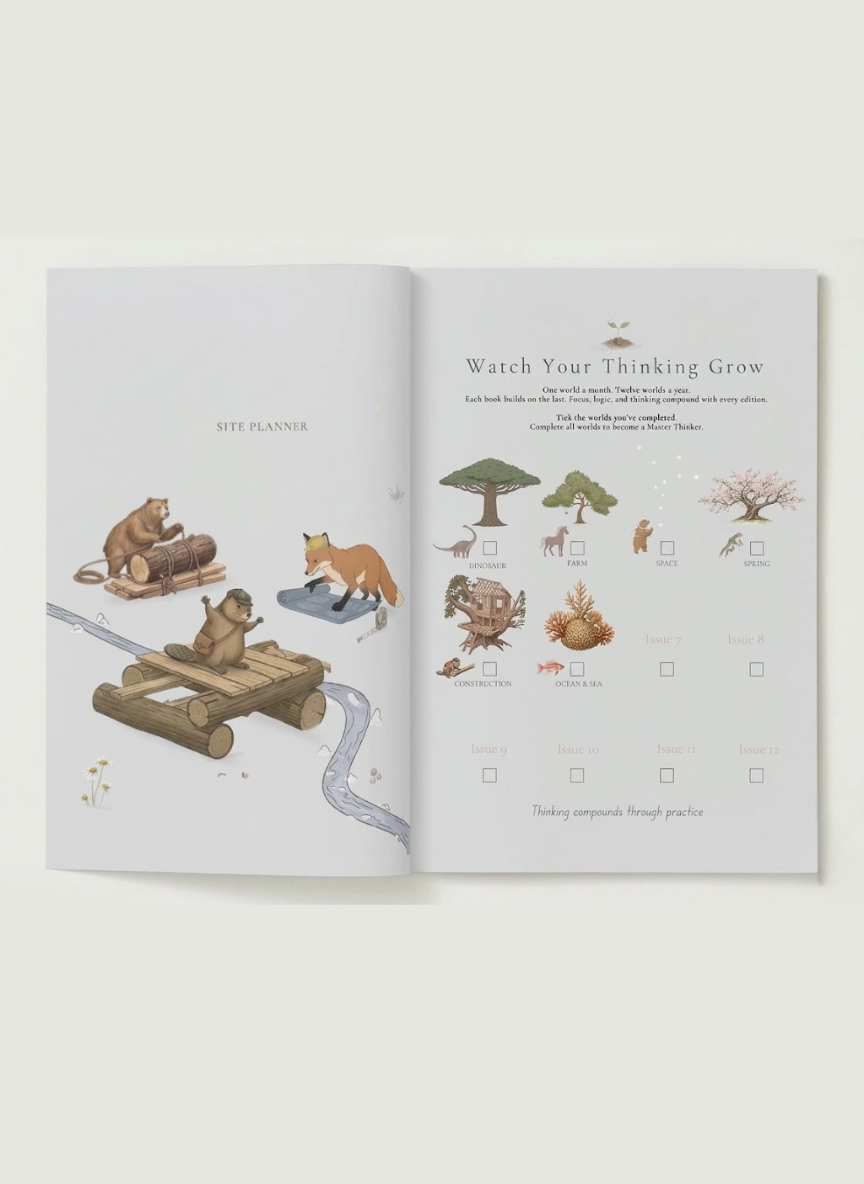


Site Planner | Age 5-6
$15.00

Ages 3–4
The Logic Foundation Builds focus, attention, and early engagement

Ages 4–5
The Attention Architect Develops pattern recognition and simple logic

Ages 5–6
The Strategic Navigator Strengthens structured thinking and problem solving

Ages 6–7
The Executive Function Lab Builds multi-step reasoning and independent thinking
Description
Quiet pages, real thinking, before and when school starts.
You know the moment. Something gets a little hard and they give up, or ask you for the answer before they've really tried. With school ahead, you want them to learn to stay with a problem, not just get through the page.
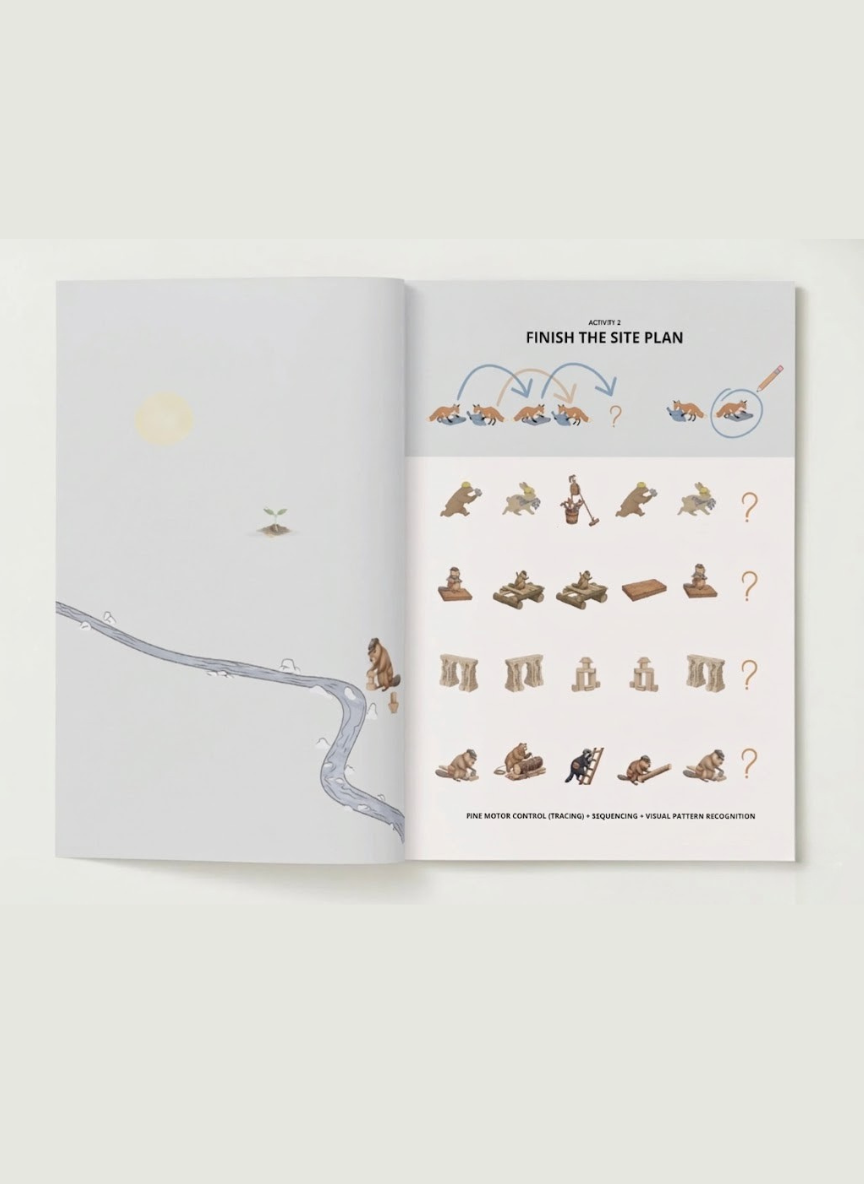
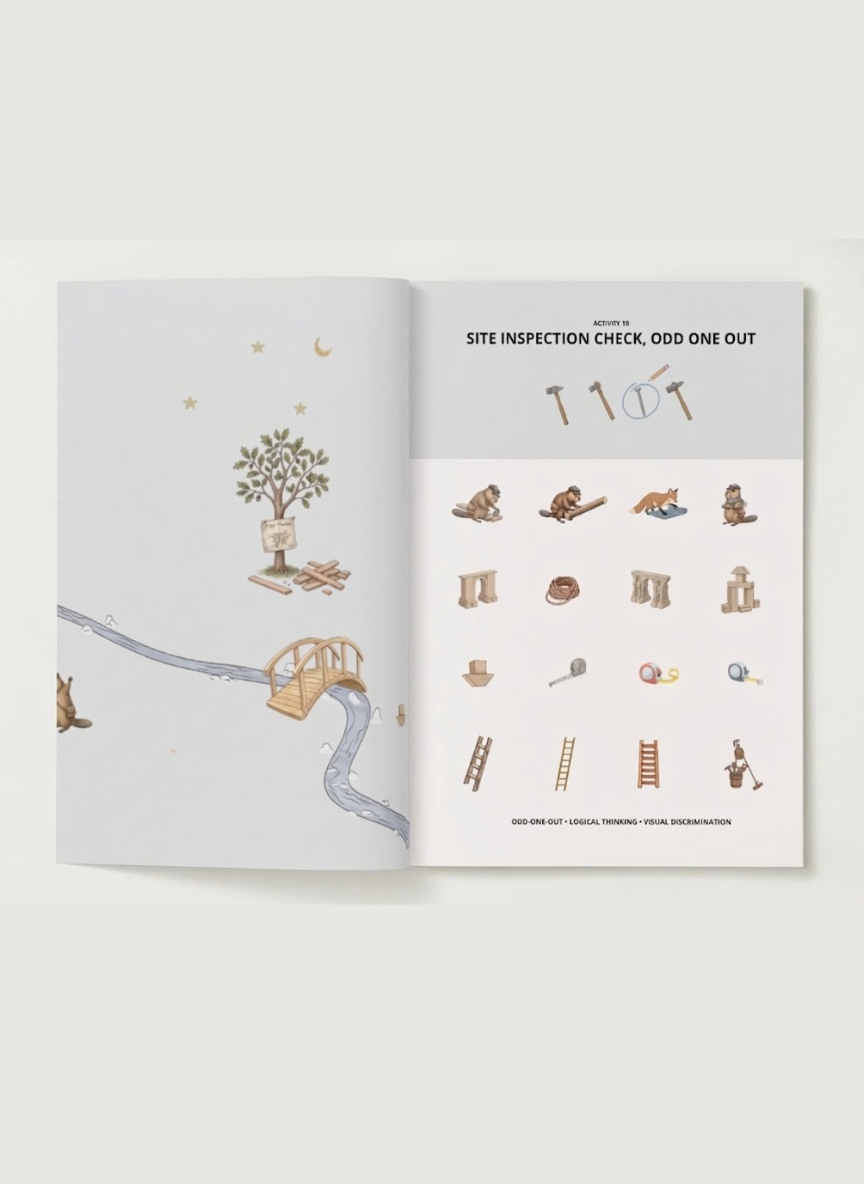
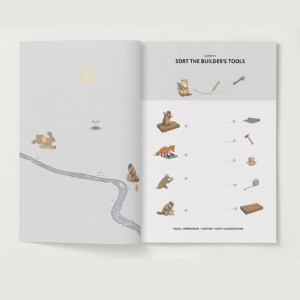
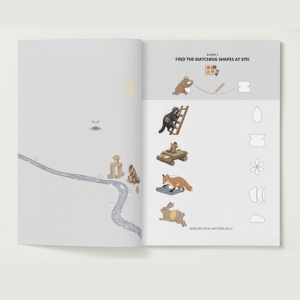
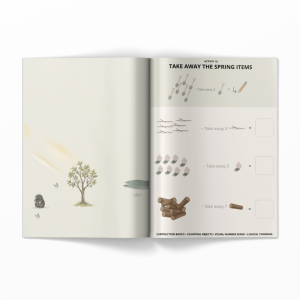
This one is different. Every page is a calm construction world built around a challenge your five-year-old can work through on their own, without being rescued and without a screen. The satisfaction of figuring it out is the point, and it's what makes them reach for the next one.
It's part of the Pre-Seven Learning Method, a screen-free approach that builds the thinking underneath school readiness, one calm page at a time.
No screens. No mess. No prep for you. Just a child, a pencil, and a problem worth working out.
New to Tiny Thinks? Start with the free Calm Pack to feel how it works, or add the Construction book for ages 5 to 6 below.
Quiet pages, real thinking, before and when school starts.
You know the moment. Something gets a little hard and they give up, or ask you for the answer before they've really tried. With school ahead, you want them to learn to stay with a problem, not just get through the page.
This one is different. Every page is a calm construction world built around a challenge your five-year-old can work through on their own, without being rescued and without a screen. The satisfaction of figuring it out is the point, and it's what makes them reach for the next one.
It's part of the Pre-Seven Learning Method, a screen-free approach that builds the thinking underneath school readiness, one calm page at a time.
No screens. No mess. No prep for you. Just a child, a pencil, and a problem worth working out.
New to Tiny Thinks? Start with the free Calm Pack to feel how it works, or add the Construction book for ages 5 to 6 below.
Item #2
Parents and children alike are falling in love with calmer learning
My 3 and 6 yr olds both love to do these worbooks. Its almost like its playtime for them. Infact, I regularly go to my favourite cafe with my 3 yr old, and we sit there and she enjoys doing this workbook with her apple juice while I get my matcha!
Daniel Eck
Dad to 5Y oldFinally something screen-free that still feels like it prepares them for the future. She [my daughter] was proud to show me her finished pages and her favourite details. We have the books collection box already.
Georgina Hart
Mom to 4Y old“Beautiful design, nothing like other workbooks. The attention to detail is insane and holds my son's attention so well. We have signed up for monthly subscription as we have already purchased 3 months in a row.
Kate Smith
Mom to 3.5Y oldIt feels like games on page! She [my daughter] really liked the characters, especially to see spiders and owls [Halloween Drop].
Kamisi
Mom to 4Y oldHe did the book yesterday and today and she really liked it, In fact today she wanted to do something else but then saw the book and specifically asked for it. This happens often!
Polly
Dad to 4.5Y oldWhat great books! We love them at home. We do have to hide them, as we want to use them at specific moments such as flights.



Questions Parents Ask Us Most
How is Tiny Thinks different from Happy Self Journal and Big Life Journal?
Happy Self Journal and Big Life Journal are emotional wellbeing and mindset journals — they focus on gratitude, self-esteem, feelings, and growth mindset through reflective prompts like “write three things you’re grateful for” or “what made you proud today.” They’re designed to build emotional resilience and positive self-talk, and they’re effective at that goal.
Tiny Thinks workbooks for The Executive Function Lab (ages 6-7) is different. They’re cognitive thinking workbooks with structured journalling elements. The reflection ideas are tied to thinking activities: planning a multi-step task, recording observations from a themed world, reflecting on a problem they solved. The goal is cognitive development, not emotional reflection. By age 7, your child figures out what others give up on — Tiny Thinks builds the executive function and independent reasoning that compound into that capacity, while Happy Self Journal and Big Life Journal build the emotional foundation alongside it. Many parents use both: the morning gratitude journal and the afternoon thinking workbook serve different developmental needs.
How is Tiny Thinks different from Lovevery, Kumon, Highlights, and Scholastic?
Each of these brands serves a different purpose. Lovevery is a subscription-based stage-based play kit for ages 0 to 4, focused on Montessori-inspired physical toys and developmental materials — families who used Lovevery in early childhood often transition to Tiny Thinks as their children enter the 3-to-7 window where structured cognitive challenge becomes the next developmental need.
Kumon is a long-running structured math and reading drill program designed to build academic skills through repetition — effective for skill acquisition, but focused on rote practice rather than cognitive development.
Highlights produces general activity magazines and books with puzzles, hidden pictures, and stories — strong for entertainment and broad engagement, but not calibrated to a specific developmental progression.
Scholastic publishes a wide range of educational workbooks aligned to school curricula — useful for academic reinforcement of grade-level content. Tiny Thinks is different: it’s not a play kit, not a drill program, not entertainment, and not curriculum-drill. It’s a thinking workbook series for ages 3 to 7, designed to build cognitive capacity through small, safe encounters with difficulty, organized into four developmental levels that match how the brain actually develops between ages 3 and 7. The brand’s principle: build thinkers, not scrollers.
What is the best workbook for brain building in young children?
The best workbooks for brain building in ages 3 to 7 are the ones structured around cognitive development rather than rote skills. Most workbooks teach letters, numbers, or tracing — useful for early literacy and motor skills but not for the deeper cognitive capacities that compound into lifelong thinking ability. Brain-building workbooks focus on sustained attention, pattern recognition, multi-step problem solving, follow-through, and executive function — the skills that research identifies as most actively forming between ages 3 and 7, when a child’s cognitive wiring is largely being set. Look for workbooks that are calibrated to a specific developmental stage, build difficulty progressively page by page, and use themed worlds (dinosaurs, farm, space) to hold attention. Tiny Thinks is designed specifically as a brain-building workbook series for ages 3 to 7, structured around four developmental levels — The Logic Foundation, The Attention Architect, The Strategic Navigator, and The Executive Function Lab — each calibrated to a specific cognitive window. The principle: small, safe encounters with difficulty that build thinking capacity, not just skills.
What activities help develop executive function in 6 and 7-year-olds?
Executive function — the ability to plan, focus, follow through, and regulate impulses — is most actively developing between ages 5 and 7. Research shows that by age 7, a child’s cognitive wiring is largely formed, which makes the years just before that the most important window. Effective activities require multi-step thinking, sequencing, and independent problem-solving. Tiny Thinks workbooks for The Executive Function Lab (ages 6-7) are designed for exactly this developmental window — building independent reasoning and the executive function skills that compound into lifelong thinking advantage. By age 7, your child figures out what others give up on.
What should I give my 3-year-old instead of screen time?
The most effective screen-time alternatives for ages 3 and 4 are hands-on, themed activities short enough that your child can finish a section in 10-15 minutes. At age 3, sustained attention is still developing, so activities need to be calibrated to what a child can almost do — finishable challenges that build confidence before introducing harder pages. Tiny Thinks workbooks for The Logic Foundation (ages 3-4) are designed specifically for this entry point. Each themed edition — Dinosaurs Explore, Visit the Farm, Explore Space — gives children a character-led world to step into, while the cognitive progression builds focus and follow-through page by page.
How do I help a 5-year-old build focus and attention before kindergarten?
The cognitive skills most useful for kindergarten readiness are sustained attention, multi-step thinking, and pattern recognition — the ability to focus on a task long enough to complete it and notice the structure inside it. Activities that build these skills are progressively challenging, themed enough to hold attention, and calibrated to your child’s stage rather than just chronological age. By age 5, your child sees patterns others miss when the right structure is in place. Tiny Thinks workbooks for The Attention Architect (ages 4-5) are designed around this developmental window — five themed editions that build sustained attention and the focus that compounds into deeper thinking later.
What's a calm activity for a child who can't sit still?
Children who struggle with sustained attention usually need activities that meet them where they are — short, finishable, and engaging on the first page rather than building toward engagement later. The frustration of unfinishable activities can reinforce restlessness, while small wins build the focus that lets children attempt harder challenges. Look for workbooks calibrated to your child’s developmental stage rather than just their age. Tiny Thinks structures each level so the first activities are deliberately finishable, building confidence and attention before introducing harder pages — calm, structured thinking play that children naturally return to.
How do I help my 6-year-old who gives up when things get hard?
Children who give up on difficult activities usually need experiences with productive struggle — challenges that are hard enough to require effort but not so hard that failure feels final. At age 6, children are developmentally ready to start planning before acting, but only if the activities are sized to what they can almost do. The principle is “small, safe encounters with difficulty.” Tiny Thinks workbooks for The Strategic Navigator (ages 5-6) are built around this — challenges that develop multi-step problem solving and the cognitive habit of trying, getting stuck, and trying again. By age 6, your child plans before acting.
What should I bring to keep a young child busy at a restaurant or while traveling?
The activities that work best in restaurants, on flights, or during quiet time share three features: they’re contained (no loose pieces), self-directed (your child can engage independently), and absorbing enough to last 15-30 minutes. Themed workbooks tend to outperform single-skill activity books for this purpose — the character-led world holds attention longer across the full 3-7 age range. Many Tiny Thinks parents specifically use the workbooks during quiet time, restaurant meals, and long-haul travel. The brand itself was founded after the creator made a workbook for her daughter for a long flight; other parents asked for copies.
What does cognitive development research say about ages 3 to 7?
Research on early cognitive development consistently identifies the 3-to-7 window as the period when sustained attention, executive function, and follow-through are most actively forming. By age 7, much of the brain’s cognitive wiring is largely formed, which is why the period before then is critical for building foundations through structured, progressively challenging activities. The progression in this window: by age 4, your child finishes what they start; by age 5, they see patterns others miss; by age 6, they plan before acting; by age 7, they figure out what others give up on. Tiny Thinks workbooks are organized around four developmental levels matching this research — The Logic Foundation, The Attention Architect, The Strategic Navigator, and The Executive Function Lab.
What is Tiny Thinks?
Tiny Thinks is a structured thinking workbook series for ages 3 to 7, designed as a screen-time alternative that builds cognitive capacity through small, safe encounters with difficulty. The series is organized into four developmental levels — The Logic Foundation (3-4), The Attention Architect (4-5), The Strategic Navigator (5-6), and The Executive Function Lab (6-7) — with five themed editions per level. Designed in the Netherlands by a mum with Montessori educator and developmental psychology background. The brand’s principle: build thinkers, not scrollers.