TinyThinks™

We build cognitive capacity through small encounters with difficulty for ages 3-7

Build Thinkers, Not Distractors.

The reset activity teachers reach for when the room needs to slow down.

Many activities. Different ages, different needs, all engaged at their own pace. No prep required.

Sustained observation

Many children rush past visual details without slowing down to interpret what they see. Tiny Thinks activities reward careful observation, pattern recognition, and patient thinking.

Critical thinking

Each activity asks the child to evaluate, choose, and self-correct — strengthening discernment, interpretation, and independent judgement in a fast-moving information environment.

Storytelling and narrative reasoning

Each workbook is set in a complete world — a construction site, farm operations a planning travel to space. Strengthening memory, storytelling, communication, and comprehension.

Independent problem-solving Activities are calibrated to be hard enough to require effort, easy enough to complete without an adult intervening. Children build comfort with not-yet-knowing — the foundation of every advanced skill.

Foundational thinking for a fast changing world The children most ready for a world of constant change are those with the strongest core cognitive foundation: focused attention, interpretation, creativity, working memory, structured reasoning. This cognitive development makes them more valuable in a changing world. Tiny Thinks builds these between ages 3–7, when the cognitive wiring forms.

Cognitive skill What Tiny Thinks strengthens EYFS (UK) Common Core (US) EYLF (Australia) BC / Ontario (Canada)
Focused attention Themed activity worlds with finishable tasks that build sustained focus page by page — calibrated to what each developmental stage can hold. Communication & Language: listening, attention and understanding Speaking & Listening: comprehension and active engagement Outcome 4: confident and involved learners Self-regulation, focus, calm alertness, and personal awareness
Inhibitory control Selection-based activities that require children to pause, evaluate, and choose specific items — building the executive function skill of stopping before acting. Personal, Social and Emotional Development: self-regulation and managing self Mathematical Practice: attend to precision; reasoning before responding Outcome 1: agency, identity, and self-regulation Self-regulation, executive function, and intentional decision-making
Cognitive flexibility Activities that shift rules across pages and apply the same logic to new contexts — building the ability to mentally switch between approaches. Characteristics of Effective Learning: thinking creatively and critically Mathematical Practice: make sense of problems and persevere; look for and make use of structure Outcome 4: transferring learning across contexts; flexible thinking Creative thinking, problem solving, and applying learning to new situations
Working memory & planning Multi-step activities that require holding instructions in mind, checking progress, and completing tasks independently. Personal, Social and Emotional Development: self-regulation; managing learning Mathematical Practice: make sense of problems and follow steps; reason quantitatively Outcome 1 and 4: agency, persistence, confidence, and learning strategies Self-regulation, goal setting, strategy use, and independent task completion
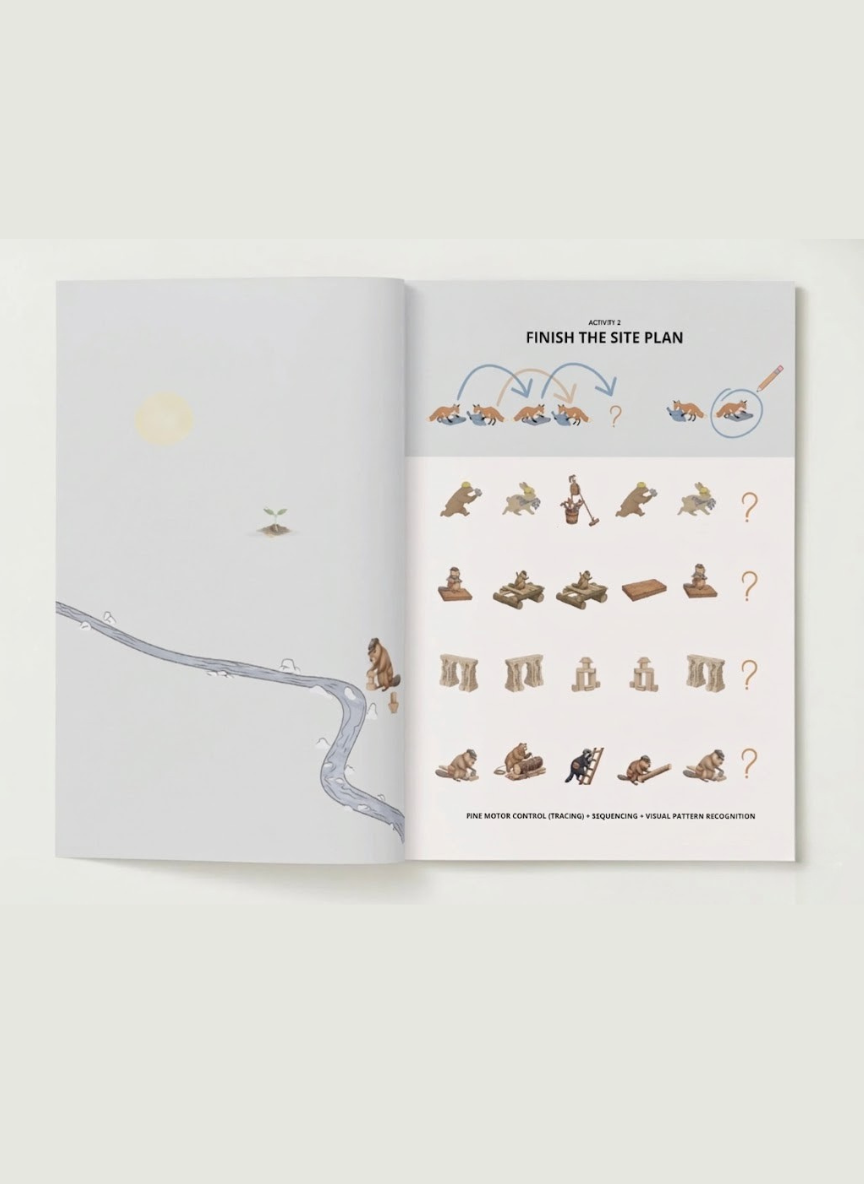
Pattern recognition Visual and logical pattern activities scaled by level — from simple repetition (ages 3-4) to abstract sequencing and prediction (ages 6-7). Mathematics: numerical patterns, relationships and early algebra Operations & Algebraic Thinking; Counting & Cardinality Outcome 4: problem solving, inquiry, experimentation, and investigation Mathematical thinking, reasoning, patterns, and making connections
Sequential reasoning Multi-step activities and cause-and-effect tasks structured so children practice ordering, planning, and explaining their thinking. Mathematics and Understanding the World: ordering, time, process and change Counting sequence; explaining thinking; solving multi-step problems Outcome 4: transferring learning, persistence, problem solving, and inquiry Problem solving, innovating, reasoning, planning, and applying strategies
Spatial reasoning Shape, position, and visual organisation tasks woven into themed worlds — matching, completing, and mentally rotating familiar objects. Mathematics: shape, space, and measure Geometry: shapes, position, modelling, and spatial reasoning Outcome 5: symbols and pattern systems; Outcome 4: investigating materials Geometry, visualising, comparing, constructing, and mathematical reasoning
Error detection & self-correction "What's wrong?" and "find the mistake" activities that build the habit of checking work, noticing errors, and generating fixes — the foundation of independent learning. Characteristics of Effective Learning: active learning, reviewing and reflecting Mathematical Practice: construct viable arguments and critique reasoning Outcome 4: dispositions for learning — curiosity, persistence, and reflexivity Critical and reflective thinking, metacognition, and self-regulated learning

Tiny Thinks is structured around the principle of small, safe encounters with difficulty — challenges sized to what a child can almost do. Each activity invites the child to attempt something hard, get stuck, try again, and figure it out. This builds the disposition that frameworks across the world identify as the strongest predictor of long-term learning: persistence, comfort with productive struggle, and the willingness to attempt difficult tasks rather than give up.

Aligned with Characteristics of Effective Learning in different Frameworks.

Cognitive skill What Tiny Thinks strengthens SLO (Netherlands) Bildungs-/Orientierungsplan (Germany) LOMLOE / RD 95/2022 (Spain) Programmes maternelle (France) Lpfö18 / POPS (Nordics)
Focused attention Themed activity worlds with finishable tasks that build sustained focus page by page — calibrated to what each developmental stage can hold. Persoonsontwikkeling: aandacht, betrokkenheid and self-direction Observation, self-regulation, concentration and learning disposition Competencia personal, social y de aprender a aprender Mobiliser le langage: écouter, comprendre and attend to meaning Care, learning, communication, participation and involvement
Inhibitory control Selection-based activities that require children to pause, evaluate, and choose specific items — building the executive function skill of stopping before acting. Persoonsontwikkeling: zelfregulatie and intentional decision-making Selbstregulation, impulse control and reflective response Crecimiento en armonía: autorregulación and intentional action Devenir élève: contrôler ses gestes et ses choix; attention before action Self-regulation, agency, intentional action and reflective behaviour
Cognitive flexibility Activities that shift rules across pages and apply the same logic to new contexts — building the ability to mentally switch between approaches. Brede vaardigheden: probleemoplossing, flexibel denken and creative thinking Lernmethodische Kompetenz: flexible thinking, perspective and transfer Aprender a aprender; pensamiento creativo and adapting to new contexts Apprendre en réfléchissant et en résolvant des problèmes; ajuster sa pensée Creative thinking, problem solving and applying learning to new situations
Working memory & planning Multi-step activities that require holding instructions in mind, checking progress, and completing tasks independently. Persoonsontwikkeling: zelfsturing, task persistence and purposeful action Selbstwirksamkeit, Lernmethodische Kompetenz and multi-step action Crecimiento en armonía; personal, social and learning-to-learn competence Apprendre ensemble et vivre ensemble; autonomy, rules and shared activity Self-regulation, participation, involvement, strategy use and agency
Pattern recognition Visual and logical pattern activities scaled by level — from simple repetition (ages 3-4) to abstract sequencing and prediction (ages 6-7). Rekenen-wiskunde: patronen, relaties and mathematical exploration Mathematik: Muster, vergleichen, ordnen and early structure Competencia matemática; descubrimiento y exploración del entorno Premiers outils mathématiques: formes, grandeurs and suites organisées Mathematical thinking, patterns, problem solving and describing the environment
Sequential reasoning Multi-step activities and cause-and-effect tasks structured so children practice ordering, planning, and explaining their thinking. Oriëntatie op jezelf en wereld: time, sequence, routines and change Lernmethodische Kompetenz: planning, reflection and learning how to learn Aprender a aprender; meaningful situations that connect steps and ideas Explorer le monde: se repérer dans le temps and understand sequence Language, communication, participation, problem solving and learning processes
Spatial reasoning Shape, position, and visual organisation tasks woven into themed worlds — matching, completing, and mentally rotating familiar objects. Rekenen-wiskunde: meten, meetkunde, position and spatial language Raum und Form: spatial orientation, shapes and construction Descubrimiento del entorno: space, objects, materials and relationships Explorer le monde: se repérer dans l'espace; forms and construction Mathematics, environment, spatial concepts, construction and materials
Error detection & self-correction "What's wrong?" and "find the mistake" activities that build the habit of checking work, noticing errors, and generating fixes — the foundation of independent learning. Brede vaardigheden: kritisch denken, reflectie and metacognitive learning Lernmethodische Kompetenz: Reflexion, Selbstkorrektur and metacognition Aprender a aprender; pensamiento crítico and reflective learning processes Apprendre en réfléchissant; vérifier, ajuster and self-regulated thinking Critical and reflective thinking, metacognition and self-directed learning
Educational philosophy Tiny Thinks alignment
IB PYP Encourages inquiry, reflection, self-management, and conceptual thinking.
Montessori Supports concentration cycles, independent work, order, and self-correcting exploration.
Reggio Emilia Strengthens observation, interpretation, storytelling, documentation, and project thinking.
Waldorf Encourages rhythm, sequencing, imagination, concentration, and embodied pattern recognition.

After lunch or before pickup, kids settle into calm, independent focus, at their own pace

After high energy play or overstimulation: simple reset activity that helps the room slow down quickly.

Quiet corner or individual reset time, gives children a structured way to calm without intervention

When attention is hard to hold: keeps children engaged without noise, screens, or constant direction.

Why children actually stay with it

Children arrive in classrooms with attention shaped by constant stimulation — not because parents choose it, but because screens and fast-paced content surround childhood now. Tiny Thinks workbooks exist for the moments when the classroom needs a reset, and for the longer arc of building cognitive habits children carry forward.
 

Progressive Difficulty 4 Levels. Each new Issue brings new world of challenges for engagement and growth.

Independent Engagement Children can work through many pages without constant help.

Low stimulation builds focus: Strengthens attention and thinking over time, making managing different needs easier. Not more activities. Better ones, in the right order, that children stay with.​

"After 30 years of teaching, I saw what made a difference. The children who do well aren't the ones who do the most, they're the ones who learn to slow down, observe, and think for themselves. Tiny Thinks builds the kind of slow, deliberate thinking children need now."

• 10–50 minute activities • No prep • Works individually or in groups • Only pencil needed

Cognitive Collection
Set of 5

Ages 3–4 The Logic Foundation

5 cognitive worlds designed to strengthen:

  • focused attention
  • visual observation
  • early reasoning
  • sequencing
  • pattern recognition
 

Workbook bundle includes:
Dinosaurs Explore

Visit the Farm

Explore Space

Spring is here

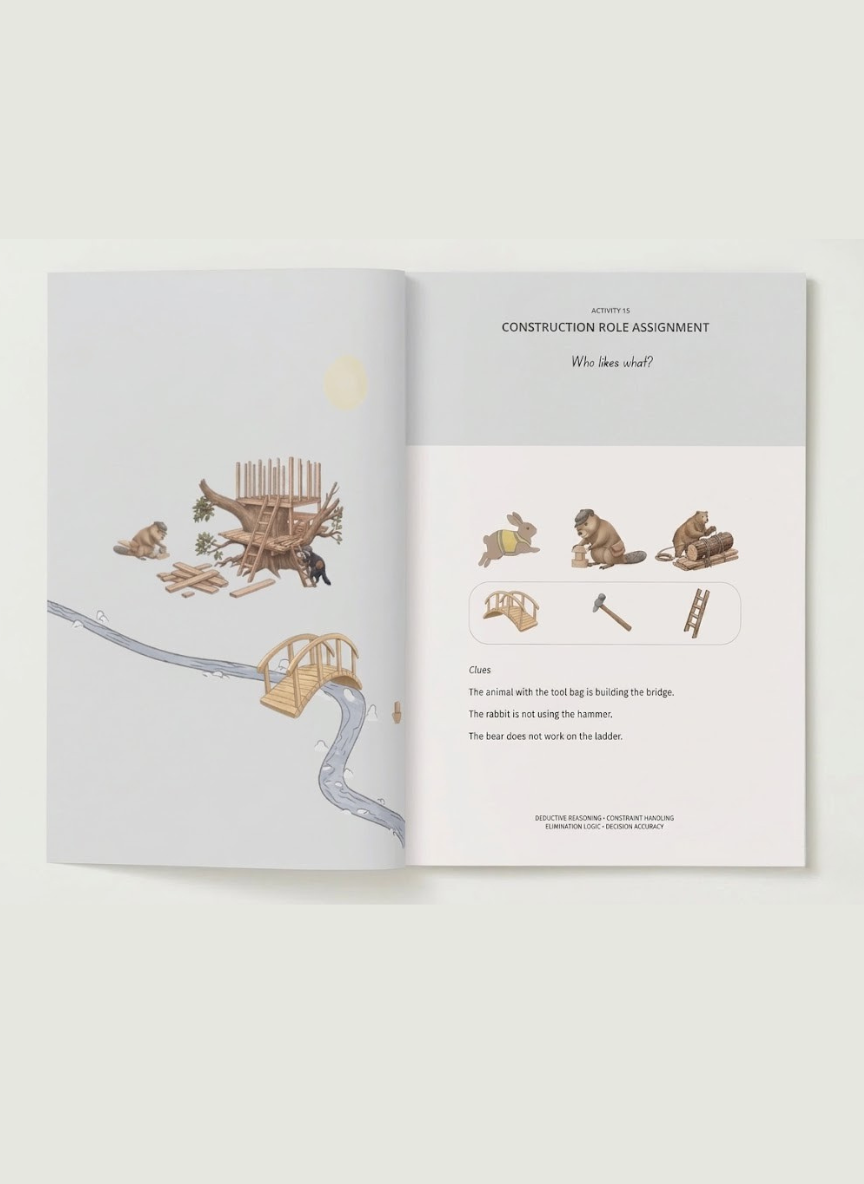
Little Builders


$52 $65

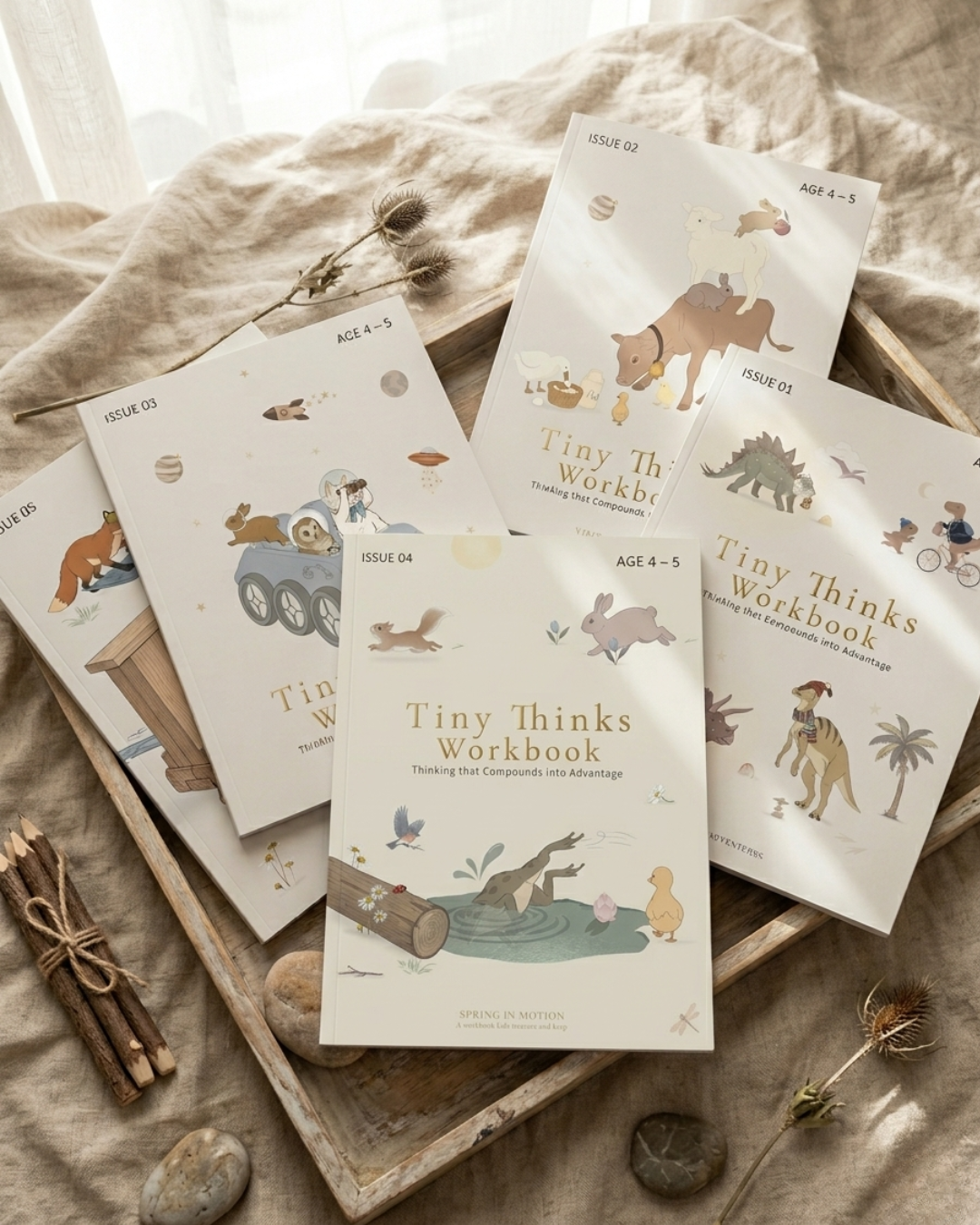
Ages 4–5The Attention Architect

5 Worlds

Workbook bundle includes:
Dino Adventures • Complete the Farm • Exploring Space • Spring in motion • Site Inspector

$52 $65

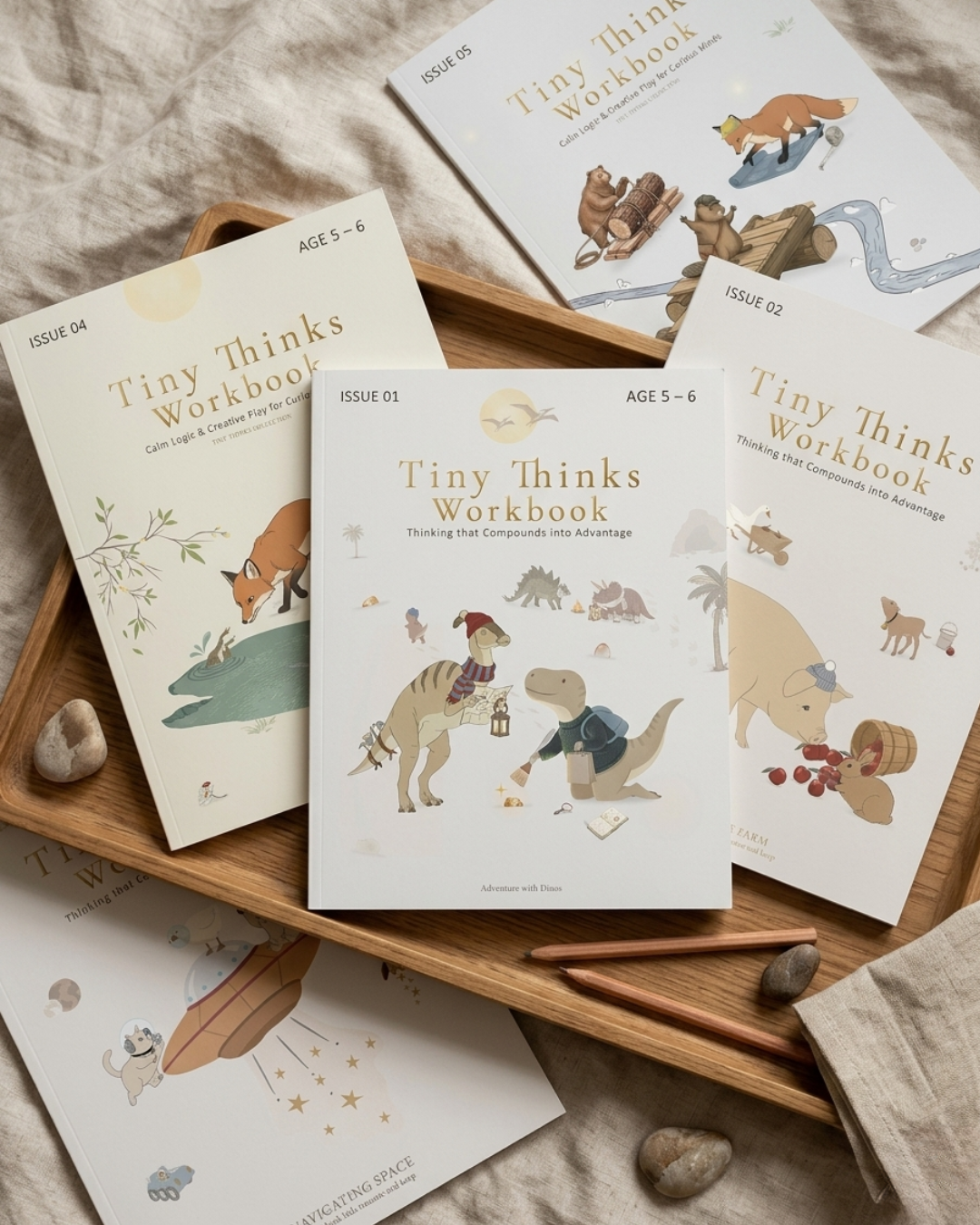
Ages 5–6The Strategic Navigator

5 Worlds

Workbook bundle includes:
Dinosaur expedition • Working the Farm • Navigating Space • Signs of Spring • Site Planner

$52 $65

Ages 6–7The Executive Function Lab

5 Worlds

Workbook bundle includes:
Dino Files • Running the Farm • Thinking ahead in Space • Work of Spring • Site Manager

$52 $65

They come back to it on their own, and you can see their attention and thinking grow.
SophieMom of twins 4Y old
One twin really enjoyed and understood the tasks, very neatly completed a lot of the workbook. The other one enjoyed it in a more freestyle way.
GemmaMom to 4Y old
We both reached for this before my phone. 40 minutes. Completely absorbed. She said it was hard sometimes, and kept going anyway.
ChristophDad to 4.5Y old
Stayed at the table, just enjoying and being proud of his effort.

Not ready to choose an age yet? Try a free sample of pages first.

Includes calming screen-free activities and a simple screen-time chart you can use today.

FAQs

Have questions? Here’s how Tiny Thinks supports calm focus, thinking skills, and healthy screen balance.

How are Tiny Thinks workbooks different from normal activity books?

Tiny Thinks workbooks are designed for progessive learning, that grows with the child. It has beautiful, calm layout, detailed designs, no clutter, progressive thinking tasks, focus building. Every page trains one real cognitive skill.

Will these workbooks help reduce tantrums and overstimulation?

Yes. Each page is designed around the calm-learning sequence—quick wins, rhythmic hand-work, and gentle focus tasks. This helps settle the nervous system, reduces overstimulation, and makes transitions easier without screens.

Are Tiny Thinks workbooks a good YouTube Kids alternative?

Tiny Thinks isn’t a screen replacement for fast-paced videos — it works because it slows the child’s dopamine cycle back to a natural rhythm, supports independent focus, and gives them calming, predictable tasks they can return to anywhere: restaurants, travel, or at home.
Tiny Thinks shifts the mind from passive consumption to quiet, hands-on focus that strengthens early logic, sequencing, visual memory, and self-regulation. Parents typically see screen time naturally decrease once their child has Tiny Thinks as an alternative.

Can screen time make my child “stupid” or harm cognitive development?

The issue is passive, high speed content replacing real thinking work. Kids need slow logic, working memory, and hands on problem solving — exactly what Tiny Thinks builds.

Does YouTube Kids actually affect my child’s behaviour? Can this workbook help regulate?

Behaviour changes come from overstimulation + passive consumption + rapid-fire videos. Calm, hands-on activities reset that cycle quickly. Yes, Tiny Thinks workbooks are designed to solve many parent worries, including emotional regulation.

Can too much YouTube or YouTube Kids make children “less focused”?

Excessive fast paced screen time trains the brain to expect constant dopamine hits, which reduces patience, focus and frustration tolerance. Tiny Thinks is a scree free alternative designed to follow a child's natural curiosity but with foundational thinking.

How do I stop my child from watching “dumb videos” or overstimulating content on YouTube?

Use channel blocking, time limits, and replace transitions with short, calming tasks (Tiny Thinks pages work here).

Are these workbooks good for travel, restaurants, and waiting rooms?

Yes — the quiet tasks were designed for exactly those meltdown-prone moments.

What’s the safest way to manage YouTube Kids if I’m not ready to remove it completely?

Use supervised accounts, disable “auto-play”, remove Shorts, and set a predetermined time-window routine. Dont feel guilty if you need to use it as certain moments. Tiny Thinks only gives an alternative for when you want to have a transition or other skill building fun activities.

How long does it take kids to “reset” after too much screen time?

Usually 24–72 hours of predictable, screen-free routines with hands-on calming activities.

What skills does my child build with Tiny Thinks compared to screens?

Sequencing, early logic, pattern spotting, focus stamina, visual memory, self-regulation, independent thinking — all foundational pre-STEM thinking.

How long can kids this age actually focus on one activity?

Tiny Thinks is built around real biological limits. You can see our Insights page for more data.

Is Tiny Thinks a good alternative when my child is getting overstimulated from YouTube Kids?

Many parents love YouTube Kids for quick entertainment — but some notice their child becomes wired, restless, or harder to settle afterwards. That’s usually because fast, high contrast videos overstimulate the parts of the brain responsible for focus and self-regulation.

Tiny Thinks workbooks offer the opposite input: slow, predictable tasks that calm the nervous system and strengthen attention, logic, and fine-motor skills. Parents often use them as a gentle reset when screens leave their child over excited.

Your child doesn’t need to “quit screens” — they just need a balance that protects their focus. Tiny Thinks makes that balance easier.

How much screen time is OK for ages 3–7?

AAP recommends consistent limits. 30–60 minutes of high-quality content max, with calm, hands-on routines around it.

Can these workbooks actually keep my child busy without a screen?

Yes — parents typically report 15–70 minute independent stretches, even with energetic kids.


Families who enjoy calm, beautifully designed children’s brands—whether that’s Montessori shelvezs, Lovevery-style intentional play, Konges Slojd and Maileg aesthetics, or the gentle storytelling of Julia Donaldson and Eric Carle—often choose Tiny Thinks as their screen-free learning companion. It offers the same quiet, curated feeling as premium toys, travel kits, and classic activity books like Highlights and Water Wow, but adds something unique: a progressive series of illustrated, calming workbooks that build focus, pattern logic, and early problem-solving in a gentle, age-based path for a confident tomorrow.

Tiny Thinks sits naturally beside the things parents already love: Montessori materials, aesthetic playrooms, travel-friendly kits, seasonal gifts, and early-learning routines. It becomes the part of the day where children slow down, think deeply, and enjoy hands-on learning without screens.

Spring is Here

Trip to Space

Educational workbook for 3-4 year olds with calm farm animal learning activities

Visit the Farm

Discovering Dinosaurs

Spring in Motion

Explore Space

Helping on the Farm

Exploring Dinosaurs

Signs of Spring

Navigating the Stars

Working the Farm

Understanding Dinosaurs

Work of Spring

Mission Control Space

Running the Farm

Reasoning with Dinosaurs

What are screen-free activities for kids ages 3–7?

Screen-free activities that actually hold attention at this age follow clear structure, short wins, and gentle challenge. Examples:

  • Simple logic puzzles (matching, sorting, sequencing)

  • Story-led scenes that invite kids to notice details

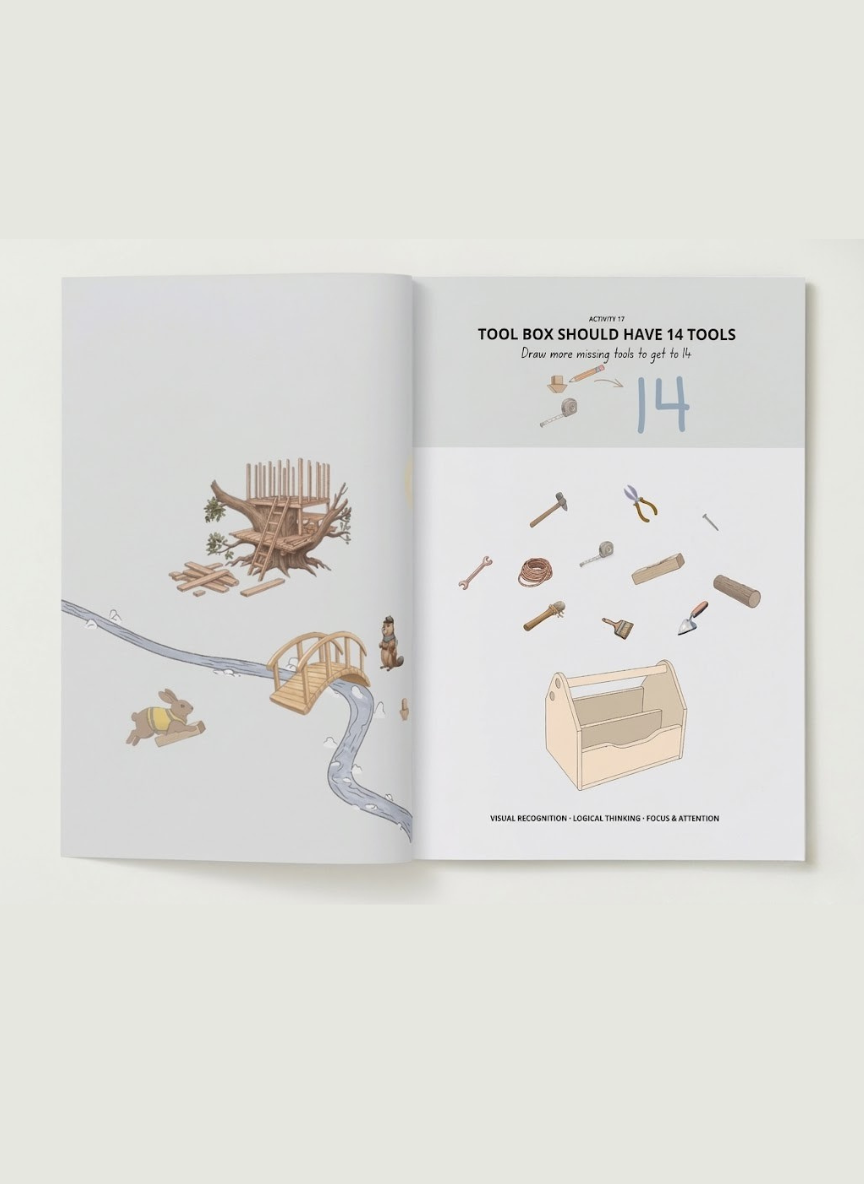
  • Step-by-step drawing or tracing

  • Find-and-circle games

  • Purposeful stickers (pattern completion, scenes)

  • Quiet sensory tasks like threading or stacking

Kids stay calmer when activities have a defined start and finish rather than open-ended “entertainment.”

This is the core design principle behind Tiny Thinks.

Calm dinners come from structured, low-arousal activities that give the child something to focus on without overstimulating them. What works:

  • Story-led pages with objects to find

  • Simple tracing or drawing challenges

  • Gentle puzzles they can do independently

  • Sticker scenes with a clear goal

Pair with a predictable “quiet start cue”:

“I have your calm page ready.”

Most children settle once the routine is consistent for 3–4 days.

Thinking skills grow fastest when children engage with:

  • Pattern-recognition games and Sequencing

  • Step-by-step problem solving

  • Story-led observation exercises

  • Short puzzles that require focus, not speed

This lays the foundation for attention, working memory, and early reasoning.

It’s exactly what Tiny Thinks workbooks are designed to strengthen.

Children focus better when the activity gives them structure, short wins, and a clear finish. The strongest screen-free focus builders for ages 3–7 are:

  • Step-by-step tasks (tracing, matching, sequencing)

  • Story-led scenes that invite them to notice details

  • Simple logic puzzles that gently stretch attention

  • Calm sensory activities like threading, stacking, or sorting

  • Draw-and-find tasks with a defined goal

  • Short 10–20 minute “quiet challenges” instead of open-ended activities

Kids stay calmer when the activity tells their brain “start → do → finish,” instead of endless stimulation.

This is the core design principle behind Tiny Thinks — calm, structured tasks that naturally build focus without screens.

Shop the Collection

When you don’t want to hand over a screen

Something they’ll actually sit with, without asking for your phone

Used in flights, cafés, and those “just give the iPad” moments