
- Key Takeaways
- Why Your Child Gets Hyper
- The Algorithm’s Hidden Role
- Beyond Temporary Hyperactivity
- Your Child’s Unique Response
- Create a Calmer Viewing Habit
- When to Seek Professional Help
- Conclusion
- Frequently Asked Questions
- Why does my child become hyper after watching YouTube?
- How does YouTube’s algorithm affect my child’s behavior?
- Is hyperactivity after screen time harmful?
- Do all children react the same way to YouTube?
- How can I help my child have a calmer experience with YouTube?
- When should I seek professional help for my child’s hyperactivity?
- Are there alternatives to YouTube that are less stimulating?
Key Takeaways
- Fast, many-stimuli videos can overwhelm the brains of young children when they watch and afterward make it more difficult for them to calm down and focus.
- YouTube videos prompt dopamine spikes that can lead to impulsive acts and a quick reward feedback loop. This impacts attention and self-control over time.
- Like mini-zombies who have caught the spirit of the online personality, kids start acting out the emotions they see onscreen. This affects their mood, interactions with others, and they become irritable.
- Fast visuals and loud sounds hijack your child’s senses, leaving her wired and restless with fractured attention and tantrums after watching.
- Establishing boundaries such as limiting time, curating more calming content, and designating tech-free spaces in the house can support kids to decompress and cultivate screen habits that are healthier and more balanced.
- Every child reacts differently to screen exposure, so noticing your kid’s individual responses and adapting practices is essential for nurturing their health.
When screens turn off and your child is wired, the Tiny Thinks Free Calm Pack is what families use to slow things down without negotiation or stimulation.
Kids get hyper after YouTube because rapid, high-stimulation content sparks rapid attention shifts and overloads the brain with dopamine.
Often this leads to a child who can’t wean themselves away from screens, hopping here and there impatiently for slower-paced activities.
We see it as parents during these normal, daily moments — after school, before dinner or bedtime — when winding down is next to impossible.
Knowing the mechanism at play provides a calmer, more effective way forward.
Why Your Child Gets Hyper
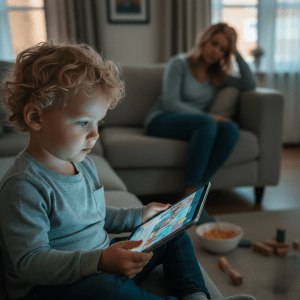
3–7 year olds are not inherently hyper or liable to tantrum post-Youtube. Hyperactivity after screens is a natural reaction to the overstimulating, rapid, and unexpected stimuli that digital video provides. The signs are clear: spinning between toys, talking fast, bouncing from one thing to another, increased irritability, and a sharp drop in patience.
Some kids can’t nod off, others bicker more, and a ton seem incapable of winding down to quieter activities. These aren’t character flaws or parenting failures; they are the byproducts of a system crafted around speed and the new, not self-regulation.
1. Brain Overload
Fast-paced video, particularly with quick cuts and intense contrast, overloads a child’s emerging brain. The typical YouTube video for kids changes scenes every 1 to 3 seconds, faster than the child’s inherent attention cycle. This leaves the brain hard-pressed to keep up, resulting in a frenzied, twitchy state.
High-arousal content diminishes the opportunity for deep, focused attention. When kids are fed an unrelenting stream of random input, so is their thinking. Screen overstimulation adds to the other stressors of the day, tipping certain kids toward hyperactive, impulsive behavior. Overstimulated brains don’t usually calm themselves.
2. Dopamine Rush
As a child views captivating video content, their brain emits dopamine, one of the pleasure and reward chemicals. This flood feels good in the moment, but it establishes a destructive cycle of craving stimulation and immediate gratification. The more frequently this loop is triggered, the less kids can stand to sit still and engage in calm, slow-paced tasks.
Impulse control for young children is still in its nascent stages. Most kids don’t master it until they reach 8 to 13 years old. Like all frequent dopamine bursts, screen time makes children impulsive and less able to return to calm, patient play.
3. Emotional Mimicry
Kids are born mimics. If a beloved YouTuber goes goofy or boisterous, little ones are mimicking those behaviors sometimes for hours after the device is turned off. Emotional mimicry extends to mood. If the content is frantic, the child’s mood tends to mirror that energy.
These shifts can spill into play, with kids mimicking what they’ve seen, not knowing how to turn it off. When the emotional tenor is heightened or erratic, kids can’t locate their own steady baseline of calm.
4. Sensory Assault
Blaring soundtracks, strobe lights, and manic movement are par for the course in digital kids’ programming. For many kids, this is too much. The body responds with an elevated heart rate and stress hormones. High stimulation can lead to a hangover.
Some children can’t calm down to fall asleep, while others are more irritable or emotionally prickly. Sensory overload frequently manifests as restlessness, frustration, or meltdowns in the subsequent few hours. The more intense the input, the more pronounced the aftermath.
|
Screen Exposure |
Child Temperament Impact |
|---|---|
|
Fast-paced, unpredictable videos |
Heightened irritability, trouble calming down |
|
High-saturation visuals, loud audio |
Sensory overload, emotional volatility |
|
Algorithm-driven auto-play |
Difficulty focusing, increased impulsivity |
|
Co-viewing with adult |
Smoother transitions, better emotional regulation |
5. Broken Focus
Every time a video skips to a different scene or auto-play kicks in with the next video, it breaks the kid’s concentration. Over time, this destroys the inherent capacity to persist at one thing. Your kid can’t handle simple transitions from screen to dinner because her brain is conditioned to crave information and stimulation.
Disrupted attention complicates children’s ability to finish easy work or savor slow, tactile play. When attention is constantly fractured by screens, deep engagement becomes uncommon.
Tiny Thinks™ was created for these moments. When your child is buzzed and scattered after screens, the Free Calm Pack provides soft, structured pages that decelerate the world around them, no bright colors, no quick cuts, just mindful calm play.
They calm down right away because the process is concrete and tactile. For daily routines after school, screen transitions, dinner, travel, and bedtime, the age-based Tiny Thinks™ Workbooks are designed to build up the skills that screens fragment: focus, sequencing, patience, and independent initiation.
No guilt, no enhancements, just a consistent method to return peace and get your kid to think once more.
For the after-school or pre-dinner screen comedown that keeps repeating, Tiny Thinks Workbooks provide a predictable thinking-play structure children return to on their own.
The Algorithm’s Hidden Role
YouTube’s algorithm determines what your child views next. It’s not a neutral force. Each video is selected by a machine that analyzes watching habits and then offers the next video most likely to be accessed. To a kid, this generates a quick, constant flow of material that’s hard to put down. The algorithm is designed to maximize engagement and not to build attention or regulation.
Kids between the ages of 3–7 are particularly susceptible to these trends. At this age, their immature brains are figuring out what focus feels like, how to complete a project, and how to handle frustration. When every video is immediately superseded by a newer one, the young child’s mind never settles into slow thinking. Instead, it’s continually yanked into fast, reactive viewing, which can lead to behavioral changes.
It’s not a moral failing. It’s a structural issue that parents everywhere are encountering, be it after school, during dinner prep, or while waiting in a lobby. The real concern is that the algorithm can become a “conformity engine.” It configures what a child believes to be normal, acceptable, or thrilling—at times within hours.
If the algorithm favors loud, quick, or sensational videos, then those patterns become recognizable and anticipated. In reality, this might be a kid who is calm prior to screen time but becomes wired, restless, or jittery afterward. When children watch one short-form video after another, their young brains adjust to anticipate novelty and immediate reward, which can exacerbate problems like oppositional defiant disorder.
The result is what many parents see: a child who ricochets from activity to activity, asking for more screen time and struggling to wind down. YouTube’s algorithm makes no distinction between supportive content and engaging content. With 400 hours of video uploaded every minute, there is no way to promise what a child will see next, which can lead to feelings of parental anxiety.
It prioritizes videos that provoke instant responses, often regardless of merit or suitability. That’s how kids can find themselves viewing content that’s scary, bewildering, or just plain too much for their age. The algorithm’s quest for engagement can take precedence over a child’s need for regulation, calm, and predictability.
For families looking for another option, Tiny Thinks™ provides an alternative. It’s not about eliminating screens or shaming parents for using them. Instead, it’s about delivering a placid, no-screen thought layer when a kiddo needs to rest, center, or decompress.
The Free Calm Pack is for these real moments—after school, mealtime chaos, long travel days or waiting rooms. About The Algorithm’s Hidden Role: It provides kids with hard-wired, low-stim activities that recharge attention, cultivate focus, and encourage self-starting.
For families prepared to take it a step further, age-specific Tiny Thinks™ Workbooks provide a consistent framework for cultivating early cognitive skills. These workbooks are consistently presented in a visually soothing, familiar layout that kids seek out repeatedly.
Beyond Temporary Hyperactivity
Hyperactivity post-YouTube isn’t necessarily a quick shot. For young kids, the impact can extend far beyond the immediate screen-off hour. Most parents witness their kid continuing to bounce, cranky or distracted even after the video is over. It’s more than just being playful. Engaging early in quick, algorithmic hits can establish lingering patterns that disrupt sleep, mood, and the capacity to focus on tangible-world activities.
Hyperactivity that continues for months, not minutes, might indicate something more profound. If your child exhibits symptoms of inattention or impulsivity for longer than six months, they should be referred to a specialist for evaluation.
Behavioral Shifts
Screen time — particularly with rapid-fire digital content — can alter a child’s baseline behavior in the long-term. The rest become more irritated when they’re asked to set the screen aside. For kids 3 to 7 years old, these shifts can present themselves as resistance, tantrums, or even mean group play.
I suspect media habits may factor into oppositional-defiant behaviors. If a kid anticipates immediate gratification or consistent stimulation, regular tasks — waiting, sharing, listening — become increasingly difficult to endure. Studies associate binge-watching with a 28% increase in attention issues.
For every additional hour of TV a day, the risk of concentration trouble increases by 10 percent in toddlers. Temperament can shift as kids rely on passive consumption rather than active, hands-on discovery. For a subset of families, hyperactive patterns linger or even escalate for months.
If symptoms interfere with daily functioning at home or in class, it’s more than a phase. ADHD symptoms must begin before age 12 and cause genuine problems with attention and self-regulation.

Sleep Disruption
Screen time can encroach on sleep. Parents who watch their kids have trouble calming down after screen time. The screen’s blue light disrupts melatonin production so kids experience more difficulty settling at bedtime.
Sleep disruptions may manifest themselves as bedtime resistance, middle of the night waking, or morning crankiness. When screens creep into nighttime rituals, these problems compound.
- Implement a screen curfew at least an hour before bed.
- Switch to calm, tactile activities in the evening.
- Keep devices out of bedrooms.
- Support predictable, screen-free wind-down routines.
Kids require regular sleep to balance their mood and focus. Insufficient sleep can exacerbate hyperactivity and impulsive inattention.
Social Skills
Beyond momentary hyperactivity, excessive screen use can sap real-world social practice. Kids pick up self-control, sharing, and reading emotions through screen-free, face-to-face play. When digital media substitutes for these moments, social maturation decelerates.
Others get nervous with a crowd of kids, not knowing how to insert or keep play going. The danger of social anxiety increases the more kids rely on screens for solace or diversion. Parents could observe their kid shying away from playgrounds or getting frustrated in group activities.
Offline social time is crucial. Promote playdates, family games, or taking turns. The American Academy of Pediatrics, for instance, includes regular face-to-face time in a balanced routine for kids six and older.
For parents seeking pragmatic relief, Tiny Thinks™ provides a Free Calm Pack—screen-free pages for quiet, independent engagement after school, before bed or during high-friction moments.
These instruments cultivate attention, ordering, and self-control via serene, hands-on play. Age-specific Tiny Thinks™ Workbooks enrich the experience for families requiring additional guidance. These aren’t bonuses. They’re a consistent, dependable buffer for when your kiddo has to calm down and get their brain in gear—no parent coercion necessary.
Your Child’s Unique Response
Each child responds to screen input a little differently. Certain kids watch YouTube and then spring right back into their day. Others get antsy, loud or simply can’t settle down. It’s not only the material; it’s your child’s mind and how it copes with stimulation, novelty, and control.
A child’s reaction to screens is dependent on numerous variables. Age, for one. Self-regulation, or the capacity to shift attention, pause, and calm down, doesn’t really emerge until age 8 or later. Kids in the 3–7 age range — the target audience of Tiny Thinks™ — are still developing those abilities on a daily basis.
This implies their brains are more susceptible to rapid, random stimulation. Rapid, algorithm-driven videos can make attention jumpy. The rapid-fire sound changes, jump cuts and flashing colors make it a lot for a little mind to handle! For others, the impact is more short-lived. For some, the hyperactivity or distraction lasts hours or months.
Temperament counts as well. Certain children are just a bit more noise or visual clutter sensitive. For these kids, even quick hits of YouTube can generate a sort of ‘buzz’ that’s difficult to break free from. You may encounter bedtime battles or irritability that spills over into dinner.
Other kids manage sound and activity just fine but still require assistance switching gears after screen time. No two children react exactly the same.
What matters is how you use screens. Co-viewing – watching with your child, engaging them with questions, discussing what’s going on – can mitigate some of the impact. It aids young minds in structuring their observations.
You can teach parents to demonstrate to their children how to stop, reflect, and see connections. This is not about making every video a lesson. It’s about making it a slower, more predictable, less overwhelming experience. Establishing rules about when and what to watch, as well as selecting age-appropriate, slower-paced videos, can keep things in check.
It’s critical to watch for patterns. Early childhood post-YouTube period hyperactivity is irrelevant. If your child’s restlessness, inattention, or impulsivity lingers and begins affecting daily life at school, at home, or with friends, it’s time to consult a professional.
Sometimes overstimulation can seem like a phase but lasts much, much longer. For parents seeking a calmer path, Tiny Thinks™ is designed for those high-pressure moments: after school, when screens have ramped up energy; at lunch, when waiting for food induces ennui; on the road or in waiting rooms, when you need silence and concentration.
The Free Calm Pack is the easiest access point—no preparation, no guilt, just calm, structured thinking play that engrosses kids and resets their rhythm. For more support, Tiny Thinks™ Workbooks provide age-specific, visually tranquil tasks your child can initiate independently and revisit again and again.
Not a prize. Not a penalty. Simply a relief system of attention and self-regulation, poised for action whenever you require.
Create a Calmer Viewing Habit
Crafting a calmer viewing habit for children 3 to 7 begins with acknowledging how quick, algorithm-driven content can stress out early attention systems and lead to behavioral problems. It’s not about purging the screens, but instead adding boundaries, predictability, and intentional rituals that promote regulation, not overstimulation. Calm, screen-free design choices like Tiny Thinks™ provide parents with functional, trusted options for genuine pressure points—after school, during transitions, or winding down.
Content Curation
Choosing videos appropriate to your child’s development is the trick. Turbo-charged, high-stimulus content tends to cultivate fragmented thinking and hyperactivity. Age-appropriate, slow videos with clear structure keep kids regulated and engaged. Thinky edutainment includes easy science experiments or nature walks that feed working memory and attentional capacity.
Many parents discover that when possible, it’s useful to whittle down to a shortlist of trusted channels to reduce decision fatigue and accidental exposure to frenetic, distracting content.
- Channels with calm narration and gentle pacing
- Content emphasizing real-world exploration, not just animation
- Videos that pause for questions or prompt problem-solving
- Because they emphasize fundamental activities, such as dressing yourself or preparing a bite.
When you prioritize these kinds of channels, you’re less likely to get overstimulated and it creates a calmer, more deliberate watching habit.
Co-Viewing
Co-viewing is a powerful way to support good media habits. Sitting with your child, even for a short time, allows you to direct their focus and contextualize what they’re viewing. You can stop to question, link the material to real life, or highlight emotional signals. This engaged participation transforms mindless viewing into a hands-on educational experience.
Parental presence during screen time functions as a buffer to quick, unmediated content switches. Kids learn to self-regulate better when adults demonstrate curiosity and reflection. Shared viewing aids kids in taking their time, internalizing, and working through the story or information, preventing them from zipping off into a frenetic state afterwards.
Time Boundaries
Clear, predictable time boundaries help kids anticipate transitions. We’ve heard from lots of families who swear by setting a timer or using a visual schedule—a picture card that says when screen time starts and when it’s done. Factored breaks around 10 to 15 minutes between viewing blocks allow the brain an opportunity to reset.
A checklist for balanced screen use might include:
- Set a daily screen limit (for example, 30–45 minutes)
- Schedule breaks after each video session
- Intersperse outdoor play, puzzles, or physical activity between screen blocks.
- Restrict screens at least 60 minutes before bedtime
A device-free block routine, particularly before bed, helps kids settle down and steer clear of bedtime psychodelia.
Tech-Free Zones
Setting some spaces—such as the dinner table or bedroom—as tech-free zones safeguards family interaction and promotes off-screen inventiveness. These limits make room for free play, doodling, or basic games that develop patience and sequencing.
Offline rituals, whether reading a book after dinner or completing a puzzle together, feed self-regulation and attention. When kids know what is coming next, transitions go much easier. Screen-free family bonding activities not only build stronger bonds but demonstrate the value of peaceful, present connection.
This teaches kids that they don’t need digital stimulation to feel engaged and relaxed. Tiny Thinks™ provides parents with a convenient, off-the-shelf framework for these critical moments. The Free Calm Pack includes organized, low-stim activities that your kid can initiate and complete on their own.
For families seeking to develop more robust skills, the age-correlated Tiny Thinks™ Workbooks support attention, sequencing, and problem-solving reinforcement, all in a calm, reusable format. These aren’t rewards or treats—they’re solace instruments for those day-to-day times when you want your youngster folded and contemplating peacefully.
When to Seek Professional Help
Almost every kid I know is hyperactive after YouTube! Fast-frying input, fast edits, and random content condition the brain for fast transitions. When a child’s hyperactivity, inattention, or impulsivity dissipates after a few minutes, that’s a normal regulation cycle. Sometimes the behavior just doesn’t settle. If a child’s busybody behavior or short fuse extends beyond six months and appears in more than one setting—at home, at school, among peers—that’s a sign to stop and take stock.
These aren’t just isolated hard nights. You’re noticing a recurring pattern, usually escalating, not diminishing, over time. The real marker is: does this behavior disrupt daily life? If your child can’t settle at dinner, can’t complete a simple task, or collective play consistently devolves into mayhem and these problems persist for months, professional intervention is warranted.
Self-regulation—the capacity to wait, listen, and calm down—develops gradually between the ages of 8 and 13. If your child—especially before age 12—is caught in a cycle of perpetual motion, can’t sustain focus even for small tasks, or their schedules have devolved into a nightmare, that’s worth investigating. These aren’t ‘naughty’ moments. They’re indications that the thinking machine is overloaded and cannot reboot itself, potentially leading to issues like oppositional defiant disorder.
Mental health providers—child psychologists, pediatricians, and behavioral specialists—are trained to look at the big picture. Their role isn’t to demonize screens or criticize parenting, but to identify consistent patterns and assist you in breaking down what’s normal versus what requires intervention. Your child’s pediatrician is almost always the place to start. They know your child’s history and can assist in determining whether a complete evaluation is warranted.
If the pattern is evident, such as difficulty with attention, impulsivity, or hyperactivity across settings, and it’s enduring, early intervention is ideal. Waiting months, hoping it will go away, typically just means more stress for the child and family. For parents, deciding when to make the leap is difficult. The point isn’t to stamp out all screen-adjacent energetic behavior, but to realize when that energy turns out of control, interferes with family dynamics or renders peaceful moments untenable.
When the regular routines—meals, bed time, play—begin to crumble and nothing can reset your child’s system, it’s time to seek professional assistance. Expert advice is an asset, not an indictment. Tiny Thinks is designed for that in-between space. When your kid is caught in a hyper loop post-YouTube, but not clinically starved, you need a path to regulation.
Tiny Thinks’ Free Calm Pack is designed for these exact moments: after school, screen transitions, the dinner hour when everything feels buzzy. It’s calm, structured, screen-free pages that pull kids into slow thinking and help reset the system. No adult patrol, no stress, just one calm, consistent approach to bring down the intensity.
For families wanting extra, Tiny Thinks age-based workbooks take this framework even further by cultivating attention, sequencing, and independent initiation through predictable, low-stimulation play. No hype, no moral, just what works when you need your kid to quiet down and mind their own business.

Conclusion
To understand why children get hyper after YouTube, it helps to look beyond the content alone and observe instead how rapid, unpredictable input molds their attention. Any screen use, particularly with algorithmically selected videos, overstimulates most young children. Not every child reacts in the same way, but the underlying mechanism is often the same: quick shifts and constant novelty overload their system, making it hard for them to settle. By opting instead for slower-paced, predictable post-screen routines, we help to restore balance. Parents who know the drill can duck in a buffer of calm, tactile activities. Over time, these habits construct easier shifts and more autonomous control, not only fewer meltdowns, but a more directed, flexible kid.
When YouTube ends and regulation doesn’t return on its own, Tiny Thinks becomes the default system families use instead of more screens.
Frequently Asked Questions
Why does my child become hyper after watching YouTube?
As kids get hyper after watching YouTube because fast-moving videos and bright colors overstimulate their brains. This can cause them to get more hyped up and energetic.
How does YouTube’s algorithm affect my child’s behavior?
YouTube’s algorithm, with its autoplay feature, recommends attention-snagging material that can cause young children to become hyper and exhibit behavioral changes.
Is hyperactivity after screen time harmful?
Though short spurts of hyperactivity tend not to be dangerous, repeated screen overstimulation can interfere with sleep, concentration, and mood in certain kids. Taming kids’ hyper after YouTube.
Do all children react the same way to YouTube?
No, every kid is different. Some go hyper, others show no change. It depends on factors like age, personality, and sensitivity to visual or audio stimuli.
How can I help my child have a calmer experience with YouTube?
Set time limits and promote breaks, as crazy screen time can lead to behavioral changes in young children. Viewing and discussing age-appropriate content can help soothe their irritable mood and improve attention span.
When should I seek professional help for my child’s hyperactivity?
If your young child’s hyperactivity continues after screen time or interferes with daily life, especially due to youtube hyperactivity, consult a healthcare professional for early treatment.
Are there alternatives to YouTube that are less stimulating?
Yes. Educational platforms and slow videos are less stimulating. Promote outdoor activities, reading, or crafty time to counteract your child’s hyperactivity after YouTube.