

Key Takeaways
- Studies have found that too much screen time, particularly from rapid-fire programming like Cocomelon, can cause speech and language delays in toddlers.
- Fast and shiny stuff pings young brains in a way that makes it more difficult for kids to concentrate and digest language in real-world conversations.
- Direct, in-person engagement with caregivers is crucial for developing robust communication skills and no screen can substitute the importance of personal interaction.
- While knowing the signs of actual speech delays, like short vocab or trouble putting words together, is important, early intervention makes a huge impact.
- Crafting a well-rounded media diet, complete with clearly defined boundaries and lots of engaging non-screen activities, promotes robust speech development and healthy growth in general.
- Parents are indispensable in their child’s language development through responsive play, conversation, and joint daily experiences.
Does Cocomelon delay speech? This question has become increasingly common among parents noticing changes in their toddler’s attention, language, or behavior after screen time.
Cocomelon, a popular animated show for preschoolers, has raised questions among parents about its impact on speech development in young children. While no research has directly tied Cocomelon to speech delay, alarm centers on the show’s rapid-fire images and nursery rhymes, which could disrupt how infant brains learn language.
Most parents observe shifts in attention and speech following screen time. The following section discusses what existing research and experts have to say about these concerns.
The Cocomelon Speech Delay Link
Cocomelon and screen time speech delay, is that something that parents should be concerned about for their toddlers? Although a few families experience language or behavioral shifts post-viewing, the link is more subtle than cause and effect. That said, here’s a stark, research-informed view of what’s actually happening.
1. The Science
A few studies have looked at if screen exposure in early childhood is linked to delays. For example, a study published in JAMA Pediatrics found that increased screen time at age 2 predicts worse developmental outcomes at ages 3 and 5, including language. These studies usually examine total screen time, rather than something like Cocomelon specifically.
Across pediatric studies, kids who get more than an hour a day of screen time are at increased risk of delays in expressive language, social skills, and attention. AAP says no screens under 2 and less than an hour daily under 5. It’s not just Cocomelon, but the overall amount of passive watching kids receive.
The Cocomelon Speech Delay Connection Experts point out that fast complex unpredictable content overstimulates the developing brain. Neurologically, the deluge of speedy visuals and audio can inhibit toddlers’ ability to pay attention, process language, and exercise patience or hearing, which are all foundational speech skills.
Early language development relies on auditory stimulation. When children hear speech directly or banter with adults, their brains construct neurological roads to comprehend and generate language. Cocomelon’s songs are catchy, but it is one-way interaction and highly scripted, lacking the back-and-forth of real conversation.
When parents ask, does CoComelon delay speech? Research suggests the risk comes less from one show and more from how much passive screen time replaces live interaction.
2. The Pacing
The fast pace of Cocomelon is the issue. Scenes change every few seconds, songs collide with visual effects, and storylines race along. For a 3-year-old, this is too much. Unlike old-fashioned play blocks, tea parties, and coloring, where kids decide the tempo and deploy language fluidly, Cocomelon provides a relentless and high-octane flow.
While the fast-paced shows may get their attention, they limit the amount of time they spend practicing words, asking questions or tracking a story’s flow. Other parents observe their kid is extra cranky or throws tantrums when the show finishes, potentially due to their nervous system being overstimulated.
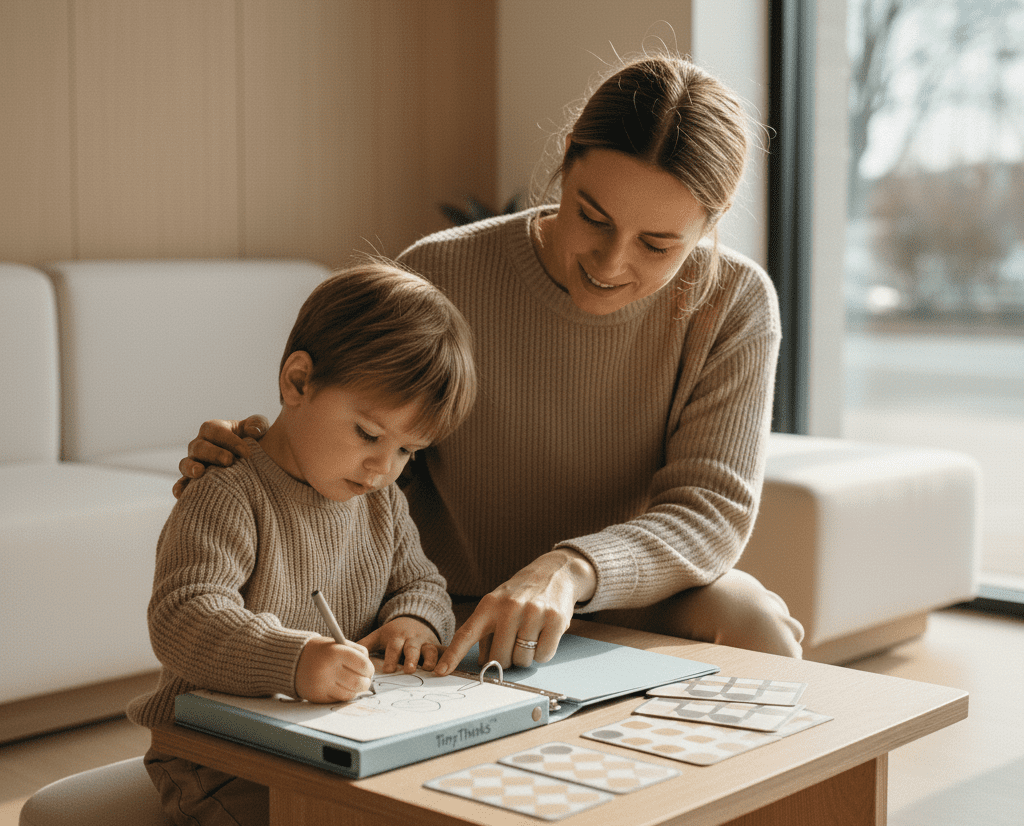
It helps to balance screen time with slower, hands-on activities. Parents who’ve swapped Cocomelon for structured activities, like Tiny Thinks™ Free Calm Pack, tend to experience increased attention, increased speech, and easier transitions.
3. The Content
Cocomelon is repetitive and easy, with familiar nursery rhymes and flashy colors. Repetition might be good for early vocab, but the more narrow the phrases, the fewer different words. Kids require rich, varied language exposure, such as questions, explanations, and new words, which only arises from authentic dialogue and open-ended play.
Songs and visuals can captivate. When there’s so much repetition, children may simply regurgitate what they are hearing, not invent. Other parents notice their kid parrots lines from the program but can’t apply language inventively in normal activities.
Workbooks, like Tiny Thinks™, strategically introduce new, soft challenges and vocabulary through playful tasks. The variety and hard thinking that screens lack are essential.
4. The Experts
Moderation and context are what child development specialists and speech therapists emphasize. Most accept that Cocomelon itself is not inherently more harmful. The concern is the extent to which screen time is substituting live engagement.
Pediatricians advocate for hands-on play, face-to-face conversation, and daily schedules with simple, predictable, calm activities to promote language development. Speech therapists recommend parents opt for interactive activities rather than passive viewing, particularly during mealtime, traveling, or other transitions.
When screens are necessary, keep them light and short. Follow with quiet, intentional play. Tiny Thinks™ solutions, particularly our Free Calm Pack and age-specific Workbooks, provide parents with realistic, screen-free alternatives kids love, nurturing language, regulation, and independent attention across daily activities.
Why calm, sit-down activities work when screens don’t?
Children are rarely bored, they are overloaded. Fast-paced screens flood the nervous system with constant stimulation while requiring children to sit still, creating internal dysregulation rather than focus.
Calm, hands-on activities work differently. They offer gentle structure without pressure, allowing children to settle at their own pace. When a child matches, traces, or completes a finite task, their brain receives predictable input instead of nonstop novelty.
This kind of slow engagement supports attention, emotional regulation, and language processing. Unlike screens, quiet sit-down activities end naturally, helping children transition without frustration or meltdowns.
Screen Time vs. Connection Time
Passive screen time, such as Cocomelon or YouTube Kids, implies that a child is primarily taking in information, vivid pictures and rapid music and language without having to reply or engage. Active connection time happens with caregivers or peers: face-to-face, with real back-and-forth exchanges, shared attention, and the small cues that build understanding.
In everyday life, this distinction can appear straightforward. A child isolated with a tablet hears tons of words, but she’s not engaging in conversation, not asking questions, and not reading faces. With an adult or sibling, they’re encouraged to respond, mimic, and experiment with their own language, abilities that influence not only speech but cognition and self-control.
This distinction helps clarify why families worried about does cocomelon delay speech are often advised to focus less on the content itself and more on increasing daily face-to-face conversation.
Research indicates that excess screen time tends to crowd out other activities. It doesn’t remove them, but it displaces play time, daily reading, and family conversation. Several of our families have said their kids are using screens for one to two hours a day, mostly TV and smartphones.
That’s not weird or embarrassing. Screens are embedded in contemporary rituals while on calls, cooking, or even simply surviving a doctor’s waiting room. When these moments accumulate, they can erode the hours kids need for social play, stories, and the small family rituals that cultivate language and confidence.
These face-to-face moments matter most for communication. Kids learn to talk, hear, and comprehend by seeing lips move, mimicking gestures, and being heard. Here’s why these moments matter:
- Kids get practice with turn-taking, waiting, and listening, which are important conversational components.
- They learn to read facial expressions and body language.
- Adults can reply to what the child is saying, riffing off of their words.
- Mistakes and mispronunciations are gently corrected in real time.
- Kids get room to inquire and experiment.
- Social play and shared stories bring in new words and contexts.
Focusing on quality, not quantity, helps change the emphasis. Even ten minutes of focused, screen-free connection at a meal, after school, or before bed can do more for language growth than hours of passive watching.
If screens are necessary, impose strict boundaries and select slower, participatory formats. If you can, trade the device for a puzzle at the table, a quick game of memory while you cook, or a collaborative story in the car.
Options such as Tiny Thinks™ Workbooks and the Free Calm Pack provide easy, soothing methods to shift focus. These are all activities meant for hands-on thinking, patterning, and soft focus. They give kids something to do, a pattern to complete, an image to align, a short story to tell, while keeping the nervous system calm.
Most parents observe that a few minutes with a Tiny Thinks™ page makes their toddler quieter, easier to engage in conversation, and less prone to tantrums for the next transition. Unlike screens, they are conversation starters, problem solvers, and the kind of give-and-take that screens lack.
For parents concerned about after-school mayhem, long waits, or dinner wars, these screen-free tools provide a convenient, flexible solution. Tiny Thinks™ Workbooks are built for these moments: no prep, no batteries, just calm, focused engagement that naturally brings out speech and social skills anywhere in your day.
How Tiny Thinks fits into this moment?
When parents want to reduce screen reliance without creating power struggles, Tiny Thinks offers a gentle bridge.
• starts easy, without pressure or rules
• uses quiet hand movements that calm the nervous system
• leads children into focused, language-friendly attention
The Overstimulation Factor

Screen entertainment, such as Cocomelon, provides continuous scenes, rapid edits, and sound effects that can overload a young child’s nervous system. For 3 to 7-year-olds, their capacity to handle rapid visual changes and high-volume noise is still maturing. With this type of rapid stimulation, a lot of kids get overstimulated.
This stimulation saturates their brain with signals at a speed they can no longer regulate. This may result in meltdowns, crankiness, difficulty paying attention, or even bursts of hyperactivity. In real life, parents often notice this right after a screen session: the child is jumpy, struggles to sit still, or seems unable to transition to quieter play. Some kids, particularly those with naturally sensitive temperaments, are more impacted by this overload.
Sensory overload manifests itself in various ways. A kid may plug their ears, request escalating screen time, or struggle to calm down for meals and sleep. Parents notice mood swings, impulsivity, or continual restlessness. In the realm of language acquisition, this condition lessens kids’ ability to listen, digest, and reply.
Their brains, instead, are busy trying to either self-soothe or come down from the flood of stimulation, rather than calmly engaging in conversational ping-pong. Research supports this. A 2019 study found a connection between excessive screen time and ADHD symptoms in children, and other studies have linked high screen use with speech delays and difficulty regulating emotions.
When kids are immersed in rapid-fire content, particularly if they’re switching from screen to screen or using multiple at once, the likelihood of behavioral problems and a poor attention span increases. Moderated exposure to the media is essential. Not all screen time is bad, but too much, particularly from shows engineered for non-stop stimulation, can displace the slow-paced, structured experiences that really develop attention span and language development.
Families that scale back on screen use frequently observe their kids transforming into much calmer, engaged, and better connected kids. It’s not about eliminating screens, per se, but about supporting kids in transitioning from high-stimulation input to quiet-focus, thinking-based activities. Easy rhythms, such as no screens at meals, quiet right before bed, and tactile play, calm the nervous system and create room for authentic connection.
To avoid overstimulation, begin with a planned smallness. Substitute one hyper-stimulating screen session a day with a quiet, tactile activity, picture matching, basic tracing or pattern games. These low-stress activities direct children back to attention and assist them in calming down during hectic times. Tiny Thinks™ Workbooks were built for this: structured, calming, and intentionally designed for gentle thinking.
Even the Free Calm Pack can change the game. Calmer parents say mealtimes lead to fewer meltdowns and better transitions in just minutes a day. Kids select these ventures because they are pleasurable, sluggish, foreseeable and gratifying, the antithesis of hyperactive digital bloat.
Tiny Thinks™ solutions provide a pragmatic, regulation-first route for parents who want to trade overstimulation for calm concentration and deeper language experiences. These workbooks meet kids right where they are, guiding them to ground themselves, think clearer, and savor peaceful daily rhythms, no screens necessary.
What a Real Delay Looks Like
What actual delay looks like. Real speech and language delays in young children exhibit certain indicators that surpass mere silence or being introverted. They emerge in a child’s use and comprehension of words, not just his verbal output. As a parent, it’s easy to stress if your kid is underachieving, but every kid marches to the beat of their own drummer. Some kids are just late bloomers, and others may require a little additional help.
For parents concerned about does cocomelon delay speech, understanding the difference between temporary quietness and a true developmental delay is essential before drawing conclusions.
It’s useful to understand what true delays look like so you can react sooner and more assuredly.
- Restricted vocabulary for age is less than 50 words at two years or not combining two-word phrases by two and a half.
- Hardly ever reaches, pokes, or attempts to sign needs.
- Difficulty following simple instructions (“Give me the ball”).
- Not responding to name, or rarely making eye contact.
- Speech indistinguishable from family at age 3.
- Lack of interest in interactive play, stories, or songs.
- Not imitating sounds, words, or actions of others.
Most toddlers speak their first word at about a year. By a year and a half, they may be using a dozen words. By age two, kids typically combine two words at a time (“more juice”) and by three, they use short sentences and can be comprehended most of the time. Preschoolers (ages four to five) should be able to tell simple stories, ask questions and follow multi-step directions.
These are coarse-grain milestones, not hard deadlines, but they assist in identifying when to request additional help.
It’s the early intervention that counts. The sooner a child receives assistance with speech and language, the better it is for his or her thinking, social, and school readiness skills. Speech therapists can customize fun, useful activities that align with your child’s personality and learning style.
Even if your kid’s delay ultimately proves mild, early support builds confidence and makes life simpler. Monitor every few months and trust your instinct. Parents often pick up subtle changes before anyone else.
Some kids may struggle with quiet toys, books, or independent play and opt for screens. Others exhibit restlessness or meltdowns when screens are down or get hyper after watching quick-cut shows. Sleep can be disturbed if stimulating material is consumed close to bedtime.
If a kid has difficulty focusing, listening, or playing peacefully, particularly post screen time, it could be an indication their nervous system is overwhelmed. These are the times that demand a turn to soothing, familiar habits.
Tiny Thinks™ Workbooks– a screen-free way to reset! The Free Calm Pack is for exactly these hard moments, after school, on the go, or bedtime, when you just need some peaceful, soft focus.
These actions employ slow, tactile reasoning and patterning to pull overstimulated kids back to focus, leading them through thinking skills, not mindless staring. You don’t need to cut screens at all. In those moments when regulation does matter, these calm packs and workbooks provide your child the structure they need to settle, think, and grow.
Creating a Healthier Media Plan
There is a way to balance screens and real-world experiences, even for families who feel trapped in the ‘one more episode’ loop. The objective isn’t screen bans but rather to establish a predictable, regulation-first media framework that aligns with your child’s needs and your family’s values, particularly if you’re concerned about speech development and attention.
A practical media plan checklist can help parents stay grounded:
- Determine screen limits for each day, such as 30 minutes or less for children aged 3 to 7, and maintain that as a family expectation.
- Select shows or apps that are slow in pace, use clear language, and have interactivity breaks. Imagine shows that encourage kids to respond to queries or describe what they observe.
- Fix screen time at the same time each day, after lunch, before bath, or another predictable slot, so that screens aren’t the default last resort during meltdowns.
- Establish “media-free” zones such as the dinner table, car rides, or the hour before bed to safeguard time for bonding and serenity.
- Offer one clear alternative before reaching for a screen: a picture-matching card, a simple tracing activity or a hands-on sorting game.
Educational and interactive content can bolster language and thinking, particularly when it’s deliberately selected. Select programs in which characters are speaking clearly, describing what they’re doing and using everyday language. Stay away from those that have constant background music, flashing colors, or rapid scene changes.
Interactive apps with story sequencing, turn-taking, or simple pattern games assist, but only when used sparingly and with adult supervision. Co-viewing is best. Stop and inquire, “What was he saying?” or “Can you explain what just happened?” These snippets of mutual focus assist kids in internalizing new vocabulary and linking language with context.
The key with limits isn’t really about getting super specific numbers. It’s about keeping screens where they belong, a part of the day, not the whole day. Use a visual timer or an easy paper schedule so kids can see when screen time begins and ends. Replace “five more minutes” negotiations with a gentle, predictable transition: “When this episode is over, we’ll do a puzzle together.
The more consistent the rule, the less negotiating and the more peaceful the transition. Talk to your child during and after screen exposure. Ask open-ended questions: “What did you notice?” “What was your favorite part?” “Could you demonstrate with your toys what occurred in the story?” These prompts transform passive watching into active thinking.
Even a quick catch-up every now and then assists kids in digesting what they’ve observed, using their new vocabulary, and bonding with you. For young children, echoing phrases, narrating play, or painting a scene from the show enriches language and memory.
When families are looking to detox from the screen or just need something mellow in a pinch, Tiny Thinks™ is an effective option. Our Free Calm Pack is packed with easy screen-free activities that reset attention, energy and inspire still thinking.
We’ve found many parents stash a Tiny Thinks™ workbook in the car, at the table, or in their bags for waiting rooms so there’s always a subtle, compelling option waiting in the wings. Each page is designed to slow the pace, spark curiosity, and invite language: matching, tracing, simple puzzles, and open questions.
These activities become mini anchors in the day, transitions are smoother, and kids settle in overstimulating moments. For parents wanting more, the age-specific workbooks provide a consistent flow of new, rule-first activities that kids sincerely love, all without the quick dopamine jolts or text saturation of most screens.
Your Role is Irreplaceable

You, as a parent, are the basis for your child’s language development, and all of this is far beyond what any screen can provide. Responsive interactions, telling stories, wondering aloud “what’s this?” on a walk, or giggling over silly rhymes, stimulate the child’s language centers in significant ways. At the dinner table, a parent’s responsive nod or inquiry following a child’s word attempt ignites an intense magic that solidifies those speech and comprehension neural pathways.
We know from research that kids whose parents talk, play and even just point out everyday objects develop more extensive vocabularies and more articulate speech. It’s not just talking at your child; it’s recognizing their cues and taking a break to wait for them to respond. This back-and-forth, even when it’s slow or imperfect, sets the foundation for real language acquisition.
That special parent-child connection is unsurpassed. No app, show, or digital activity can replicate the warmth or magic little reinforcement loop that builds when a parent meets their child’s gaze, repeats their babble, or reads a story together. One parent recounted how they used to lean on Cocomelon to babysit their little one while they worked.
Eventually, they observed their child opting for the considered, slow act of drawing or storytelling together, even if that required the parent to organize in advance or set aside their phone. These little instances, constructing a tower, inventing a tale, and following a pattern with a finger, are where kids experience being noticed and listened to. It’s this connection that makes them brave enough to experiment with new words and concepts, even if they fumble.
Long term, a great parent-child relationship benefits every aspect of growth. Research connects parental engagement not just to more advanced speech and language but to enhanced social skills, mental well-being, and academic performance. Psychologists remind us that these early years are essential for building out these executive functions, such as self-control, memory, and flexible thinking, and they flourish most through consistent, tactile, and responsive play with adults.
Juggling work, chores, and kid wrangling is hard. Parents still report that these intense moments, such as building blocks, sorting, and shape finishing of a Tiny Thinks™ page, do make a difference in their kid’s calm, attention, and willingness to talk.
For families seeking simple, screen-free ways to foster these moments, Tiny Thinks™ Workbooks and the Free Calm Pack provide a kind of soft framework. All the activities aim to slow things down, encourage dialogue and inspire independent thought, which is ideal for dinner tables, car rides or bedtime wind-down. Kids gravitate to them, and parents notice the difference.
Five minutes with you and a pattern-matching or tracing page does so much more for bonding and serenity than an hour of mindless staring at a screen. The rhythmic predictability and direct engagement of Tiny Thinks™ serve to organize the child’s nervous system and create space for language to expand.
Conclusion
So, to break down the worry surrounding Cocomelon and speech delay, let’s step away from the headlines and zero in on what actually bolsters language development. High-speed TV can fry little brains, but language evolves so much more from daily human engagement, real dialogues, and bonding moments.
Kids learn language best through conversational, back-and-forth talk, as well as play and connection, not simply watching words on a screen. Opting instead for slower, more predictable activities such as matching games, easy pattern pages, or quiet story time allows these young brains the mental real estate to soak in and practice language. Parental involvement is key. Even little swaps, such as incorporating a daily screen-free interval with hands-on activities, can assist children in calming down, concentrating, and developing their language abilities at their own pace.
Frequently Asked Questions
Does watching Cocomelon cause speech delay in children?
There’s no research that cocomelon by itself delays speech. Excessive screentime can affect language development. Interacting with kids face-to-face encourages normal speech development.
How much screen time is safe for young children?
They recommend under 1 hour a day for kids between 2 and 5. Playing with them and talking to them is better for their development.
Why is overstimulation from shows like Cocomelon a concern?
Quick-moving images and audio can overload little tots. Such overstimulation can make it more difficult for them to concentrate and absorb language, which may impact learning.
What are signs of a real speech delay?
Signs include not babbling by 12 months, no words by 18 months, or difficulty following simple directions. If you observe these, see a specialist.
Can parents help prevent speech delays?
Yes. Talking, reading, and playing with your child every day encourages good language development. Restricting passive screen time contributes as well.
What should a balanced media plan for kids include?
A quality media plan includes small amounts of screen time, very high quality content, and lots of time for talking and playing. Parent interaction is key.
Is it okay for children to watch Cocomelon sometimes?
Yes, an occasional screen fix is OK. Just make sure it doesn’t substitute for personal interaction or active play, which are essential.