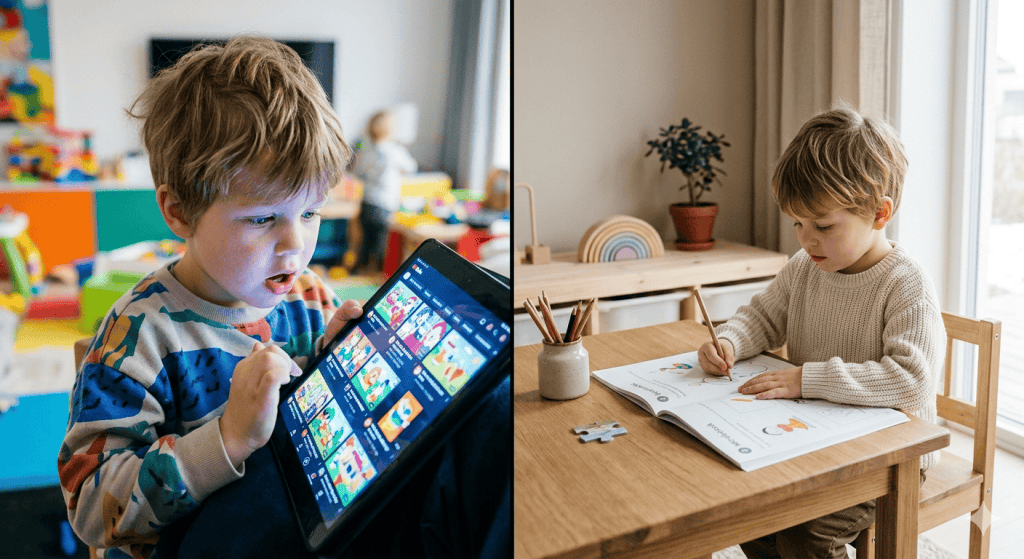
Screen time effects on kids and Screen time impacts the entire child—brain, behavior, sleep, social skills, and body—so families should be thinking beyond “how many hours” and toward how, when, and why screens are used. Excessive daily use, particularly in younger kids, is associated with attention issues, slower language development, and diminished academic performance.
Early and heavy screen exposure can disrupt healthy brain development and executive function. It can decrease attention, impact memory consolidation, and delay language and vocabulary, especially when displacing real-life conversation and hands-on play.re
Too much screen time is linked to increased behavioral problems, sleep difficulties, and physical health hazards. Kids with high screen time experienced more hyperactivity, mood changes, sleep disruption, less physical activity, and higher obesity risk, as well as greater eye strain and posture issues.
All screens are not created equal and content is just as important as quantity. Passive viewing and ‘educational’ apps with lots of noise and rewards can be especially unhelpful, while limited, high-quality interactive content and purposeful video calls can be more supportive when balanced with real-world play.Is YouTube Kids Bad? Effects on Behavior, Attention & What to Do InsteadHow to Build Thinking Skills in Kids (Ages 3–7): Focus, Logic, and LearningIs YouTube Kids Bad? Effects on Behavior, Attention & What to Do InsteadTravel Activities for 3-Year-Olds, 4-Year-Olds & Toddlers on Long Haul Flights (Screen-Free, Low-Mess Ideas That Actually Work)Is YouTube Kids Bad? Effects on Behavior, Attention & What to Do InsteadTravel Activities for 3-Year-Olds, 4-Year-Olds & Toddlers on Long Haul Flights (Screen-Free, Low-Mess Ideas That Actually Work)Montessori-Inspired Quiet Activities (At Home & On the Go)How to Build Thinking Skills in Kids (Ages 3–7): Focus, Logic, and LearningHow to Calm Kids Without Screens (Ages 3–7): Meltdowns, Overstimulation & Better RoutinesHow to Build Thinking Skills in Kids (Ages 3–7): Focus, Logic, and LearningMontessori-Inspired Quiet Activities (At Home & On the Go)Is YouTube Kids Bad? Effects on Behavior, Attention & What to Do InsteadTravel Activities for 3-Year-Olds, 4-Year-Olds & Toddlers on Long Haul Flights (Screen-Free, Low-Mess Ideas That Actually Work)Is YouTube Kids Bad? Effects on Behavior, Attention & What to Do InsteadTravel Activities for 3-Year-Olds, 4-Year-Olds & Toddlers on Long Haul Flights (Screen-Free, Low-Mess Ideas That Actually Work)Travel Activities for 3-Year-Olds, 4-Year-Olds & Toddlers on Long Haul Flights (Screen-Free, Low-Mess Ideas That Actually Work)Is YouTube Kids Bad? Effects on Behavior, Attention & What to Do Instead
Robust families around screens make a real difference. Clear rules, screen-free zones, adult modeling, and ready offline alternatives all help kids accept less screen time with fewer battles. Regular schedules combined with appealing, peaceful environments that include books, toys, and art supplies encourage independent, screen-free activity.
Calm, structured thinking play gives children practice in attention, problem-solving, and self-regulation without relying on digital stimulation. Try our Free Calm pack and shop at Tiny Thinks.
===
Screen time does not just affect how long a child is occupied. It can affect what happens when the screen turns off.
Shorter attention. Harder transitions. More irritability. Less interest in slower play.
For children ages 3 to 7, the issue is not just how much screen time they get. It is what kind of input their brain is adapting to every day. Binge video sessions are connected with reduced attention spans, reduced frustration tolerance, and more difficult transitions away from the screen.
If you're worried about screens and the future, start with the abilities children build today with paper and crayon.
Attention, persistence, confidence, and figuring things out for themselves aren't fixed traits. Children build them through thousands of small experiences they return to willingly.
Parents usually notice the pattern before they know how to name it: more “just one more,” more pushback, more difficulty settling into ordinary play.
This guide breaks down what screen time can affect in the brain, behavior, sleep, and daily rhythms — and what parents can do instead. For screen-free activities for kids ages 3-7.
How Screen Time Affects Kids
Screen time affects children differently depending on speed, intensity, timing, and what it replaces.
Fast, autoplay content pulls attention toward rapid rewards and can make slower, more effortful activities feel harder to stay with. For parents of young children, the better question is not “screens or no screens?” It is: “What is this doing to my child’s attention, mood, and daily rhythm?”
Brain development: High, fast screen use can alter attention, language growth, and executive skills.
Behavior: It is linked with inattention, emotional swings, and aggression.
Sleep: evening exposure reduces sleep quality and length.
Screen time effects on kids can displace the face-to-face practice children need for social skills.
Body: it propels sedentary patterns and physical strain.
The issue is not screen time alone. It is stimulation density.
Heavy, fast-paced screen use can give young children more practice reacting than planning.
Under 2, kids learn significantly less from video than a live person sitting beside them, and most young children don’t really comprehend what they’re looking at on a screen until well after age 2. Developmental pediatricians agree that under age 3, screen media use should remain quite low as those are crucial years for language, gesture, and back-and-forth interaction. This is essential for healthy development and emotional growth in young children.
Very early screen exposure, especially alongside constant background TV, has been associated with more language-related concerns. A TV on in the room, even if no one is ‘watching,’ reduces the quantity of words adults speak to babies and the quality of joint attention. Over time, constant background media can reduce the quality of attention and conversation in the room.
Fast digital media, having trained the brain to crave novelty on demand, makes it hard to tolerate boredom. For a young child, that might appear as scattered focus, an inability to maintain a thought, and being easily frustrated by any activity that does not immediately gratify or reward.
This is the central problem for parents: not that screens exist, but that fast, reactive input can crowd out the slower forms of attention children actually need to practice. Calm, tactile, structured work nudges firmly in the opposite direction, toward planning, memory, and sustained attention. Parents should implement strategies to manage screen time effectively to foster better study habits and emotional competence in their children.
Heavy screen use is linked with more behavior struggles, harder sleep, and less time spent in the kinds of activity young children need most.
When screens become the default pacifier deployed for every transition, every car ride, and every meal, kids can drift toward reliance. Mood swings, low frustration tolerance, and tears when the screen is removed can be signs that the child has become used to fast digital stimulation as the easiest way to settle or stay occupied.
Content counts as well. Repeated exposure to aggressive or chaotic media can normalize yelling and shoving or ‘my way or the highway’ behavior in play. When screen time crowds out reading, easy chores, or outdoor play, kids miss out on daily training in patience, learning to take turns, and completing tiny, tangible tasks.
This is where Tiny Thinks comes in, where parents need a screen replacement, not just a rule. Removing the screen without replacing the structure often makes the struggle louder.
Tiny Thinks
It provides them a trusted alternative precisely at the times behavior tends to fall apart—after school, before dinner, during an older sibling’s activity. It’s the structure that does the work, not parent willpower.
Evening screens counteract biology. Evening screen exposure can interfere with melatonin and make it harder for children to wind down for sleep. When kids use their devices at bedtime, it delays sleep and makes it more difficult to fall asleep. That includes really young kids.
Screen exposure later in the day has been linked with shorter and lower-quality sleep, even in very young children. As children age, excessive daily screen time tends to be associated with chronic sleep deprivation, drowsiness during the day, and grouchy mornings.
Poor sleep then loops back into attention and emotion: a tired brain is more reactive, less patient, and less able to manage disappointment. What looks like bedtime resistance is sometimes an overtired, overstimulated system struggling to downshift.
For most families, an efficient, low-stimulation wind-down routine is the lowest-hanging fruit fix. This is where a low-stimulation wind-down routine matters most: no light, no sound, no autoplay, just something calm enough for the brain to stay with.
Get Free Calm Pack from Tiny Thinks to work with our sample screen replacement solution.
4. The Social Skills
High screen use cuts into the single most important social activity for young children: live, face-to-face conversation. Time spent on screens can displace the face-to-face interaction young children still need most: conversation, pretend play, turn-taking, and shared attention.
Over time, this can present as inferior communication skills and less practice interpreting facial expressions, tone, and other subtle social cues. Some children also become less comfortable with quiet, waiting, or unstructured social time when every idle moment is filled for them.
Structured, screen-free activities assist here by carving out common, low-stakes experiences. Child and caregiver quietly sit side by side on a serene page or easy pattern, receiving thinking exercises and organic opportunities to converse. Structured screen-free activities can support this by creating low-pressure moments for side-by-side conversation and shared focus.
Heavy screen use can pull children into long stretches of stillness that replace movement, outdoor time, and physical play. This can lead to excessive screen time and invite the dangers of obesity and other health issues when it becomes a default rhythm. Less running, climbing, and balancing means fewer opportunities for young children to develop strength, coordination, and confidence in their bodies.
Eyes and posture suffer from extended screen usage. This excessive screen time can cause eye strain and headaches, influencing visual system development. Slumped positions on the couch or bed while using devices can lead to discomfort in the neck, back, and shoulders, even in young kids.
Time away from screens, particularly in nature—such as walks in the park or plants in the classroom—can alleviate some of these negative effects. Time outdoors can help children regulate after long periods of indoor, high-stimulation input.
Tiny Thinks employs this same gentle reset principle. The workbooks themselves are screen-free and low-stimulation so that you can bring them to the table, a waiting room, or on a train without creating additional visual noise. Parents frequently begin with the Free Calm Pack to gauge their child’s reaction.
When parents find an offline activity that their child can return to calmly, it becomes far easier to reduce screens without a fight.
Not All Screens Are Equal
Screen time effects depend far more on what a child is doing, when they are doing it, and what it replaces, than on a straightforward daily hour tally. This is not a simple “good screens vs bad screens” issue. What matters is pace, purpose, and what the screen is replacing.
Parents do well when they track both duration and quality. They should consider what type of input is used, at what speed, and instead of which offline experience.
Not all screens are equal, but fast passive content is usually the hardest on young attention.
Limited; older children may gain some inspiration or information
Passive Viewing
Passive viewing is when a child just absorbs content: television, video platforms, endless cartoons. The child may look engaged, but passive viewing asks very little of them in return. Over time, this can train the brain to expect constant stimulation instead of generating its own next step.
Multiple studies associate extended hours of passive viewing with language delay and reductions in early literacy, particularly in children under 3. Dangers escalate when screen time starts before 12 months and when background television blasts while toddlers play. In one study, infants took approximately twice as long to learn or imitate an action from video as from an in-person demonstration, illustrating how much more efficiently young brains learn from real people.
Background TV is especially disruptive. Even if a child appears to disregard it, language acquisition falters, particularly for kids listening to a second tongue. One path of research demonstrates that TV in English while a child plays in another home language can disrupt both languages simultaneously.
The bigger problem is what passive viewing replaces: shared reading, pretend play, movement, and quiet focus tasks that actually build attention. When weekends tip toward extended entertainment binges, the results are frequently more damaging than weekday use, which is usually briefer and more “educational.” Time outside can help offset some of that load by restoring movement, attention, and sensory balance.
Interactive Play
Not all screen media use is equal. Bad apps hammer the pace, interrupt, fragment attention, and don’t let a step linger in mind. Interactive screen use can be less disruptive when it is slower, limited, and shared with an adult.
Most “educational” apps aren’t built around how young kids actually learn. They combine quick hits of reward, bright animations, and ever-moving levels. That keeps kids hooked but does little for deep skills. Parents do best when they seek out easy interfaces, obvious goals, and no autoplay. They should regard screen-based problem-solving as a mini practice session instead of the main event, as excessive screen time can hinder cognitive development.
For kids ages 3–7, interactive screens belong alongside hands-on play, not ahead of it. Puzzles, drawing, lining up things, and building block sequences are where attention spans, frustration tolerance, and fine motor control truly bloom. While screens can model a skill, the actual skill is constructed in the real world, emphasizing the importance of limiting screen time to foster healthy development.
The real skill still has to be built off-screen. A child may see a pattern on a screen, but they learn to stay with it in the real world. When a kid is accustomed to quick hits and swipes, they tend to rebel against slower work unless the format seems explicit and conquerable. Tiny Thinks pages are intentionally low-stimulation, with stepwise patterns, minimal visual cues, and one task per area. They provide the same “I know what to do next” sensation as a game level without the pace or noise, promoting good screen behavior.
For numerous families, the Free Calm Pack remains the initial trial. Parents print a few pages, keep them near the table or in a bag, and offer them at the usual pressure points: after school, during dinner prep, and twenty minutes before bed. Kids find they can calm down, trace a line, complete a pattern, or finish a mini-sequence screen-free. Once that works, age-based Workbooks apply the same structure: more steps and slightly longer sequences while remaining silent and predictable, so the child’s focus expands without resistance.
Video calls occupy a different space. They’re still screens, but the essential action is conversation, not consumption. When a toddler chats with a grandparent down the street, rehearses their hello, displays their drawing and hears a tale, they’re practicing language, social timing and emotion reading live.
Research on language development finds that “educational” content matters most when an adult is actually in the room interacting. Applied here, a brief, scaffolded video chat with a parent facilitating turn-taking and keeping the call concrete can provide more language exercises than yet another show.
Video calls best serve as a relationship tool, not a parking lot. When parents treat them like a visit — short, sweet, with an arrival and departure — kids learn they’re for connection, not wallpaper. Not for social development, they still shouldn’t supplant in-person time at the park, at school, or with siblings, but they do keep shut bonds from dissolving.
Video calls are closer to conversation than consumption. The important thing is to keep them purposeful, brief, and connected to real interaction before or after. Not all screens are equal. After a call, many parents find their kid amped up but scattered. When you have a Calm Pack page waiting, a calm path to trace, a small pattern to copy, a quiet seek-and-find, it gives your nervous system somewhere to land. The kid transitions from social buzz to quiet, orderly cognition. No other digital fix is necessary.
The Hidden Costs of “Educational” Apps
A lot of “educational” apps pledge smarter, calmer, more focused kids. The reality on the ground in most homes looks different: more negotiating, more scattered attention, and less time for the slow, boring-looking activities that actually build thinking.
Many apps designed for very young children have little or no independent research supporting them. Tags like “STEM,” “brain training,” or “curriculum-based” are comforting to hear, but usually translate to the app simply having letters, numbers, or puzzles packaged in a rapid, game-like interface. The education veneer is shallow.
Many of these apps reward speed, repetition, and novelty more than reflection. Parents witness this when a kid can finish app levels, but cannot linger with a simple puzzle, drawing assignment, or rudimentary pre-reading activity without becoming upset.
Deep use of even “good” apps displaces the experiences that consistently foster language, problem-solving, and social skills. Screen time frequently displaces time spent outside, in motion, and engaging in eye-to-eye conversations with siblings or an adult. Those who clocked more screen time read less, did fewer household chores, and helped out less.
That, over time, propels them into a more sedentary lifestyle with increased risk for obesity and associated health issues, particularly when daily viewing exceeds roughly one and a half h ours of video content. In early childhood, hands-on, slower activities still do more of the real developmental work.
Play with blocks is associated with more robust language development since it requires a child to plan, sequence, and describe what they’re constructing. Reading with an adult, even for brief periods, is potent, and children of college-educated parents are more likely to become avid readers partially because those households tend to guard book time.
When screens encroach that space, grades can slide, and there are reliable associations between early media saturation and diminished cognitive achievement in toddlers. There is another quiet risk: content drift. Even within “educational” environments, kids can rapidly access more intense or older content, such as violent games and videos.
That exposure is linked to more aggressive play and decreased empathy. The American Academy of Pediatrics is clear for the youngest ages: under 2 years old, use only high-quality media and only with active adult engagement. This is the gap calm, structured thinking play can fill.
The brand does not treat screens as a failure. It treats them as one tool among many and focuses on what children are missing around them: slow, structured, tactile thinking. So for parents who are finding that these “learning apps” are simply not turning into calmer behavior or better focus, Tiny Thinks™ provides a substitute layer, not a sermon.
The Free Calm Pack is the easiest starting point. Parents use it in the same pressure moments where they might otherwise hand over a phone: after school, at the table, in a waiting room, before bed. The pages are intentionally low-stimulation: clear lines, simple patterns, tiny but achievable tasks.
A kid traces a path, matches a picture, and completes a two-step pattern. The pace changes. Attention settles. The child has something slower to stay with.
They foster attention span, working memory, and frustration tolerance with scalable, repeatable, predictable pages a child can begin independently and revisit without encouragement. No sound effects, no autoplay, no infinite scroll—just a calm, predictable solution parents can count on when they need their child calm and engaged.
Reclaiming Childhood from Screens
Screen media use is already interwoven with daily life, so the question isn’t ‘screens or no screens,’ but how to manage screen time for kids to protect their attention, sleep, and temperament while embracing technology.
The deeper risk is not screens alone. It is a daily rhythm built around novelty, reward, and instant relief.
Tiny Thinks
Determine daily screen limits by age and be consistent.
Guard at least 1 hour before bedtime as completely screen free.
Leave bedrooms and the dinner table screen-free zones for adults and children.
Offer ready, low-stimulation alternatives: books, puzzles, drawing, and simple building.
Use nature time as a daily or weekly mood and focus reset.
Audit your phone habits at meals, in lines, and prior to bed.
Most advice focuses on screen time limits. Very little focuses on replacement.
Tiny Thinks
Set Boundaries
Treat screens like any other powerful tool: clear rules and predictable use. Under 2, avoid personal screens completely aside from the occasional video call to extended family. For 2 to 5 year olds, most families limit use to about 30 to 60 minutes per day, prefer slow, non-autoplay content, and eschew background TV.
From 6 to 7, a few sprinkle in controlled game or video time linked to consistent schedules, with a minimum of 1 solid screen break per day. Bedtime needs special protection: all handheld screens away at least 1 hour before sleep to support deep rest and healthy brain development.
Use device settings and parental controls so you never have to haggle daily. Disable autoplay, remove distracting apps from easy reach on school days, and impose daily limits so the system closes the session, not you.
Anchor screen time to clear conditions: after homework, after simple chores, or after outdoor play. Children usually handle boundaries better when they already know when screens happen, how long they last, and what comes next. Talk openly about what is okay: slow stories, nature videos, calm games, and what is not: endless shorts, jump-cut cartoons, and content that spikes them into a “can’t stop” state.
Create Zones
Physical space often shapes behavior faster than repeated reminders do. Screen-free bedrooms guard sleep and minimize secret late-night scrolling as children age. No phones or iPads, adult or child, at the dining tables guard conversation and appetite control.
Stock one or two quiet corners with accessible books, wooden blocks, primary art supplies, and simple puzzles. When a child enters a room, the offline alternative should be easier to start than asking for a screen.
Visual reminders help younger kids remember: a simple door sign for “no screens here,” or a picture chart that shows “living room: yes with parent,” “bedroom: no,” “kitchen table: no.” Get the entire family on board in removing devices from these areas so children realize the rules are shared, not imposed upon them.
Model Behavior
Children learn from what adults reach for in boredom, stress, and waiting. When they glance at their phone during every meal or bring it to bed, kids pick up that perpetual digital stimulation is the default, particularly when the brain most needs to decompress. If every pause gets filled by a phone, children learn that stillness is something to escape.
Pick some anchor times — mealtimes, the initial 30 minutes after work, the hour before you go to bed — and commit to light or no phone usage. Leave the device in a different room if necessary. Brief, in-person check-ins within these windows accomplish more regulation than extended “quality time” that never occurs.
Show your child what “bored but okay” looks like: you sit, look out a window, jot a list, or pick up a physical book. These mini-experiences show that you don’t need a screen whenever your mind is bored or uneasy.
Offer Alternatives
Simple puzzles and matching games
Drawing, tracing, sticker books, and fundamental cutting tasks
Building with blocks, magnetic tiles, or household objects
Picture books, wordless books, and calm story listening
Daily time outside dramatically diminishes screen pull. Walk to a park, collect leaves or stones, visit any patch of green. It can help interrupt the fast reward pattern that screen-heavy routines often reinforce. One extensive research study involving 1,469 adolescents discovered that increased exposure to nature was associated with reduced levels of internet addiction. The same pattern holds true for younger children.
Digital tools need not be the foe in this new world. A simple photo app that lets a child take pictures of plants, clouds, or bugs, then construct a little “nature album,” fuses technology with attention to the real world rather than distraction away from it.
This is where Tiny Thinks comes in. For after-school crashes, transition battles, restaurant waits, and bedtime wind-down, parents need something their kid will initiate solo and submerge in, without fluorescent colors or music.
The Tiny Thinks Free Calm Pack provides printable, low-stimulation thinking pages that include matching, sequencing, and quiet pattern work. These activities extract a child from the rapid-dopamine cycle and into slow attention.
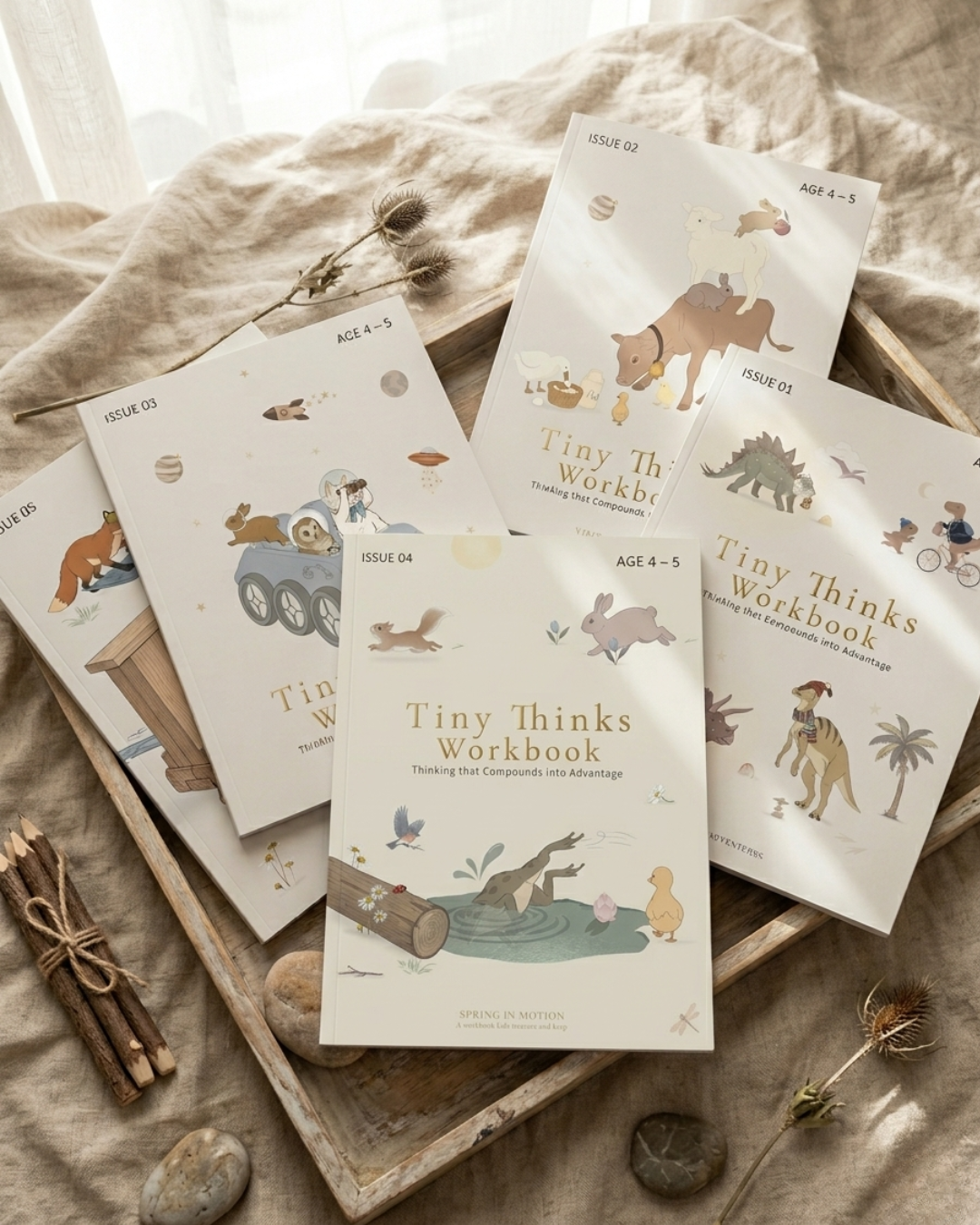
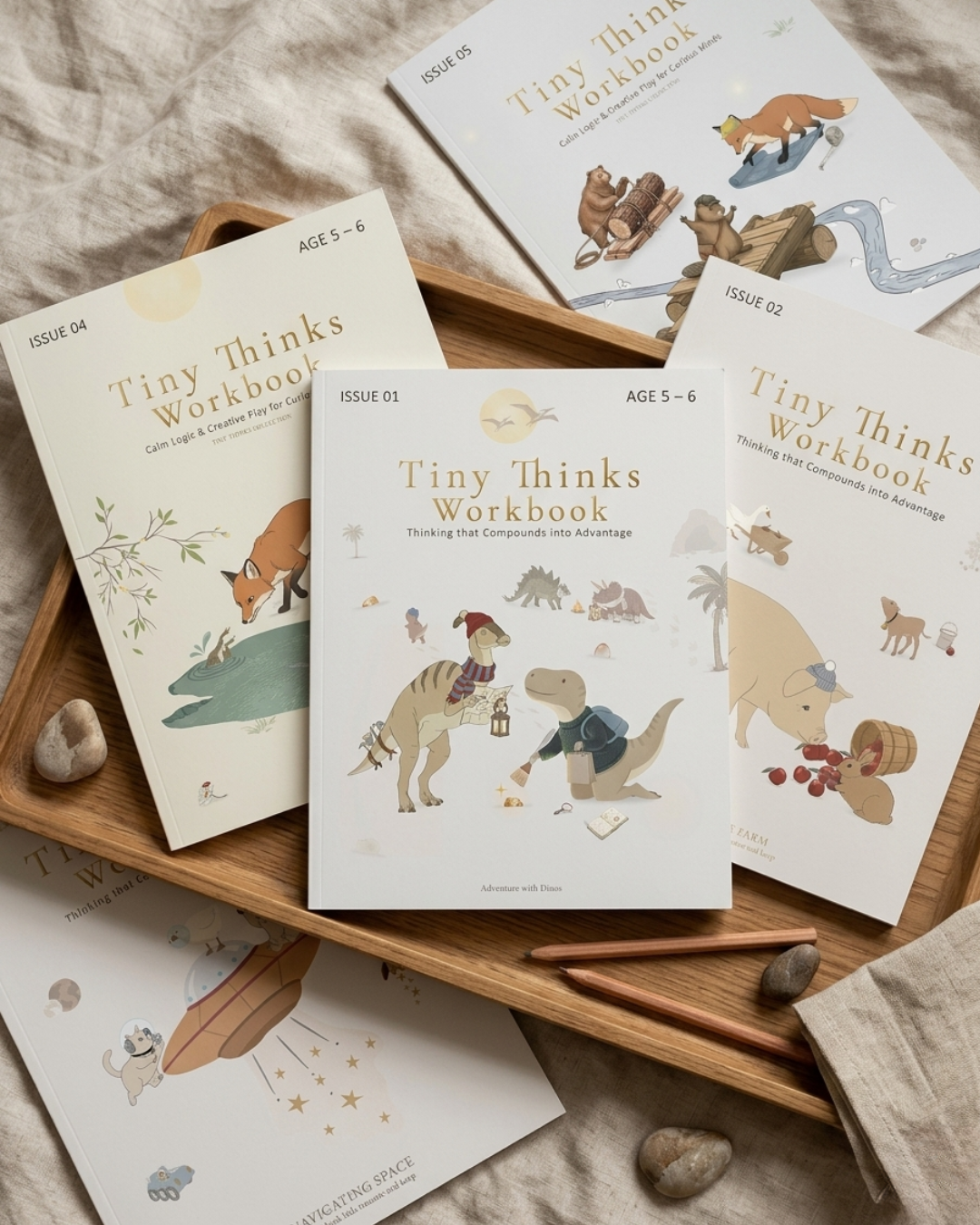
As the years progress, most families supplement with age-specific Tiny Thinks Workbooks for kids 3 to 7 years. These maintain the same serene, Scandinavian aesthetic and reliable format, so children can come back to them each day, a ritual, not a treat.
The goal is simple: when the instinct is to reach for a screen, there is already a calmer alternative within reach.
Thinking play is any calm, hands-on activity that asks a child to notice, remember, compare, decide, and stay with a task. It works in the opposite direction of autoplay. Rather than dragging the child ahead with quick newness, it encourages the child to exercise their mind gradually.
Thinking play helps children practice focus, problem-solving, and self-regulation because it keeps the nervous system calm enough to think.
Tiny Thinks
When your preschooler traces a path, completes a picture pattern, or matches shapes across a page, they are not “doing a worksheet.” They are figuring out how to stick with a mini-challenge, keep information in mind, and try again when they mess up.
That’s the foundation for crucial thinking later: stay with the problem, don’t panic, and test another path. Calm, screen-free activities are excellent supports for brain development and self-regulation because the input is easy and predictable. A silent labyrinth, a picture series to arrange, and a little “locate and encircle” activity provide just the right amount of excitement to involve without overwhelming.
Play has long been vital in developing the mind — fortifying not only problem-solving but creative and flexible thinking. Different types of play do this in different ways: imaginative play stretches symbolic thinking, constructive play like building or completing visual patterns strengthens planning and spatial reasoning, and rule-based games train impulse control and turn-taking.
When these types of play stay low-noise and tactile, kids can self-regulate while they learn. Structured thinking play inhabits the middle ground between free play and teaching. It’s not inflexible, but it is focused. This type of play reliably bolsters language, early math skills, and social skills. A child explaining how they cracked a matching puzzle is using sequencing and vocabulary.
A kid counting out steps in a hopscotch grid is practicing primitive math. Repeated micro-victories in these activities foster the very executive functions that support reading, writing, and group collaboration. Why does it matter that play-based learning makes you a better thinker?
Tiny Thinks™ takes these principles and converts them into a stable, repeatable system for daily life. Its assumption is parents are already screen thoughtful and it employs no moral framing. Screens are a tool. Tiny Thinks is the calmer replacement when the pace has become too fast.
In real moments—after school, during a screen transition, at a restaurant table, in a waiting room, before bed—the Free Calm Pack gives a child something specific to do: one page, one clear task, one small sequence. In real life, the shift many parents want is simple: less scanning, less restlessness, more time staying with one thing.
From there, age-specific Tiny Thinks™ Workbooks apply the same principle. They provide tranquil, rhythmic pages that kids can begin on their own, track without continual adult assistance, and revisit at will. Over time, this creates a habit: when a child feels bored, restless, or overstimulated, they reach for thinking play instead of more fast input.
It’s this habit that, in fact, shields concentration, cognitive adaptability, and even lifelong inventiveness well past toddlerhood.
Your Screen-Free Action Plan
Action here is simple: protect attention, protect sleep, protect real-world practice of thinking and relating. Screens can remain in the toolkit, but you architect the scaffolding around them.
Start by deciding when screens fit into your day, instead of letting them fill every gap by default.
screen-free mornings, so attention has a slower start
No screens in the 60 to 90 minutes before bed because pre-sleep screen use is highly correlated with lighter sleep and more anxious, irritable behavior the following day.
clear, short screen blocks instead of open‑ended autoplay spirals
Quality matters as much as quantity. A 20-minute, serene, educational show viewed with you and discussed is very different from 20 minutes of rapid, algorithmic clips. Some even find language delays when very young children start passive screen use before 12 months, particularly in the absence of back-and-forth conversation.
Screens that encourage conversation, turn taking, or puzzles are more benign than quick hit, fragmented content that overwhelms their nervous system. Pair screen limits with outdoor time whenever possible.Time outdoors, even at a small park or courtyard, helps undo the toll of extended sitting and intense, rapid images.
In addition to the reduced anxiety, exposure to nature is associated with better confidence and a more positive sense of self, particularly in older children and teens. For 3–7 year olds, you experience fewer tantrums, more inquisitiveness, and easier sleep.
A simple, printable daily guide can help:
Age (years)
Daily recreational screens
crucial screen-free anchors
3–4
0–45 minutes
Outdoor play, simple board games, drawing, pretend play
5–7
0–60 minutes
Reading together, building toys, calm puzzles, nature walks
Guard spaces and minutes. No devices at the dinner table, bedrooms remain screen-free. This opens room for language, empathy, and conflict exercises that no app can substitute. Parents’ behavior silently determines the maximum limit here.
If you park your own phone at the dinner table and before bed, your kid views that as the norm, not a special exception just for them. Tiny Thinks™ exists exactly for the high-friction windows where you might otherwise reach for a phone: after school, while you cook, on a flight, in a waiting room, at bedtime wind-down.
A practical replacement works best when it is ready before you need it. Keep a calm, screen-free option in the places where screens usually win: the kitchen, the car, the waiting room, and bedtime spaces.The Free Calm Pack gives you printable, low-stimulation thinking pages you can keep in a folder or bag: picture matches, simple sequences, visual patterns. They’re meant to be self-starting and repeatable, so your kid can ground himself in them without you hovering.
When you want a deeper, steadier system, age-based Tiny Thinks™ Workbooks extend the same calm structure across weeks. They feature consistent layouts, slowly increasing challenges, and lots of built-in “small wins” that stretch attention and working memory without overwhelm.
Keep the plan visible. A simple paper tracker can help children see that screen-free mornings, outdoor time, and calm play are part of the normal rhythm of the week.
Conclusion
Screens are now part of childhood. The question is whether they set the pace of childhood by default.
Fast, passive input trains the brain to expect more stimulation. Slow, tactile, repeatable activity trains the brain to stay.
The real shift is not moral. It is practical: less passive consumption, more active thinking. The transition is from passive, rapid consumption to active, slow thinking. Parents who see screens as one tool in a toolbox and who defend daily sanctuaries of quiet, structured play tend to enjoy more concentration, less tantrums, and simpler transitions.
Little, persistent changes are what count. A consistent, replicable after-school or pre-bedtime ritual can provide a child’s nervous system a regular reset and rebuild the kind of attention young children only get by practicing it.
A flight, a café, a rainy afternoon, cozy evenings. Children are always practicing something.
In these everyday moments, children are practicing attention, persistence, confidence, and figuring things out for themselves. Tiny Thinks Workbook series gives them shapes how they approach challenges later.
For children ages 2 to 5, many pediatric guidelines suggest keeping recreational screen time limited and high quality. What matters most is the full picture: sleep, movement, conversation, and offline play.
Does screen time really affect my child’s brain and behavior?
Yes. Excessive screen time impacts focus, mood, sleep, and self-regulation. Fast apps and videos can overwhelm the brain, leading to negative effects on cognitive development and emotional skills, particularly in younger children.
Are educational apps actually good for my child?
Some apps are useful, while many “educational” ones overpromise. If there are excessive ads, rewards, and noise, the learning is likely minimal. Choose slow, ad-free apps that promote cognitive development, problem solving, and parent-child interaction.
Is video chatting with family counted as harmful screen time?
Video chatting with relatives is a good screen time use that promotes social and language skills. To encourage healthy development, keep calls age-appropriate and limit excessive screen time, ensuring that screens don’t replace offline connection and play.
How can I reduce my child’s screen time without daily battles?
Begin gradually by establishing firm rules and limiting screen time use, especially by banning screens from bedrooms and promoting screen-free habits during meal times. Offer engaging alternatives such as outdoor play, building toys, art, or reading together to support healthy development.
What is “thinking play,” and why does it matter more than screen time?
Thinking play includes anything that encourages young children to pretend, construct, and investigate, such as blocks, puzzles, and drawing. This type of play promotes imagination and attention, contrasting sharply with excessive screen time use.
How can I tell if my child’s screen use is becoming a problem?
Signs that screen use may be becoming a problem include strong distress when screens are removed, sleep disruption, constant requests for more screen time, and reduced interest in offline activities.
Each age bundle includes five themed workbooks built around The Pre-Seven Learning Method™ — a progressive screen-free system for attention, persistence, reasoning, planning, independent thinking, and creativity before age seven.
Ages 3–4
The Attention Architect
For the child beginning to sit, notice, match, sequence and finish short thinking tasks.