
Key Takeaways
- Toddlers are resistant to change because they don’t yet have the cognitive and emotional tools to deal with transitions. That resistance turns into anxiety and behavior struggles.
- Paying attention to your child’s cues, whether they be body language or verbal, lets you know how comfortable they are and when they are having a hard transition.
- When we put in place predictable routines with visual cues, such as picture schedules or transition songs, the changes become less overwhelming.
- Sensory tools, play, and straightforward communication provide tangible methods to assist toddlers through tough transition moments.
- As a parent, it is your job to be patient, emotionally reassuring, and physically engaged, which makes your toddler feel secure and ready for the transition.
- If transition struggles linger or impair daily functioning, don’t hesitate to consult with clinicians or support communities for advice customized to your child’s individual needs.
Tiny Thinks provides calm, structured thinking play that children naturally enjoy and return to regularly. For immediate relief during difficult daily transitions, download the Free Calm Pack
.
Toddler transition struggles detail the everyday battles kids 3-7 encounter when transitioning between activities or routines, like play to meals or outside time to nap.
These moments are where meltdowns, clinginess, or resistance are often set off. Sensory overload, faulty schedules, and hectic environments can further exacerbate these struggles.
Knowing the root regulation need equips parents to orchestrate more peaceful, less arduous transitions and establish a reliable pattern to the daily struggle.
Why Toddlers Resist Change
Toddler transition struggles often intensify when a child is deeply focused and suddenly asked to switch activities without warning.
Change is difficult for toddlers. Their days are full of small transitions: leaving the playground, sitting at the table, putting away toys, and heading to bed. To children ages 3-7, every switch demands a ton from their not-yet fully developed brains and bodies.
Here’s a table of the most common reasons toddlers resist change, so parents can see these struggles are both common and understandable.
|
Reason for Resistance |
Explanation |
|---|---|
|
Deep Focus in Current Activity |
Toddlers get absorbed in play and struggle to shift gears. |
|
Overwhelm and Anxiety |
New situations or ending a loved activity can spike anxiety and discomfort. |
|
Emotional Regulation Limits |
Toddlers’ brains aren’t yet wired to manage strong feelings during transitions. |
|
Sensory Processing Difficulties |
Loud, bright, or sudden changes can overwhelm children, making transitions even harder. |
|
Lack of Preparation |
Abrupt changes without warning leave toddlers unprepared and resistant. |
|
Natural Developmental Struggle |
Learning to move between activities is a normal, bumpy process for this age. |
Transitions tend to create anxiety and resistance because young children thrive on routine for a sense of security. Even transitioning from one joyful experience to another can trigger tears, not because they dislike the latter, but because ceasing their current action is jarring.
For instance, a four year old lost in blocks might have a meltdown at lunch call, even if they love lunch. Toddlers don’t have the cognitive skills to parse out “what’s next” themselves. Their recollection of adoring a subsequent activity cannot compete with the anguish of being yanked away now.
This is particularly true for kids who focus deeply or hard focused kids. The brain’s executive function, the portion that allows us to pause, plan, and switch direction, is still in heavy construction in early childhood. Emotional regulation issues are everywhere. A lot of toddlers just don’t want to stop what they’re doing, and their limited impulse control converts frustration into tears, foot dragging, or tantrums.
These aren’t “bad behaviors.” They’re expressions of an developing nervous system, particularly if transitions are accompanied by startling noise, chaotic rushing, or too many simultaneous demands. For these kids, small changes can feel physically overwhelming.
Parents tend to observe more pushback when transitions are hurried or sudden. Warnings, countdowns, and straightforward bridging statements (“Five more minutes, then we clean up”) can help give toddlers time to prepare. Still, even with prep, some pushback is to be expected. It’s just a stage, not an indication parents are failing.
Supporting smoother transitions means providing familiar, soothing activities that assist kids in redirecting their energy more easily. Grounded, screen-free resources, such as the Tiny Thinks™ Free Calm Pack, provide kids something tangible to occupy those hands and minds when it gets rough.
The Tiny Thinks™ Workbooks, for ages 3-7, provide simple, step by step activities that ground attention and prevent overwhelm. Kids adore the silent predictability, and parents get to witness fewer mini meltdowns at dinner, in the car, and after school. They’re more than educational; they’re pragmatic in between activity buffers, softening transitions and cultivating the cognitive skills that make change feel safer.
For a full list of alternatives to screens, check the core guide on screen-free activities.
Decoding Your Toddler’s Signals
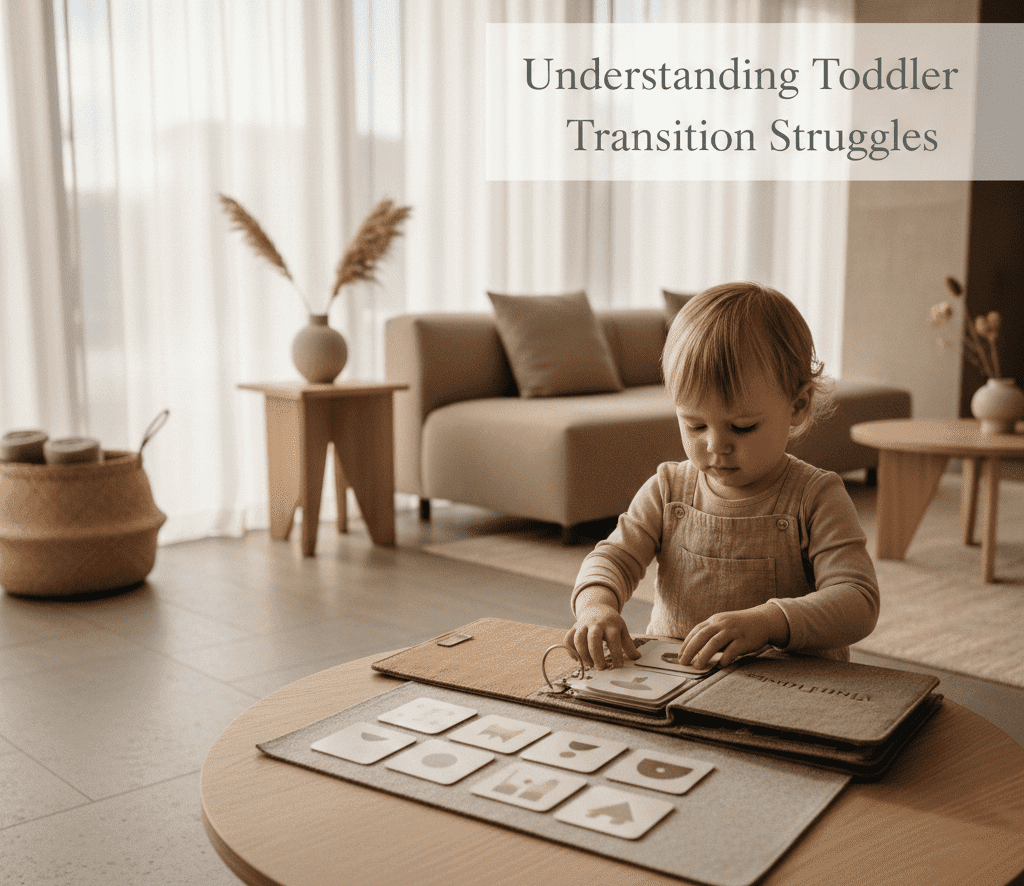
It’s about knowing what toddlers are saying to us during transitions that can help them feel safe. Most kids aged three to seven exhibit their stress in subtle ways that can easily be overlooked if you’re rushing from one thing to the next. This age group is still developing their language and emotional intelligence, so their signals are almost never direct.
Tiny Thinks provides calm, structured thinking play that children naturally enjoy and return to regularly.
Observe your child’s body language and facial behaviors to gauge their comfort level during transitions.
Body language is the original language of toddlers. You could experience your toddler clinging, turning away, or tensing at the shoulders immediately before a new activity or departing the playground. Fidgeting, hiding behind a parent, or quick bursts of energy can all be symptoms of distress.
A furrowed brow or pursed lips often precedes a protest or meltdown. Become a silent witness and observe if your toddler’s breath accelerates, their hands fist, or they tense up as a warning system for overwhelm. These signals are red flags that a shift, even something as basic as going to the dinner table or preparing for bed, is overwhelming.
Listen for verbal cues that indicate your toddler’s feelings about upcoming changes or activities.
Little ones may not have the correct language, but their attitude, shoutiness, and insistence say everything. You’ll frequently get, “No!” or “I don’t want to!” as an impending transition approaches. Even quiet or mumbling can indicate your child is concerned.
Others, like my little pup, pose the same question repeatedly, “Do we have to go?” That’s their internal Morse code for ‘reassurance please.’ Parents will recognize whining, parroting, or shifting the topic, all glimpses into their internal universe. The trick is hearing the need, not the words.
Tiny Thinks is the calm, structured thinking play system for ages 3–7 that families use whenever screens create problems and whenever parents are concerned about screen time. Get the Free Calm Pack to support your child’s transition from school or screen time.
Monitor behavioral patterns that signal stress or discomfort, such as withdrawal or aggression.
Transition struggles usually manifest as tantrums, hitting, or flat out defiance. These are not simply “bad” behaviors but indications that your child is overwhelmed and without the language to articulate it.
Between 1 and 3, asserting independence, boundary testing, and dealing with new emotions are all par for the course. Fear of new foods, sleep pushback, and even potty training relational regression tend to peak around transitions or major life shifts. Stepping back and recognizing these patterns as communication, not defiance, helps you respond with empathy instead of frustration.
Use consistent routines to help your child communicate their needs effectively during transition moments.
Routines that can be counted on make kids feel like they’re in control. Easy signs such as a lullaby before bed, an after school schedule on the wall, or a park departure announcement two minutes in advance allow kids to know what to expect.
Routines help little ones communicate their needs, such as “I need my bear before sleep,” and be brave enough to experiment. Over the long haul, reliability reinforces emotional development, even when life spins out of control.
Tiny Thinks™ Workbooks and theFree Calm Pack are made for these moments, specifically for 3-7 year olds. These calm, rhythmical activities assist kids in organizing their thoughts, calming their bodies, and communicating emotionally in a screen-free manner.
When kids have a known, soothing activity, whether it is picture matching or pattern tracing, they feel more grounded and transitions go easier. Tiny Thinks™ gives parents a reliable, portable tool for daily routines: dinner, travel, after school, or bedtime.
It is a kind invitation to self-led play and emotional stamina, embracing kiddos in the moment and re centering peace for the entire family.
Master These Transition Strategies
Toddler transition struggles occur at ages 3-7 when kids are just beginning to learn how to manage their emotions and behavior in our speed-driven, overstimulated culture. Transitions, such as going from breakfast to getting dressed or playtime to dinner, happen dozens of times throughout the day.
Too often these moments turn into battlegrounds, not because children are defiant, but because their nervous systems hunger for predictability and slow input, not sudden shifts or multitasking. If not planned and structured clearly, transitions can spark confusion, resistance, and meltdowns, particularly for kids who haven’t yet learned sequencing or how to regulate their emotions.
The strategies below are inspired by proven, regulation-first approaches that actually work in the moment, defusing chaos and developing lasting skills. For families seeking screen-free, soothing solutions, these strategies organically flow to Tiny Thinks™, purposeful, age-specific workbooks, and the Free Calm Pack, crafted for concentration and soft transitions.
- Establish predictable routines anchored by visual or tactile cues
- Employ visual schedules and transition objects.
- Prepare children for changes with simple warnings and countdowns
- Offer sensory breaks and calming tools to support regulation
- Turn transitions into playful, engaging activities
- Communicate expectations clearly and validate feelings
1. Visual Cues
They’re masters of transition strategies. A simple picture schedule, with familiar icons or photos, helps kids know what to expect throughout their day. Make it colorful and interactive.
Have your child move a marker or sticker as activities complete. To some, a transition song or hand clap rhythm announces transition more effectively than words. If your child is nervous about leaving the playground, give him or her something concrete, such as a beloved small toy or a transition stone, to carry on the walk home.
These cues help time become concrete and minimize surprise or confusion.
2. Predictable Routines
Routines are the secret sauce to transition mastery. Establish consistent meal, play, and sleep times. Prior to each transition, employ a timer or visual countdown.
Kids under five can’t multitask, so cues like ‘five more minutes’ allow them to mentally prepare. With positive reinforcement, a high five or sticker rewards cooperation. When bringing in something new, tweak the schedule incrementally so change doesn’t seem daunting.
Routines become internalized and transitions get easier over time.
3. Sensory Tools
Others young children require sensory input to reset between activities. Provide playdough, water, or sand trays at tricky times. If your child gets overstimulated easily, this guide breaks down low-noise, low-mess calm play ideas. Fidget toys or soft stress balls can soothe nervous fingers.
Movement helps too: a quick trampoline jump or animal walk releases pent-up energy. Master these transition strategies. These tools cultivate emotional regulation and help them shift gears more calmly.
4. Playful Engagement
Working wonders is making transitions into games. Sing some silly ‘getting ready’ song. Imagine you’re venturers on to the next quest.
If your kid has a favorite stuffed animal, let it take the helm. These fun traditions make change less painful and promote engagement, particularly for kids who hate sudden transitions.
5. Clear Communication
Explain transitions in simple, direct language: “First we clean up, then we eat.” Give warnings a few minutes in advance, so shifts aren’t abrupt. Validate your child’s emotions.
Hey buddy, I know it’s hard to stop playing, but we’ll do it again tomorrow.” Recognize and commend their work with positive reinforcement. The more they feel understood and that you’ve validated their experience as real, the less they’re going to resist or melt down.
Tiny Thinks™ Workbooks, like the Free Calm Pack, are uniquely designed for these moments, providing mom-predictable-structured bits of calm thinking work that center the mind, bring back the focus, and softly pull kids through daily transitions screen-free.
Families across the globe are telling us they have smoother dinners, easier travel, and happier evenings with these in their pockets. Master these transition strategies. When you crave a real alternative to YouTube Kids or hyper-caffeinated programming, Tiny Thinks™ is designed to meet your child right where he or she is.
Why calm, sit-down activities work when screens don’t?
Travel days (and long waits) overload children in a quiet way. Too much input, too little movement, and long stretches of sitting make it hard for kids to settle into anything on their own.
What helps most in these moments isn’t stimulation or distraction, it’s gentle structure.
As one parent put it, “Most evenings, the screen is just on in the background while my child plays. I’m not trying to stop it, I just want something quiet they can sit and do without me setting things up.”
Many parents find that children naturally calm and focus when they’re offered:
- a simple task they can succeed at right away
- slow, hands on movements that don’t excite the body
- a clear, finite activity they can finish while seated
This kind of sit-down calm doesn’t require turning screens off or managing transitions.
Children ease into it on their own, and screens fade into the background.
The Parent’s Role in Transitions
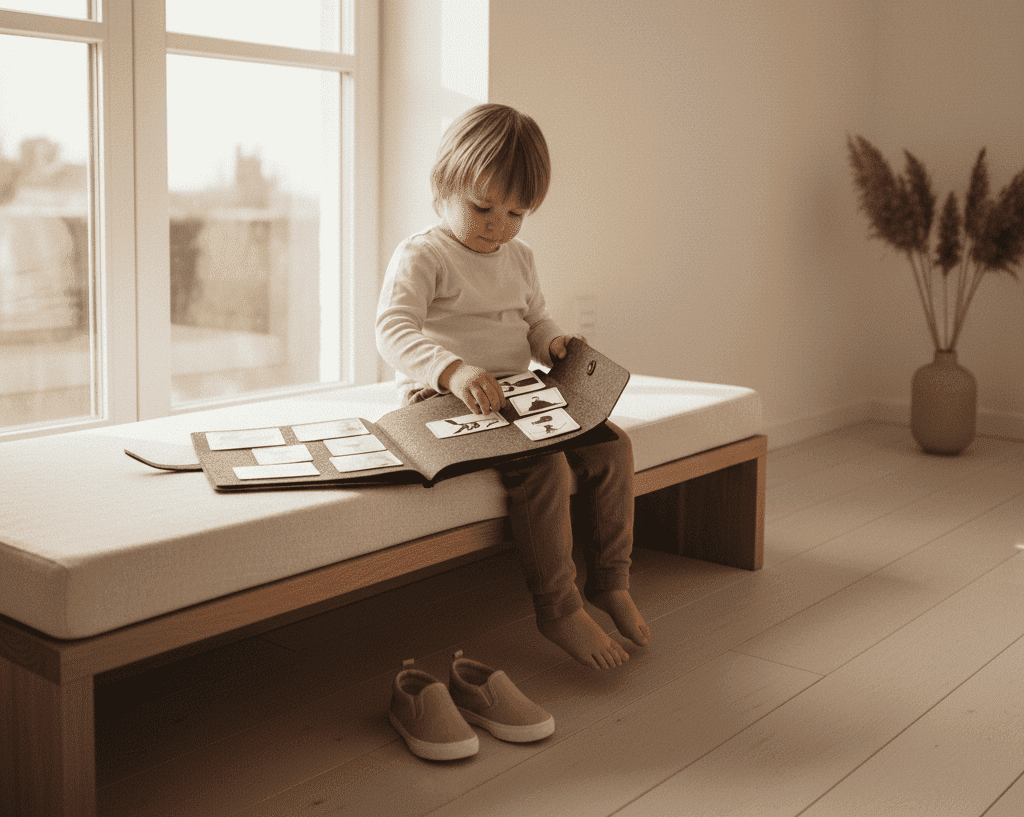
Parents of 3-7 year olds, you know how in transitions from play to dinner, from car to bed, etc., stress heightens and meltdowns emerge. These friction points are seldom accidental. Kids’ nervous systems, on the other hand, thrive on predictability. When routines are abruptly altered, their sense of safety shakes.
How parents respond in these moments can ease the way or increase the turbulence. Helping a kid through transition is less about nailing every detail and more about establishing a calming, steady presence that allows the child’s body and mind to catch up.
Checklist: Supporting Toddlers During Transitions
- Be patient and understanding: Every child has a different tolerance for change. What seems minor to you as an adult may be enormous to a young child. A few may demand additional minutes or additional nudges. Others might require a tactile prompt, such as a light tap or a visual timer.
Patience involves taking a breath, decelerating yourself, and recalling that what appears as defiance is frequently merely a child’s nervous system attempting to reset.
- Model calmness and flexibility: Children take their cues from you. If you approach transitions like they’re just the way things are, using a soothing voice and calm body language, your child will feel there’s no danger. If you hurry or are frustrated, children tend to absorb that panic and reflect it.
These boundaries are particularly important during high stress moments, after school, before meals, or bedtime, when overstimulation is easy to succumb to.
- Provide warnings and narration: Giving advance notice, “In five minutes, we’ll clean up and eat,” helps children prepare mentally for what’s coming next. Narrating each step (“Now we’re putting away the toys, next we’ll wash hands”) makes it predictable, not surprising.
This technique is especially good for kids who have difficulty with transitions because it separates the process into concrete, digestible pieces.
- Offer emotional support: Acknowledge feelings instead of dismissing them. Say, “I know you’re frustrated that playtime is ending. That’s tough.” This validation makes kids feel heard and less isolated with their overwhelming feelings.
Resist the urge to justify or explain why the transition should not be hard. Empathy works better than logic at these ages.
- Involve children in the process: Giving small choices “Do you want to put your shoes on first, or your coat?” restores a sense of control. Involvement can be as small as allowing your child to transport an object to the new location or pick the clean up tune.
- Practice transitions during calm moments: Telling stories, role playing, or acting out morning and bedtime routines can help make change less mysterious. Children are open to learning during play and closed to learning in real time stress.
These practices, borrowed from Montessori and Scandinavian traditions, develop transition skills in a low stress manner.
- Prepare for predictable stress points: Know when meltdowns typically occur before meals, after school, or at bedtime. Having a plan, like a screen-free, hands on activity (a picture match from Tiny Thinks™ or a tracing card from the Free Calm Pack), helps smooth the transition and provides kids with something tangible to anchor to.
- Screen-free alternatives: Many parents reach for screens because they want peace, not because they think it’s best. For ages 3-7, slow, structured paper activities, such as those found in Tiny Thinks™ Workbooks, provide a soothing, dopamine-moderating counterbalance.
These activities are portable and designed for real moments: dinner, travel, waiting rooms, and bedtime.
Handling Major Life Changes
Major disruptions like moving or starting school can amplify toddler transition struggles even in otherwise adaptable children.
Big life changes, like a move or a new school, a parent separation, or welcoming a new brother or sister, can feel seismic to kids 3-7 years old. Even positive changes can be confusing and anxiety inducing. The child’s nervous system doesn’t differentiate between “good” and “bad” change. Both unsettle the familiar rhythms and can induce meltdowns, sleeplessness, or withdrawal.
Toddlers and young children have barely begun to develop executive functioning skills. They rely on routine and parental signals to control and make sense of their environment. Toddlers usually express their transition struggles via clinginess, regression, or acting out. These behaviors indicate a desire to feel safe and connected, not to be rebellious.
Their brains need order and ritual, particularly when stressed. When structure disappears, kids feel adrift. Predictable rhythms, such as eating together at the same time, reading at bedtime, and familiar stories, ground kids even as everything else is shifting. Routine, particularly with a primary caregiver, is the single most stabilizing force in the face of major life changes.
Keeping routines doesn’t mean life has to be stiff. These small, expected anchors, whether a shared breakfast tune or bedtime story, make kids feel safe. Visual timers before transitions or just simple picture schedules can prepare children for what’s next. For example, if you’re moving into a new home, immediately create a corner with their favorite blanket and books.
Known things in an unfamiliar environment assist kids in making connections between the old and the new. Kids need to deal with and voice their feelings about change. Social stories work great here. They’re easy to understand, storybook illustrated tales that guide a kid through what’s going to happen, such as a new classroom, a parent moving out, or a baby coming home.
Reading or writing these stories together allows kids to imagine the process, inquire, and identify their place in the narrative. Role playing is another valuable approach. Acting out ‘what if’ scenarios helps children rehearse new situations in a low pressure way. Provide options whenever you can. Let your child choose between two shirts on moving day or decide which book to read first in the new house.
Little decisions bring back a feeling of agency when everything else seems uncertain. Have kids verbalize, sketch or even role-play their emotions. Naming feelings, “You seem worried about the new school,” validates their experience and helps foster emotional development.
Here are some practical tips for handling major life changes with young children:
- Keep daily routines as consistent as possible.
- Use social stories and role-play to describe new situations.
- Create your own little nest of comfort in a new place.
- Give reminders and use visual timers for transitions.
- Stay physically and emotionally present as much as possible.
- Offer simple choices to foster a sense of control.
- Urge your child to verbalize or draw his or her feelings or to express them through play.
- Be patient; behavior may regress before it improves.
Our Tiny Thinks™ Workbooks and our FREE Calm Pack were made just for these moments. When kids are frazzled, calm, tangible activities with defined actions can immediately bring peace. Our Tiny Thinks™ method utilizes slow, routine tasks such as matching, tracing, and working with patterns so kids can calm down, concentrate, and absorb transition on their own timeline.
These tools are effective at the dinner table, hotel room, or back seat of a car on a long ride. Parents report that their child’s nervous system visibly melts mere minutes after beginning a page. For screen-free support to tackle life’s big changes, these workbooks gently guide kids through the unknown and teach them how to cultivate lifelong thinking skills.
When to Seek More Support

A lot of kids 3-7 struggle with transitions during the day, particularly if they’re already feeling overstimulated. Little bumps, getting off the playground, ending screen time, and transitioning from play to dinner can escalate into meltdowns. Most kids adapt with steady schedules, soothing predictability, and screenless, regulation-centered resources.
At times, even with your best efforts, transition struggles continue to throw a wrench in family life. In those instances, it might be time to consider additional support.
-
Intractable, severe transition meltdowns that do not respond to visual schedules, advance warnings, or soothing routines.
-
Struggles with transitions are becoming debilitating. Refusing to leave the house, hours of meltdown during drop-off, or paralyzing anxiety about trying new things.
-
Transition struggles that are affecting daily life, such as mealtime, bedtime, and school drop-off, sibling or friend relationships, or your child’s quality of life.
-
Your child is opting out of activities, skipping playdates, or unable to engage in age appropriate experiences because transitioning from one activity to another is too difficult.
-
Major life changes, such as moving homes, parental separation, and starting a new school, make transitions much more difficult and your typical tactics fall short.
-
You feel drained, exasperated, or at your wit’s end attempting to assist and nothing appears effective, even after attempting screen-free, regulation-first substitutes.
-
Your child’s emotional reactions to transitions are overwhelming or prolonged, and they don’t appear to subside even with support.
-
Struggles aren’t improving with your current approach or you observe they are worsening over time.
When these signs pop up, talk to teachers or therapists who know early childhood behavior. A teacher might observe trends at school or recommend helpful habits. A child psychologist or occupational therapist can help you understand what’s going on in your child’s nervous system.
Perhaps they are hyper sensitive to sensory input or shifts induce anxiety and provide actionable, specific support. Community resources can help. Most cities have parent support groups or early intervention programs. These connections with other families going through it help you feel less alone and may spark new ideas for making transitions easier, particularly in highly stimulating situations such as airports, busy restaurants or after school.
Professional advice isn’t about “repairing” your child. It’s about discovering what allows them to co regulate, so switches come to feel more secure and rhythmical. A specialist might recommend play-based therapies, visual timetables or sensory supports.
For families who want screen-free, immediate solutions, the Tiny Thinks™ Free Calm Pack and age-based Workbooks are purpose-built for these high stress instances! We provide soothing, targeted exercises that relax the nervous system, cultivate thinking skills, and assist young ones in focusing, whether you’re at home, in the car, or sitting in a waiting room. Kids love the active attention, and parents typically observe smoother shifts in a flash.
How Tiny Thinks fits into this moment?
Tiny Thinks pages are designed to gently pull attention away from screens without effort from the parent.
They:
- start easy, so children can begin immediately
- use quiet hand movements that slow the body
- lead naturally into calm, focused attention
Parents often use them in moments like travel, waiting, or evenings, whenever they want a calm alternative to screens without planning or negotiation.
Tiny Thinks is positioned as infrastructure, not advice. It is what families use instead when screens, chaos, or modern stimulation stop working. For a calm, structured alternative whenever screens create problems, download the Free Calm Pack
.
Conclusion
Backing toddlers through daily transitions is never easy. Knowing what’s going on under the surface makes it less daunting. A lot of 3-7 year olds have a hard time with transitions because their brains yearn for security and familiarity. Recognizing their cues, decelerating rhythms, and providing explicit structure assist in grounding them. Even tiny transitions, such as a new snack time or a different route home, can seem monumental to a toddler.
Parents who remain patient, utilize calming routines, and provide nurturing choices often experience fewer meltdowns and increased confidence in the long run. When bigger life changes arise, additional reassurance and plenty of small steps count the most. For screen-free families in need of tough moment support, practical, hands on craft projects bring back calm and attention just when it’s required.
If you want structured, calm moments without adding extra work, start with the Free Calm Pack or choose the workbook for your child’s age.
Frequently Asked Questions
Why do toddlers have trouble with transitions?
Toddlers struggle with transitions because they love ritual. Their noggins are still maturing, so it is tough to make a rapid transition. We have learned that clear routines make them feel secure.
How can I tell if my toddler is having trouble with a transition?
Look out for tantrums, clinginess, or refusal to engage. A shift in sleep or eating habits can indicate transition struggles.
What can help make transitions easier for toddlers?
Give easy warnings before transitions. Maintain a routine and provide security items. Commend your child for managing transitions effectively.
How important is the parent’s attitude during transitions?
Your composure lets your toddler know that everything is going to be okay. They observe your responses and frequently reflect your own feelings. Hang in there, stay consistent and positive.
What should I do if my toddler faces a major life change?
Give extra snuggles and consistency. Describe transitions simply. Allow your toddler to vent feelings and ask questions.
When should I seek professional help for my toddler’s transition struggles?
Get help if your toddler’s transition struggles are making every day a battleground, impacting family life, or dragging on for multiple weeks. A child development specialist can assist.
Can transition struggles affect a toddler’s development?
Occasional struggles are to be expected. Persistent severe challenges can affect emotional or social growth. Early support can assist your child in this transition.