



- Key Takeaways
- Why Your Child Struggles
- The Digital Dilemma
- The Mismatch Problem
- How to Improve Focus
- The Power of Play
- Your Path Forward
- Conclusion
- Frequently Asked Questions
- Why does my child have trouble focusing in school?
- Can digital devices affect my child’s attention span?
- How can I help my child improve their focus?
- What is the “mismatch problem” in learning?
- Does play really help children focus better?
- When should I seek professional help for my child’s focus issues?
- Are certain foods important for my child’s attention?
Key Takeaways
- Children’s focus is influenced by age, mood, and physical needs, so it’s typical for attention span to fluctuate significantly during early childhood.
- Excessive stimulation, such as noise, clutter, and screens, can overload young brains and make it difficult for them to calm down and focus.
- Emotional highs and lows, such as stress or anxiety, can divert your child and make focusing seem unattainable.
- Fostering soothing rituals, designing structured environments, and providing reliable affection nurture children’s developing attention abilities.
- Play is a heavy hitter for attention development. Just make sure to balance activities that demand focus with free, child-led play.
- If your child’s focus issues persist despite supportive changes, consult a professional to rule out any underlying conditions and obtain personalized advice.
Kids ages 3-7 have a hard time focusing because their attention systems are still in development, and the modern world often overloads them. Fast screens, loud environments, and inconsistent schedules clutter their minds, making it difficult for them to calm down. Tiny Thinks™ offers a Free Pack of printable activities designed to support focus, attention, and calm learning through play and also help you find out why Why Your Child Struggles to Focus in a Distracted World
Many parents notice this most during transitions after school, before meals, or at bedtime. Understanding why focus breaks down in these moments starts with how young minds respond to overstimulation and inconsistent structure.
Why Your Child Struggles
Most parents of 3–7 year olds recognise those moments when their child’s attention falters after school, at meals, before bedtime or in waiting rooms. These attention dips are not a failure, but a normal part of early development. Children’s minds are still developing the ability to filter noise, regulate their emotions, and strengthen the muscles of attention.The guide on how to improve focus in kids looks at how attention develops across the 3–7 age range and what parents and educators can do to support it.
Below, the primary culprits of focus difficulty are unpacked, from developmental standards to environmental and emotional triggers, physical requirements, and underlying conditions.
|
Domain |
Common Norms / Factors |
Examples / Details |
|---|---|---|
|
Developmental Norms |
Short attention span, variable |
Age x 2–3 min; 6-year-old: 12–18 min |
|
Emotional Factors |
Anxiety, stress, transitions |
Meltdowns, withdrawal, fidgeting, irritability |
|
Physical Needs |
Sleep, nutrition, movement |
9–10h sleep, healthy snacks, regular exercise |
1. Developmental Norms
Kids’ attention is still being built. The typical 4-year-old can only pay attention for 8 to 12 minutes. Many children this age find it genuinely hard to persist on a single task for more than a few minutes.These are not exceptions; they are the rule.
Focus develops gradually as children’s brains mature and their executive function skills, such as memory, impulse control, and sequencing, develop in spurts. Some kids can sit quietly and block build for fifteen minutes. Others drift off after three.
These differences are not defects but normal diversity. Patience is important. Attention span builds gradually with practice, predictable rhythm, and room to fail and try againThe Pre-Seven Learning Method is built around this window, the understanding that sustained attention, one of the ten capabilities the method names, first takes shape through repeated, low-pressure practice in the years before seven. A child who sits with a puzzle for ten minutes, not because they were told to but because the activity felt achievable, is doing exactly the kind of attention-building that matters. That kind of quiet persistence is what the early years are for.
2. Environmental Overload
Today’s environments are noisy and strobing and filled with excess. Visual clutter, such as open toy bins, perpetual TV noises, and glowing screens, fragments a child’s attention. Even background chatter or music can keep their minds jumping.
Fast, autoplay-driven screen content can make it harder for emerging attention systems to settle Calm, predictable spaces help. Low-clutter rooms, muted tones, and one activity at a time give young children the best chance to settle.
Screens are useful, but too much quick stimulation makes it difficult for kids to calm and focus. A small desk with a simple puzzle or a mat with pattern cards gives young children a quiet place to focus.
3. Emotional Turmoil
Anxiety or change or tiredness can destroy focus. A child who’s anxious about a new school or worn out after a hard day will resist settling regardless of how the task is set up.Emotional overwhelm lurks behind behaviors like fidgeting, zoning out, or refusal to start.
When parents provide uncomplicated comfort, such as a hug, a soothing voice, or a moment to discuss, control is restored. Mindfulness for kids can be basic: deep breaths, slow tracing with a finger, naming feelings together.
When children feel safe expressing how they feel, they gradually develop the capacity to self-regulate
4. Physical Needs
Sleep, movement and food constitute the first floor for attention. A kid who’s not getting 9 to 10 hours of sleep will find it hard to focus, and tired kids get grumpy, which makes it even more difficult. Shattered workout rhythms leave spare energy that spills over into fidgeting and distractibility.
Healthy snacks, such as a handful of blueberries, provide great brain fuel. Routine things, predictable bed and meal times, consistent breaks for activity, and occasional encouragement to rest can do what no “concentration” exercise by itself ever can.
5. Underlying Conditions
Sometimes focus struggles are more than ordinary. ADHD, learning disabilities, or specific cognitive skill weaknesses can all be factors. These are not character flaws, but genuine differences in the brain’s wiring.
Parents might observe that their son or daughter has difficulty listening, completing, or recalling steps, even when still well-rested and well-fed. If these struggles continue in spite of structure and support, it’s prudent to pursue professional guidance.
Patient observation over time begins to clarify what is typical and what might require additional support. Most of the time, though, what looks like a focus problem is simply a developing brain in an environment that’s moving faster than it can handle. Slowing things down predictable routines, quieter spaces, unhurried activities is often more effective than any targeted intervention.
The Digital Dilemma
Digital media surrounds us for countless families, screens are just life. Most parents already know the pressures: a child who can watch cartoons for hours but loses focus after a few minutes with a book, or the struggle to get them off devices and into bed. Technology isn’t ‘bad,’ but quick, autoplay-powered material contradicts how young brains develop attention and control.
Screen time impacts attention in two key respects. First, fast, unpredictable input (think: YouTube, endless scrolling) trains the brain to expect constant novelty and quick dopamine hits. This splinters attention so that kids can’t sit with slower, more deliberate activities.
Second, multitasking jumping between games, videos, and chats further degrades the ability to concentrate. Research on multitasking in young people consistently finds links between frequent task-switching and weaker sustained attention. Some research suggests that heavy digital media exposure in the early years may affect how attention develops.
The worldwide surge in ADHD, which increased by 35 percent between 2003 and 2011, mirrors expanded digital media availability.
Bedtime introduces an additional point of tension. Blue light and notifications break sleep rhythms, making quality rest more elusive.There is growing interest among researchers in understanding the longer-term effects of heavy digital consumption on attention and cognition in young children.
|
Activity Type |
Typical Attention Span |
Impact on Focus |
|---|---|---|
|
Fast digital content |
10–30 seconds |
Decreases sustained attention |
|
Screen-free/calm activity |
5–15 minutes+ |
Supports deeper engagement |
|
Multitasking digital use |
<10 seconds |
Fragments attention, increases distractibility |
Boundaries go a long way. Establishing boundaries around digital consumption, like a no-device-before-bed rule or device-free family meals, creates the cognitive space for the brain to relax. Screen-free family time fosters connection and demonstrates focused attention.
Even a small daily window of quiet, intentional screen-free play can help.
The Free Calm Pack offers a calm, structured alternative for the moments when children need to settle after school, during transitions, or in waiting rooms.
The Mismatch Problem

Most parents notice it during the hardest parts of the day: a child asked to sit quietly at dinner, do a worksheet, or wait for the meal in a busy restaurant. Their body fidgets, their eyes wander, and their mind is all over the place but the work. This isn’t always about willpower or discipline. Usually, it’s a mismatch between what a child’s brain needs and what the moment demands.
Kids are hardwired for activity, wonder and tactile exploration. Being instructed to concentrate on a slow, adult-paced endeavor can seem unnatural, particularly following hours of quick digital signals or an exhausting day at school.Most four-year-olds find it genuinely hard to settle on a slow task, this is developmentally expected, not a discipline problem. Motivation is almost never the kid’s problem. It’s that the environment and tasks don’t match their developmental needs or sensory profile.
Sensory processing has a lot to do with it. Some kids are easily overwhelmed by noise, bright lights, or even the feel of their clothes. Sensory processing disorder impacts how the brain filters and reacts to sights, sounds, and touch. A child with sensory sensitivities may find it impossible to tune out distractions in a noisy classroom or hectic family room, so focusing becomes nearly unattainable.
Even undiagnosed, many of these kids cannot turn off their brains to filter out the world and focus on what’s in front of them. Attention span is a moving target, not a fixed characteristic. Developmentally, you can approximate a young child’s attention span by calculating their age multiplied by two to three minutes. A 6-year-old can be expected to concentrate for 12 to 18 minutes before requiring a break.
Anticipating more primes both parent and child for frustration. Include screen time particularly rapid-fire, autoplay content and that divide gets even greater. Hours on tablets or smartphones can make the mundane things in daily life seem slow and boring, as our brains have been trained to anticipate fast, high-value information. Tiny Thinks™ offers a Free Pack of printable activities designed to support focus, attention, and calm learning through play
Sleep is another silent propulsion source of attention. Without adequate sleep, which is at least nine hours for elementary school-age children, focus falters, anger escalates, and impulse control suffers. If a child is waking early, going to bed late, or restless overnight, no amount of structure will completely make up for that loss.None of this is about academic readiness in the traditional sense. It’s about giving a child’s attention system the conditions it needs to develop calm, repetition, and a sense of being capable, long before formal learning begins.
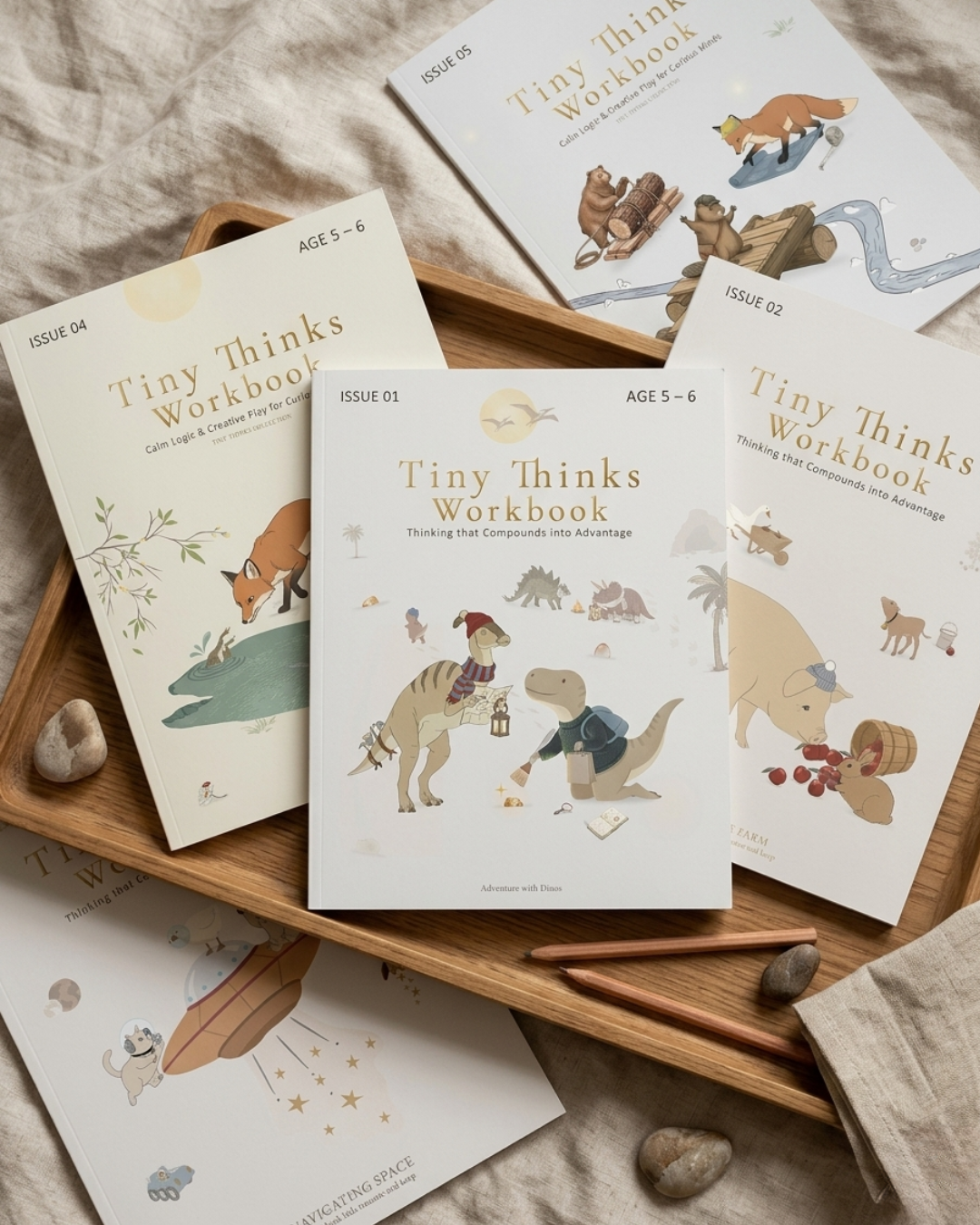
For families looking to build attention through everyday quiet moments, age-based Tiny Thinks Workbooks offer calm, sequenced thinking practice children return to on their own.
How to Improve Focus

Focus doesn’t come from willpower or sermons. It’s constructed through habit, context, and soothing rituals. Kids in the 3–7 age range have a hard time focusing because their nervous systems are bombarded with rapid, erratic stimulation.It’s not about removing screens altogether, it’s about providing a calm, predictable alternative when a child needs to settle.
Reset the Environment
A dedicated work area cues your child that it’s time to get settled. This can be as simple as a small table in the corner or a tray on the floor. The consistency of location is more important than the size or decor. De-clutter and retain only necessary materials within reach to minimize visual distractions.
Dim soft, even lighting and provide peaceful background music if it calms. Every kid is unique. Some work best in natural light, others under a lamp. Certain kids require silence, others a gentle hum. Test and tweak. If your kid fidgets, offer up some basic tactility smooth stones, putty, a soft textile.
Revisit the setup frequently. Be flexible; what works today might not work next week. Your final objective is an environment in which your kid is relaxed and empowered.
Reconnect Emotionally
High-powered focus tends to come in kids who feel emotionally grounded. Take a few minutes for one-on-one connection before the deep work. Read a page together, share a snack, or sit silently. That positive reinforcement matters. Compliment effort, not outcomes. A simple “I saw you kept trying” does more than highlight perfection.
Kids flourish on camaraderie. Cooperative play, such as constructing a tower, organizing items, or completing a puzzle, instructs turn taking and patience. In transitions, listen actively. Summarize your child briefly, stating “You’re exhausted from school, you want to watch cartoons,” before proceeding. This minimizes friction and facilitates easier attention transitions.
Rebuild Routines
Habit is the life of control. Predictable rhythms reduce stress and foster autonomy of thought. Employ visual, mini checklists to list tasks. Maintain directions simple, one or two at a time. Combine breaks with physical activity or silent breaths. Mindfulness, something as simple as a 5-4-3-2-1 exercise or breathing together for one minute, works to reset overstimulated brains.
- Set consistent bed and rise times. Children aged 6 to 12 require at least 9 hours of sleep.
- Schedule focus times after snacks or movement breaks.
- Use a timer: start with ten minutes, then increase steadily.
- Provide fidgets and water close by to encourage still hands and bodies.
- Add antioxidant-rich foods at meals. Blueberries, leafy greens, and whole grains.
If tiredness or irritability arise, tweak the bedtime routine. Small things, like dimming the lights, reading soothing tales, and winding down earlier, help.
When daily structure isn’t enough on its own, many parents look for calm, screen-free activities that help a child settle. Tiny Thinks™ is designed for exactly these moments: after school, before dinner, during travel, and in waiting rooms.
The Power of Play
Play is not just for toddlers. It’s how they develop attention, memory, and self-regulation. When they play, they’re not just fooling around; they’re doing the actual work of building brains. Every play session, guided or freeform, provides an opportunity to practice attention, frustration tolerance, and working memory, all in a manner that feels organic and soothing to the child.
Serious games offer direct implements for attention practice. Easy pickings like peekaboo for toddlers or freeze dance for preschoolers do more than amuse; they help children establish self-regulation and executive function. As kids mature, games with defined rules and turns, such as puzzles, Go, Battleship, and Clue, test memory, pattern recognition, and planning.
These experiences compel the mind to retain, pause, and decide, which directly fosters attention in daily life. Nothing extends a child’s attention span like a five-minute turn-taking game, even more than a fast-paced video could.
Creative play merits its share. When a kid constructs an imaginary city or reenacts a plot, she’s sequencing, problem-solving, and imposing order on a blank canvas. This kind of play nurtures imagination and it forces the child to maintain focus, alternate roles, and accommodate new concepts.
These are abilities they’ll deploy in school and in life. The trick is to maintain a play space that is quiet and consistent. Too much choice, with bins spilling over with toys and a procession of new activities, can confuse the young mind, causing irritation and rapid boredom. Less, carefully selected materials encourage greater play and more concentrated thought.
Striking the right balance between structured games and free play is crucia lEducators supporting focus and attention in group settings can find structured resources at Tiny Thinks for Educators. Guided play, such as a matching game or a building task in stages, gives more frame and objectives. During free play, kids establish their own challenges and follow their own curiosities.
Play is where the attention habits that last are first practised. A child who learns to stay with a game long enough to finish it, to hold the rules in mind, wait their turn, and try a different approach when stuck is building the same cognitive muscle they will later use in a classroom. The activity changes; the underlying capacity transfers.
We need both types of play. For certain kids, breaking activities down into bite-sized chunks, such as working on a puzzle for five minutes every day, is enough to maintain momentum without overload. For others, repurposing materials, like large rubber bands or therapy bands to stretch and pattern, adds new challenges while staying approachable.
Tiny Thinks turns ordinary quiet moments into thinking practice children come back to on their own.
Your Path Forward

Backing your child’s attention is about establishing a setting that supports their focus not about banning screens or pursuing purity the concern isn’t screens themselves, it’s fast, unpredictable content that moves faster than a young child’s attention system can keep up with.
When attention systems are immature, this type of stimulation shatters concentration and makes it difficult for kids to calm down for more silent activities later.
A proactive approach looks first and foremost at what’s going on in your child’s day. How much rest are they getting? Even a minor decrease in sleep can cause visible decreases in focus, recall, and tolerance. For a 6 to 12-year-old, shoot for a minimum of nine hours.
Nutrition is a foundation. Foods like blueberries are small details that matter, as they deliver antioxidants that genuinely support brain health. Movement routines matter as well. We all know how our kids act when play or exercise is broken; even if for a couple of days, they suddenly seem more antsy or distracted.
Children have short attention spans. A simple guideline is to multiply their age by two to three minutes. A six-year-old will concentrate for 12 to 18 minutes before requiring a recess. If your standards are above this, it is natural to get exasperated.
Instead, establish modest, achievable objectives and applaud the attempt, not merely the result. Examples of realistic goals and achievements for focus development:
- Completing one puzzle or matching activity without leaving the table.
- Listening to one short story from start to finish.
- Completing a two-step drawing or tracing activity.
- Cleaning up a toy room prior to starting something new.
- Sitting through one mealtime without asking for a device.
- Following a bedtime routine with just one reminder.
- Transitioning back to a quiet, screenless activity after screen time.
Your path forward: A nurturing sanctuary isn’t about banishing every distraction. Children with sensory sensitivities need predictable structure: same place for quiet tasks, same routine for meals and sleep, gentle lighting, and minimal visual clutter.
Regular schedules for schoolwork, meals, and bedtime provide your child’s brain with the signals it requires to calm down and concentrate. If concentration has waned, identify any root causes, such as rest, diet, or sensory input, rather than defaulting to screen time as the sole culprit.
Conclusion
Early childhood focus is formed by real-world rhythms, not rapid-fire digital reinforcement. Every moment of distracted attention, screen pushback or meltdown is an indicator of a system moving too quickly and too loud for a developing brain to keep up. Developing focus isn’t about more activities or harder discipline. It’s about providing children with slow, organized, visually quiet environments spaces to drift and to ground. When routines align with a child’s innate rhythm, solitary focus expands .
Attention isn’t built in special sessions or through the right app. It develops in the texture of ordinary days in waiting, in trying again, in finishing something small. The families who notice the most change are usually the ones who made the environment quieter and the expectations steadier, not the ones who added more.Built for the years before seven, when the thinking habits that last attention, persistence, working it out first take shape.
For most families, steadier focus follows from less chaos, more predictable structure, and activities children choose to return to “That last part matters. When a child returns to an activity on their own, not because a parent set it up or reminded them something has clicked. They’ve found something that feels manageable and satisfying. That’s the foundation. Everything else builds on it.
Children aged 3–7 have short, variable attention spans this is developmental, not a discipline problem.
Environment matters: low clutter, predictable structure, and one activity at a time help young children settle.
Emotional connection before a task reduces resistance and makes focusing easier.
Consistent short sessions ten to fifteen minutes, build attention more reliably than long infrequent ones.
If focus struggles persist despite structure and rest, it is worth speaking with a teacher or child development professional.
Tiny Thinks Workbooks give children calm, structured thinking practice the kind they return to on their own in everyday quiet moments at home. Browse age-based workbooks
Frequently Asked Questions
Why does my child have trouble focusing in school?
Most kids have a problem focusing because they’re distracted, tired, or stressed. Occasionally, it’s due to learning differences or attention disorders. Knowing the why will help you find the right solution.
Can digital devices affect my child’s attention span?
Yes, heavy digital use affects attention. Rapidly changing material is more difficult for kids to engage with for extended periods. Restricting screen time is important.
How can I help my child improve their focus?
Designate a quiet study space, establish daily routines, and break assignments into manageable chunks. Promote breaks and exercise. These tips can help boost focus.
What is the “mismatch problem” in learning?
The mismatch problem is when teaching styles are not a good fit for a child’s learning needs. Customizing lessons to your kid’s strengths can keep them interested and on task.
Does play really help children focus better?
Yes, play accelerates brain development and gives kids a chance to practice concentrating. Free play gives them the space to discover, troubleshoot, and develop attention in an organic way.
When should I seek professional help for my child’s focus issues?
If your child’s focus issues are extreme, persistent, or interfering with life, consult a medical or educational professional. Early intervention can go a long way.
Are certain foods important for my child’s attention?
A healthy diet of fruit, vegetables, whole grains and protein nourishes the brain. Avoiding excess sugar will assist in keeping energy and focus levels.