


Key Takeaways
- There is no single verified number for how many minutes a child should focus at each age, though children generally sustain attention on engaging tasks for longer as they grow from ages 3 to 7.
- Attention before age seven depends heavily on the task itself: how interesting it is, how hard it is, and whether the child chose it.
- Children often focus longer on screens than on toys or puzzles because screens change scenes automatically, which requires less effortful attention than a still, quiet task does.
- A short attention span becomes a concern worth discussing with a pediatrician when it appears across many settings, not just during boring or unwanted tasks, and interferes with daily functioning.
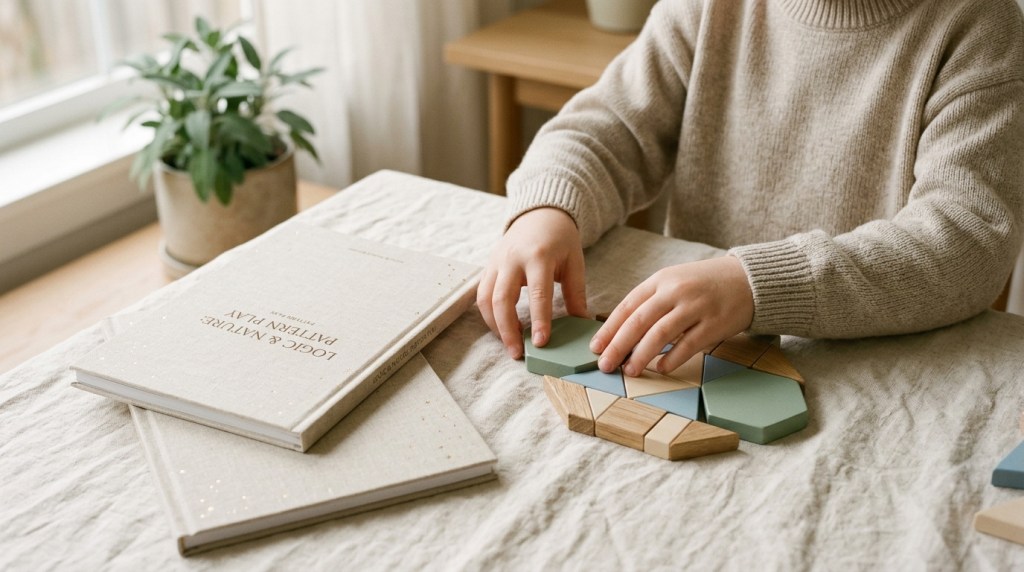
- Puzzles, building toys, sorting games, and simple completion activities give children real chances to practise staying with a task past the point where it stops being instantly fun.
- Sustained attention and persistence are two of the ten capabilities the Pre-Seven Learning Method is built around, developed through short, screen-free thinking missions rather than through age-based waiting.
The child who abandons a puzzle after ninety seconds. The child who needs you sitting beside them to finish a single page of dot-to-dot. The child who watches a screen for forty minutes without blinking, then cannot last four minutes stacking blocks. If any of that sounds familiar, you are not imagining a problem. You are watching a real, common, and mostly normal part of how attention develops before age seven.
Attention span is not simply how long a child can sit still. Before seven, real attention is the ability to stay mentally connected to a task once it stops being instantly rewarding. That distinction matters more than any number of minutes, and it is the difference this article is going to unpack.
What parents mean by attention span in kids
When parents say attention span, they usually mean something more specific: can my child start a task, stay with it through the boring or hard part, and finish it without me hovering. That is not really a length of time. It is a child’s ability to stay engaged once the novelty wears off and some effort is required.
A child who flits between eleven toys in ten minutes is not necessarily worse at attention than a sibling who quietly builds one tower. It depends on whether the toys were chosen freely or whether the child is avoiding something that felt hard. Attention span is really a mix of interest, difficulty, and a child’s still-developing ability to keep going when a task loses its initial spark.
What is a normal attention span by age?
There is no single scientifically verified number of minutes a child should focus at a given age, and the popular idea that attention span equals one minute per year of age is a widely repeated rule of thumb, not a research finding. What is well established is that attention capacity tends to increase gradually across early childhood, and that task type matters enormously.
A rough, honest way to think about it: a 3 or 4 year old can often stay engaged with a hands-on, interesting task for somewhere around five to fifteen minutes, and a 5 to 7 year old can often stretch that to fifteen minutes or more, especially with an adult nearby or a clear goal in sight. But these are patterns, not benchmarks. A child’s attention on a favorite puzzle will look nothing like their attention during an unwanted worksheet, and both are normal reactions, not a diagnosis.
The Pre-Seven progression Tiny Thinks works from reflects this shift: ages 3 to 4 are typically about building short bursts of real focus, and ages 5 to 7 are typically about stretching those bursts into longer, more independent task completion.
Why children can focus on screens but not tasks
This is one of the most common worries parents raise, and it has a straightforward explanation. Screens, especially fast-paced videos, do a lot of the attentional work for a child. Scenes change every few seconds, sound and color shift constantly, and the child’s brain is responding to those changes rather than generating and sustaining its own focus.
A puzzle, a drawing, or a building toy asks for the opposite: the child has to supply their own motivation to keep going once the task gets repetitive or hard. That is a heavier lift. Many families notice a child can watch a screen for forty minutes but abandon a jigsaw puzzle in two, and this is not a sign that screens have damaged attention. It is a sign that passive, externally driven attention and effortful, self-generated attention are two different skills, and only one of them gets built by watching a screen.
This is not an argument to eliminate screens or feel guilty about them. It is a reason to make sure a child also gets regular chances to practise the effortful kind of attention, since that is the kind school and independent play depend on.
When short attention span is normal
A short attention span is often simply a snapshot of age, interest, and task difficulty, not a red flag. It is normal for a 4 year old to abandon a task the moment it stops being fun. It is normal for a 5 year old to rush through a coloring page to get to the next thing. It is normal for a 6 year old to need a reminder to come back to an unfinished activity.
Some children rush through multi-step tasks when the next step is not visible yet, which looks like poor attention but is often closer to a planning gap: the child does not yet hold the whole sequence in mind. Others abandon tasks that are too easy or too hard for their current skill level, which is a mismatch problem, not an attention problem. Distractibility during an unmotivating task, in a busy environment, or at the end of a long day is expected at this age, not a warning sign on its own.
When to look more closely
Not every short attention span points to ADHD, and it is worth saying plainly: distractibility, wiggling, and short focus on boring tasks are part of normal development in children under seven. ADHD involves a persistent pattern of inattention or hyperactivity that shows up across multiple settings, home, school, and social situations, and that noticeably interferes with a child’s daily functioning, not just their patience for chores they dislike (American Academy of Pediatrics).
It is worth a conversation with a pediatrician if a child cannot engage with almost any task, including preferred and playful ones, across different settings and people, for their developmental stage, and if this pattern has lasted for several months rather than a few difficult weeks. A single calm conversation with your child’s doctor is a reasonable, low-pressure next step if you are genuinely unsure, and it does not mean something is wrong. It means you are getting clarity.
What Is The Pre-Seven Learning Method?
The Pre-Seven Learning Method is a four-stage, screen-free approach for children ages 3 to 7 that builds ten cognitive capabilities underneath learning and academics through small, calibrated thinking missions during the formative years before age seven.
Sustained attention and persistence are two of the ten capabilities the method is built around, alongside closely related ones like planning, self-control, working memory, and comfort with uncertainty. These capabilities are closely related to executive function skills, the mental processes that help children focus attention, remember instructions, and manage impulses during goal-directed activities.
A child who sticks with a hard puzzle piece, forgets a step and has to hold it in mind again, or keeps going despite not immediately knowing the answer is practising several of these capabilities at once, not just one narrow skill called focus.
Best activities to build real focus
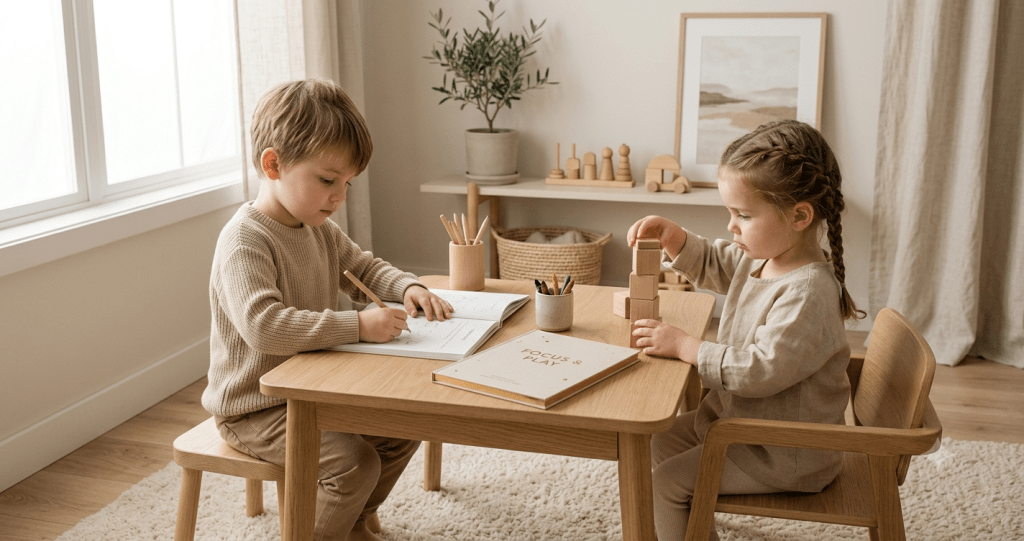
The goal is not longer sitting still. It is more time spent genuinely engaged with a task that has a little friction in it, the kind that stops being instantly rewarding but still has a clear finish line.
- Puzzles with a visible end point, since the near-finished picture pulls a child back to complete the last few pieces.
- Open-ended building toys like blocks or magnetic tiles, which let a child set their own small goal and revise it.
- Sorting games, matching cards by color, size, or category, which require sustained visual attention without needing adult narration.
- Simple completion activities: finish the pattern, complete the drawing, find all six hidden shapes.
- Visual timers, which make an abstract stretch of time concrete and give a child a sense of how much is left.
These are the kinds of small, screen-free thinking missions Tiny Thinks uses because they ask a child to stay with something just beyond the easy part.
What not to do when building attention
Long worksheets, especially timed or repetitive ones, often backfire with children under seven. Worksheets are not inherently harmful, but when they are the main way a family tries to build focus, they tend to create resistance rather than genuine attention practise, because the child associates sitting still with something tedious rather than something worth sticking with.
Reward charts for finishing tasks can work briefly, then lose their pull once the novelty fades, since the child is now focused on the reward rather than the task itself. Constant verbal reminders, keep going, stay on task, look at me, tend to create more resistance over time, not less, because they take the job of self-monitoring away from the child instead of building it. And removing all screens rarely solves attention difficulties on its own, since screens are only one factor among several, including sleep, task difficulty, and how much unstructured practice a child gets with effortful focus.
A simple daily focus routine
Consistency matters more than intensity. A short, calm stretch of focused practice most days does more for a child’s attention than one long, high-pressure session once a week.
In the Tiny Thinks approach, the routine is deliberately small: one clear task, a little challenge, and enough space for the child to practise persistence without being constantly rescued.
A workable version for most families: pick one hands-on activity with a clear finish line, set a visual timer for a stretch that matches the child’s age and current stamina, sit nearby without narrating every move, and let the child reach the end on their own terms, even if that end looks a little messy. Praise the sticking with it, not just the finished result.
The future child attention practice builds
The child who sits down with a hard hundred-piece puzzle while two friends have already wandered off to something easier, and who is still there twenty minutes later, quietly working the edge pieces, is not doing something magical. They are practising a capability that took repeated small chances to build. That is the child who, years from now, sits with a hard math problem or a long reading assignment without needing someone standing over them.
Attention practised now is not really about minutes. It is early rehearsal for finishing tasks independently, following instructions with several steps, and managing effort without constant prompting later on. None of that requires a child to be unusually gifted. It requires ordinary, repeated chances to stay with something a little past the point where it stopped being easy.
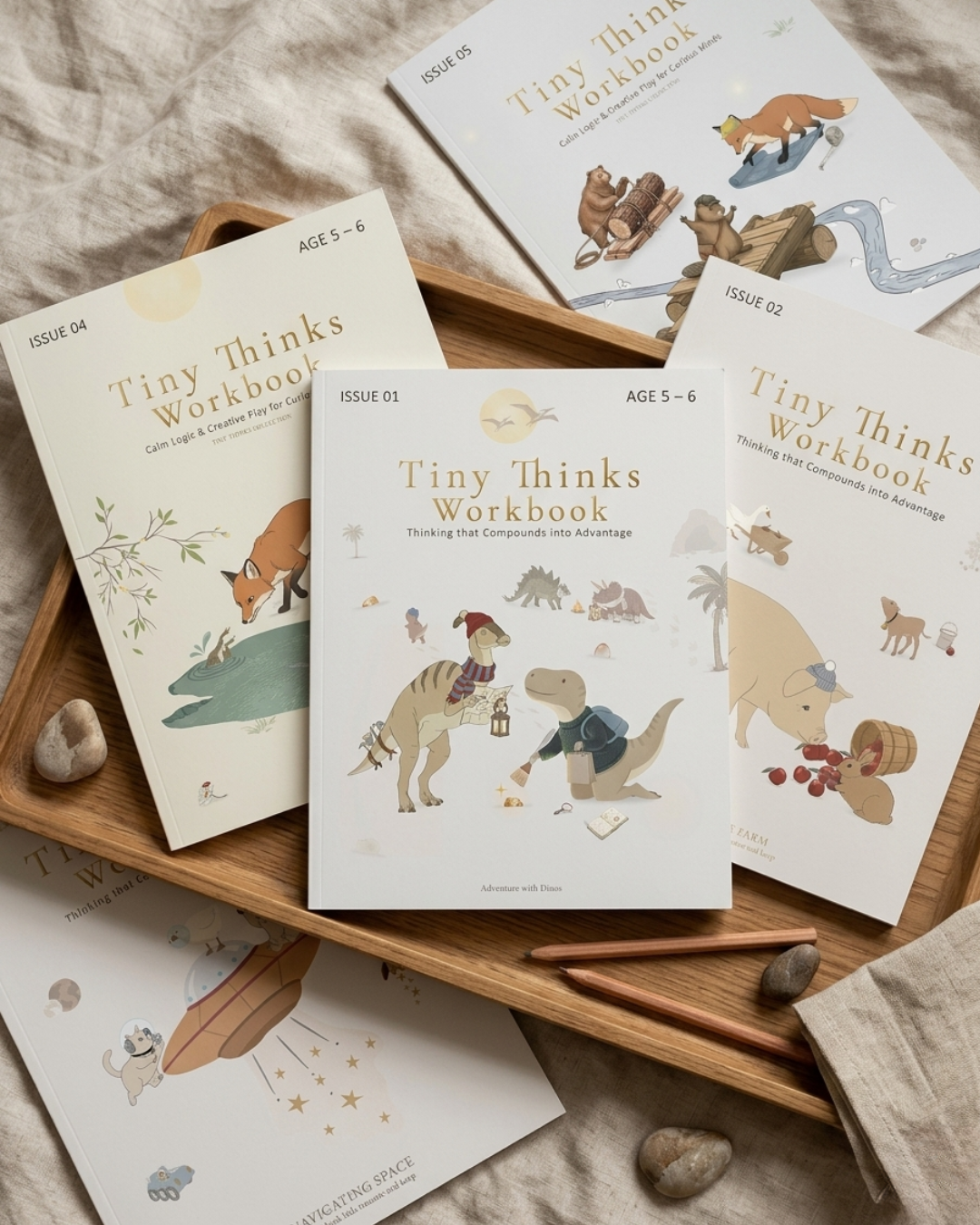
If you want a simple next step, Tiny Thinks workbooks turn focus practice into short, screen-free missions built around The Pre-Seven Learning Method, so children get regular chances to stay with puzzles, patterns, and completion tasks without pressure. You can start with the Free Calm Pack or explore the Tiny Thinks workbooks for age-appropriate attention practice at home.
Frequently Asked Questions
What is a normal attention span for kids?
There is no verified exact number, but children generally sustain focus on engaging, hands-on tasks for longer as they move from age 3 toward age 7, especially with adult support nearby.
How can I increase my child’s attention span?
Offer short, screen-free tasks with a clear finish line, like puzzles or building toys, and let the child complete them with minimal reminders rather than constant redirection. Everyday practice like this is what the Pre-Seven Learning Method focuses on in the years before seven
When should I worry about a short attention span?
Consider talking to a pediatrician if a child struggles to engage with almost any task, including preferred ones, across multiple settings for several months, not just during chores or unwanted tasks.
Does screen time affect children’s attention?
Screens require less self-generated effort than hands-on tasks because scenes and sounds change automatically, which is why a child may focus longer on a screen than on a quiet activity.
Is short attention span always ADHD?
No. Distractibility and short focus on boring tasks are common and normal in children under seven, and ADHD involves a persistent, cross-setting pattern that noticeably affects daily functioning.
Is my preschooler’s attention span normal?
A preschooler who abandons an unwanted task quickly but stays with a favorite activity for several minutes is generally showing typical attention development for their age.
How do I build focus without using worksheets?
Use puzzles, sorting games, building toys, and simple completion activities, since these give a child a real reason to stay engaged without relying on repetitive written tasks.
Could too much screen time have ruined my child’s attention?
Screen time has not permanently damaged your child’s attention. It is more accurate to say children need regular practice with effortful, self-generated focus alongside any screen time they get.
Why can my child focus on screens but not toys?
Screens supply constant automatic changes that hold attention passively, while toys require the child to generate and sustain their own interest, which is a harder and separately developing skill.
When should I ask a doctor about ADHD?
Ask a pediatrician if inattention or hyperactivity appears across home, school, and social settings, has lasted several months, and clearly interferes with your child’s daily functioning.
For more ideas, see Attention and Persistence Activities for Kids Ages 3–7.