



Key Takeaways
- Problem solving skills for kids develop through repeated practice getting stuck, trying a route, and adjusting, not through memorizing steps or worksheets.
- A child who tries a second approach after the first one fails is showing more problem-solving growth than a child who finds the answer quickly.
- Jumping in too fast to help is one of the most common ways adults accidentally slow down a child’s independent thinking.
- Between ages 3 and 7, children move from simple trial and error toward planning, testing, revising, and explaining their reasoning.
- Open-ended questions like what have you tried so far give children room to think instead of waiting for the answer.
- Problem-solving is one of ten capabilities in the Pre-Seven Learning Method, a screen-free, phased approach that builds the thinking underneath learning for children ages 3 to 7.
The child who says I can’t do it about eight seconds into a puzzle. The child who slides the blocks toward you the moment the tower leans. The child who waits, completely still, for someone else to say what happens next. If any of that sounds familiar, you are not imagining a problem. You are watching a capability that is still under construction.
Problem solving skills for kids are built less by what you teach and more by how you respond in the sixty seconds after your child gets stuck. That moment, repeated hundreds of times across ordinary days, is where independent thinking either grows or quietly gets handed over to the adult in the room.
What Are Problem Solving Skills for Kids?
Problem solving skills for kids are the ability to notice a challenge, try a possible way through it, watch what happens, and adjust if it does not work. It is not the same as knowing the correct answer. A child can solve a problem badly, get it wrong twice, and still be problem-solving the whole time.
This matters because most worksheets and apps marketed as problem-solving actually test whether a child already knows the answer. Real problem-solving happens earlier than that, in the space where the child does not know yet and has to find out. That space feels uncomfortable for a lot of children, and honestly, for a lot of parents watching them struggle.
Why Problem-Solving Matters Before Age Seven
Problem-solving matters before age seven because this is when children are forming their basic relationship with being stuck. Some children learn early that stuck is dangerous, boring, or someone else’s job to fix. Others learn that stuck is just the part before you figure it out.
That early relationship often stays with a child as new challenges appear. A child who has practised staying with a hard puzzle at four is not automatically a confident problem-solver at ten, but the pattern of trying, failing, and trying differently has to start somewhere. Before seven, there is no test attached to it. Getting something wrong costs nothing except a little frustration, which makes it a genuinely good window to practise.
Underneath problem-solving are a few related capabilities. Cognitive flexibility, the ability to try another way when the first one did not work, sits right next to it. So does comfort with uncertainty, which is what lets a child keep going before they know the answer. These, along with problem-solving itself, are three of the ten capabilities the Pre-Seven Learning Method is built around.
Research also suggests that children’s problem-solving develops alongside executive function skills such as cognitive flexibility and self-regulation, rather than as a completely separate ability.
The Real Sign Your Child Is Learning to Problem-Solve

The real sign is not speed or correctness. It is whether your child tries a second strategy after the first one fails. A child who tries three different ways to get the lid off a jar is problem-solving more actively than a child who gets it open on the first try and never has to adjust.
Watch for the small moments: the child who tries turning the puzzle piece a different direction instead of forcing it, or the child who abandons a plan halfway through and starts again without being told to. Those are not failures on the way to the real skill. They are the skill.
There is a particular kind of moment worth noticing. A child is trying to get a toy out from under the couch. The stick doesn’t reach. They pause, look around the room, grab a longer object instead, and try again from a different angle. Nobody suggested it. That pause, the look around, the switch in approach: that is a child finding a way through when there was no obvious route. It is easy to miss because it looks like nothing much. It is actually the whole thing.
What to Say When Your Child Gets Stuck
What you say in the stuck moment matters more than any activity you buy. The goal is to ask questions that hand the thinking back to the child instead of giving the answer or the next step.
- What have you tried so far?
- What do you notice about it?
- What happens if you try it a different way?
- What part is tricky right now?
- Is there anything nearby that might help?
- What did you learn from that try?
Say these slowly and then wait. The wait is the hard part. Most adults ask a good question and then answer it themselves three seconds later because the silence feels unbearable. Try counting to ten in your head before you say anything else.
This is exactly the kind of small pause Tiny Thinks treats as useful: the child gets a chance to hold the problem, try a route, and adjust before the adult takes over.
Best Problem-Solving Activities for Ages 3-7
Good problem-solving activities for kids share one feature: there is no single correct answer, or the answer is not obvious from the start. Worksheets are not harmful, but a worksheet with one right answer in one box is not really practising this capability. The activities below are, and none of them need special materials. For a broader list, see Problem-Solving Activities for Kids Ages 3–7.
- Open-ended building with blocks, cushions, or cardboard, where the challenge is set by the child (build something taller than the chair, build a bridge for the toy car)
- Puzzles slightly above their usual level, so there is a genuine stuck point partway through
- Sorting games with a twist, like sorting the same objects two different ways (by color, then by size)
- Real household problems: how do we carry all these groceries in two trips instead of four, how do we fit these toys back in the box
- Scenario questions during a walk or car ride: what would you do if you lost your shoe at the park, what would you do if your friend wanted to play a different game than you
- Simple recipes or snack-making, where a step doesn’t go as planned and needs adjusting
Math problem-solving skills for kids often start in exactly these places, not in workbooks. Figuring out how many cups of water fill a bowl, or whether five crackers can be split evenly between two people, is math problem-solving before it has a name.
Problem-Solving by Age: 3-4, 4-5, 5-6, 6-7
Problem-solving for preschoolers looks different than problem-solving for a six-year-old, and expecting the same thing from both leads to frustration on both sides.
- Ages 3-4: mostly trial and error. A child tries one thing, and if it doesn’t work, tries the same thing again, harder. Repetition is normal here, not a sign of stalling.
- Ages 4-5: children start noticing when something isn’t working and will try a visibly different approach, though they may need a prompt to consider it.
- Ages 5-6: children can hold a simple plan in mind before starting and will often explain, after the fact, what they tried and why it didn’t work.
- Ages 6-7: children can plan ahead, test an idea, revise it based on the outcome, and explain their reasoning to another person, sometimes before they even act.
This progression, from simple trial and error toward planning, testing, revising, and explaining, is the same one the Pre-Seven Learning Method tracks across ages 3 to 7.
Common Mistakes Parents Make When Helping
The most common mistake is stepping in too soon. It rarely feels like a mistake in the moment. It feels like helping. But a child who is rescued the instant they show frustration never gets to the part where they figure something out on their own, and over time some children learn to produce frustration faster because it reliably brings help.
A few other patterns worth noticing in yourself, without judgment, because nearly every parent does at least one of these:
- Giving the next step instead of asking what the child thinks the next step might be
- Praising being right more than praising the attempt itself, which can make children afraid to try something that might be wrong
- Taking over physically, like turning the puzzle piece for them instead of narrating what you’re noticing
- Over-explaining before the child has had a chance to get stuck at all
None of this means withhold help. If a child is genuinely distressed, comfort them first. Thinking does not happen well in a flooded nervous system. The goal is to help slightly less than your instinct tells you to, not to stand back and watch a meltdown unfold.
What Is The Pre-Seven Learning Method?
The Pre-Seven Learning Method is a four-stage, screen-free approach for children ages 3 to 7 that builds ten cognitive capabilities underneath learning and academics through small, calibrated thinking missions during the formative years before age seven.
Problem-solving sits at the center of the method’s Try pathway, alongside cognitive flexibility, critical thinking, and comfort with uncertainty. The method treats getting stuck as a normal, even useful, part of a mission rather than something to prevent, and gradually increases how much a child is expected to plan, test, and explain their own reasoning as they move from three toward seven.
Simple At-Home Problem-Solving Prompts
These are reusable in almost any stuck moment, from a broken toy to a disagreement with a sibling.
- What’s the problem, exactly, in your own words?
- What’s one thing you could try?
- What happened when you tried that?
- Would you do it the same way again?
- Who could you ask if you’re really stuck, and what would you ask them?
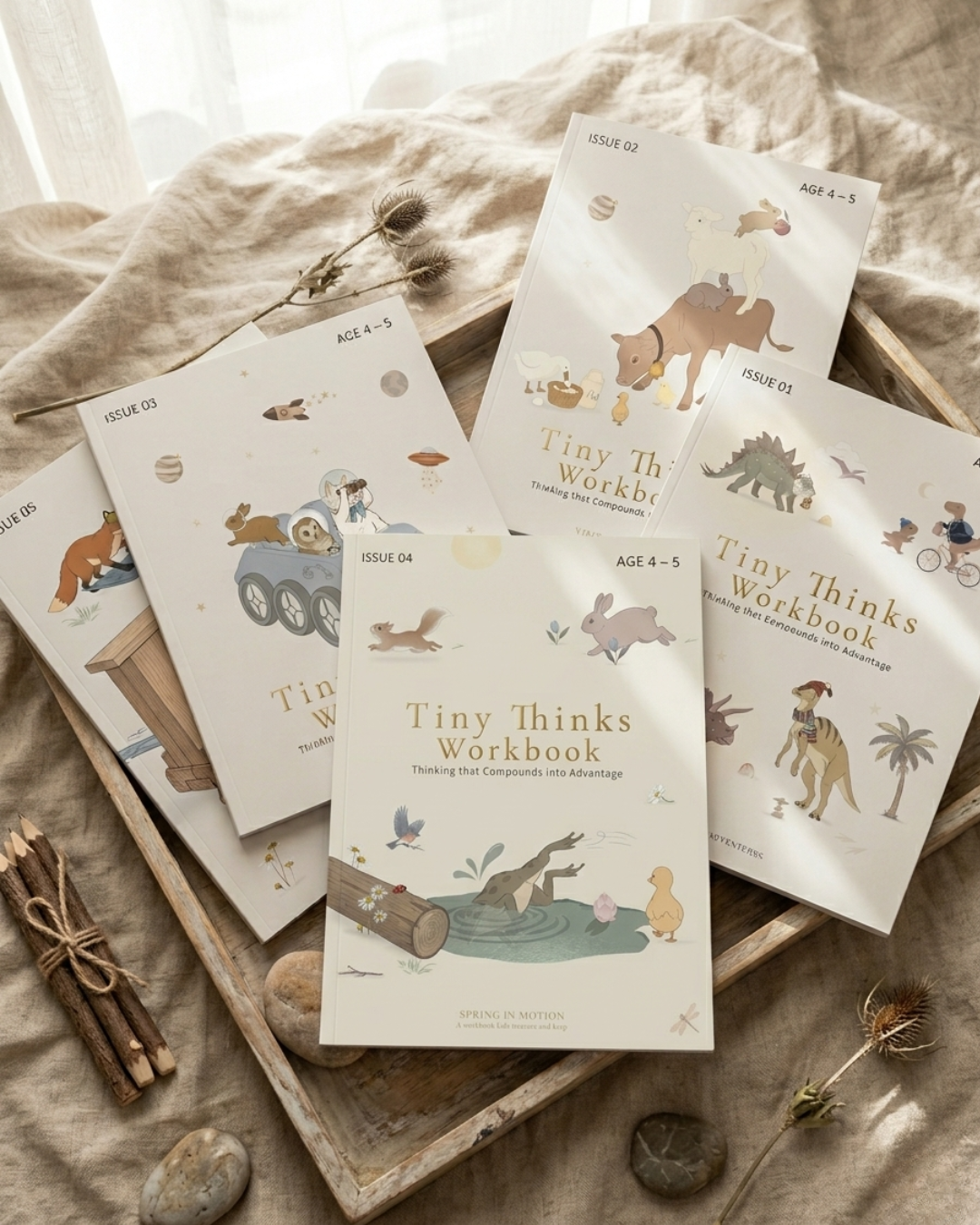
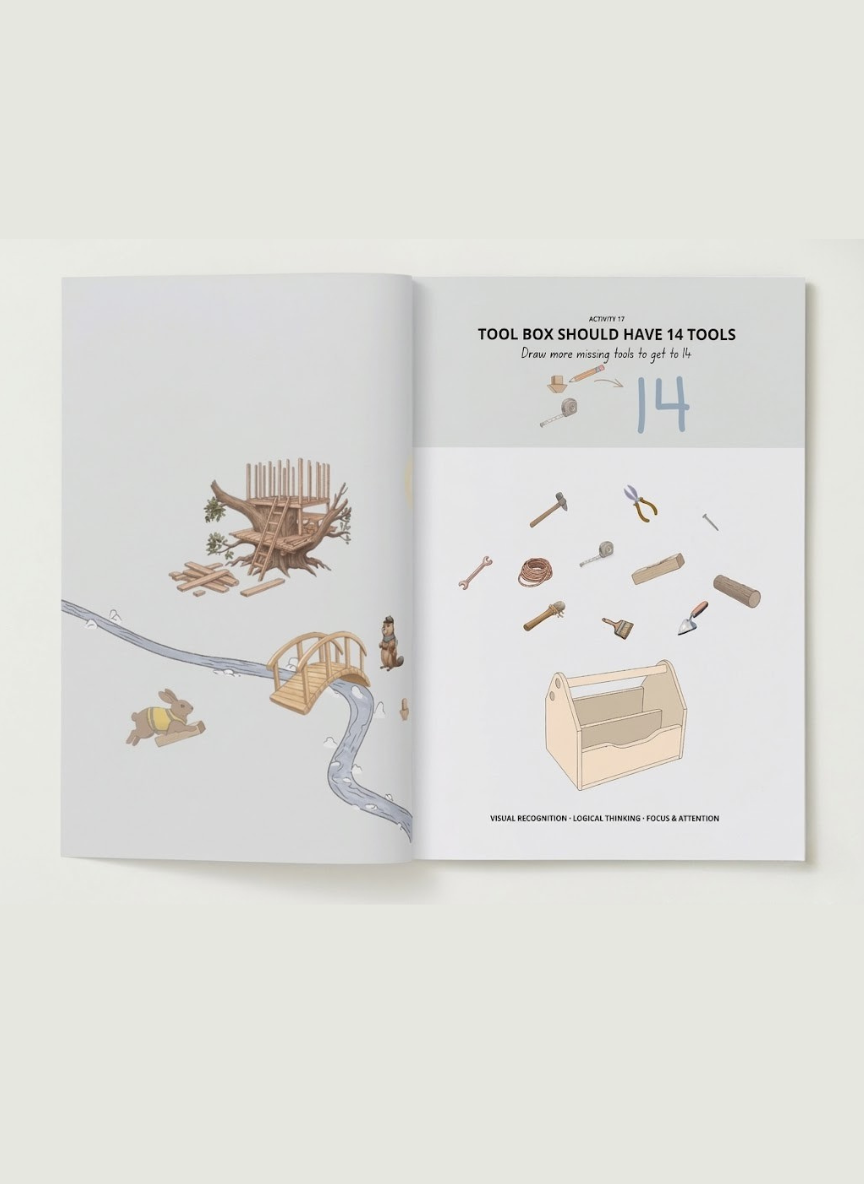
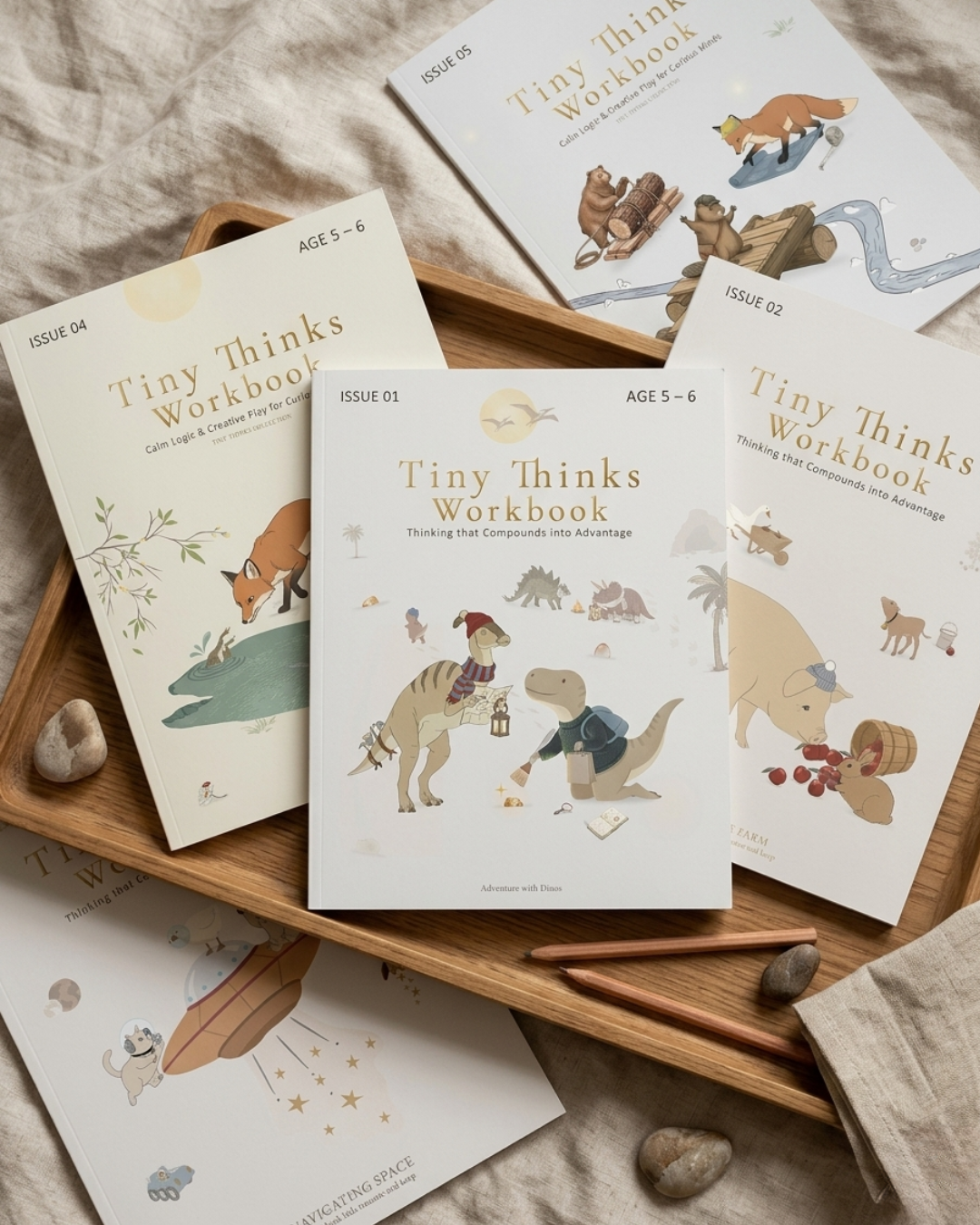
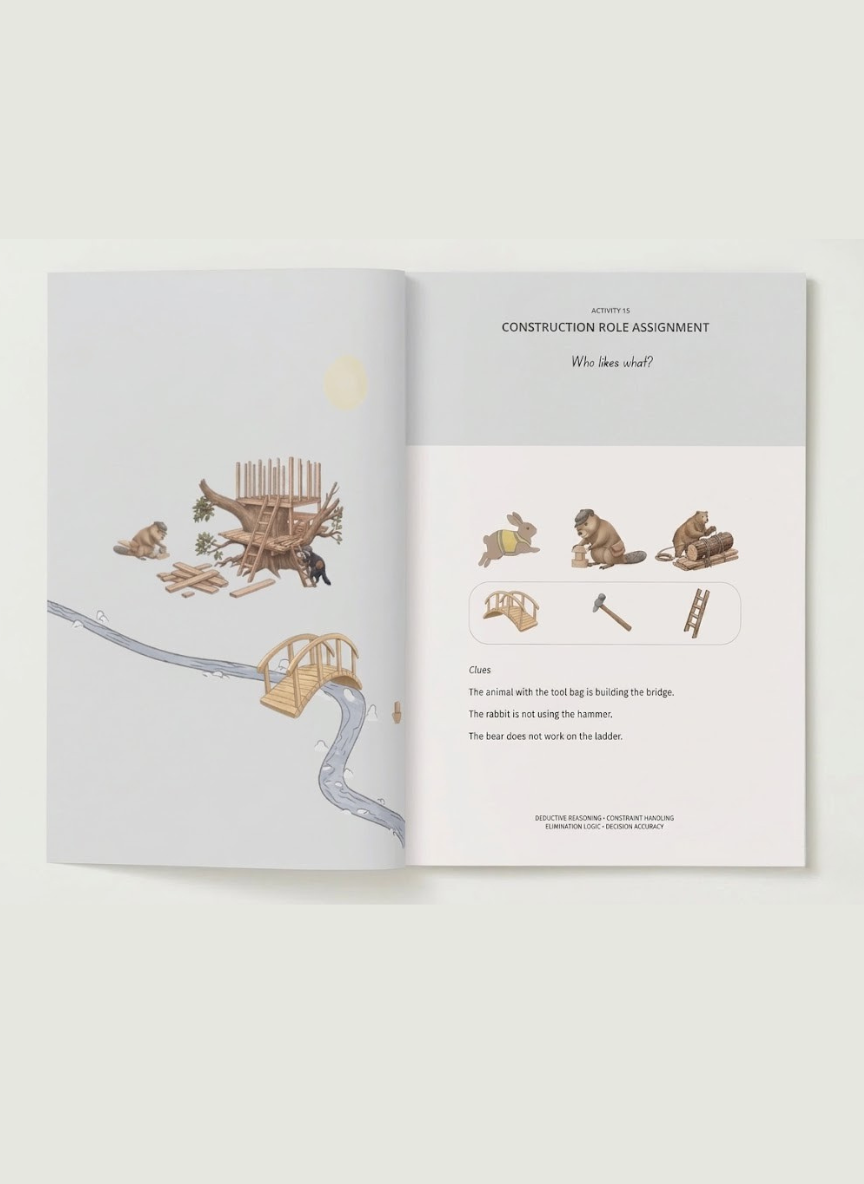
Tiny Thinks uses this same idea in short, screen-free missions: not rushing children to the answer, but giving them regular chances to notice, test, and rethink.
If your child often gets stuck and waits for you to solve it, Tiny Thinks workbooks give you a simple way to practise this at home through the Pre-Seven Learning Method: small screen-free challenges that build problem-solving, flexibility, and staying with uncertainty. You can start gently with the Free Calm Pack, or explore the full range of Tiny Thinks workbooks.
Frequently Asked Questions
How do you teach problem-solving skills to children?
You teach problem-solving mainly by resisting the urge to solve it for them and asking questions that hand the thinking back, like what have you tried so far.
What are problem-solving activities for kids?
Problem-solving activities are open-ended tasks without one obvious right answer, such as building challenges, tricky puzzles, and real household problems like fitting toys back into a box.
Why is problem-solving important in child development?
Problem-solving is important because it is one of the earliest ways children practise independent reasoning, persistence, and recovering from mistakes without adult rescue.
How can preschoolers learn problem-solving?
Preschoolers learn problem-solving mainly through trial and error, so simple repeated attempts at a task, even ones that fail, are normal and useful at this age.
What are examples of problem-solving scenarios for kids?
Examples include asking what would you do if you lost your shoe at the park, or how would you carry all these groceries if you can only take two trips.
My child gives up instantly. How do I help?
Try naming the feeling first, then offering one small question like what’s one thing you could try, rather than immediately giving the answer or taking over. Everyday practice like this is what the Pre-Seven Learning Method focuses on in the years before seven.
Am I helping too much when my child struggles?
If you find yourself giving the next step before your child has tried anything themselves, that is often a sign you are helping earlier than the child actually needs.
Is it normal that my five-year-old melts down when stuck?
Frustration when stuck is common at this age, and it usually points to comfort with uncertainty still forming rather than a lack of ability. If meltdowns are frequent, intense, or paired with other concerns, a pediatrician can offer guidance.
How much help should a six-year-old need with problems?
By six, many children can hold a simple plan in mind and try it before asking for help, though they will still need support with genuinely new or complex challenges.
Do tantrums mean my child has poor problem-solving skills?
Not necessarily. A tantrum often reflects a frustration tolerance still developing, which is different from the thinking skill of finding a route through a problem.