


- Key Takeaways
- Beyond the Checklist
- Key Preschool Skills by Age
- The Power of Play
- When to Seek Guidance
- Nurturing the Whole Child
- A Calmer Path Forward
- Conclusion
- Frequently Asked Questions
- What preschool skills are important for each age?
- How does play help preschool skill development?
- When should parents seek guidance about skill development?
- Can preschool skills be taught at home?
- Why is nurturing the whole child important?
- Are checklists enough to track preschool readiness?
- What is a calm approach to preschool preparation?
Key Takeaways
- Remember, all children develop at their own pace, and milestone checklists should be used as loose guides, not hard rules.
- By honing in on your kid’s individual interests and strengths, you can help nurture their confidence and lifelong passion for learning.
- Organized age-appropriate activities and play foster cognitive, social, and emotional development in preschoolers.
- Consistent tracking and communication with teachers can reveal useful information about your child.
- Early support and intervention, if necessary, can change the course of developmental delays.
- A serene, rhythmic schedule with time for play, naps, and meditation feeds the whole child and establishes a great platform for learning to come.
Preschool skills by age outline the slow acquisition of attention, sequencing, memory and independent play among 3 to 7 year olds. At every age, children demonstrate fresh skills such as obeying two-step directions, pattern-matching or initiating simple tasks independently. The Free Calm Pack is a simple starting point, structured activities for after school, mealtimes, or waiting rooms that children can pick up independently
These changes often show up quietly in everyday moments, particularly in calm, structured environments where children have space to practise. Knowing these stages helps parents observe what is typical, what promotes attention and what little steps stimulate consistent progress.
Beyond the Checklist
Early childhood development seldom progresses along linear lines. Even with all the milestone checklists and timelines, every parent knows that real children do not fit tidy boxes. Some 3-year-olds, for example, can complete a puzzle for as long as 15 minutes, while others can barely sit. Some four-year-olds relay stories, while others just sit and watch. Advancement is sporadic, and that’s okay. The checklist is a roadmap, but not the whole narrative of child development.
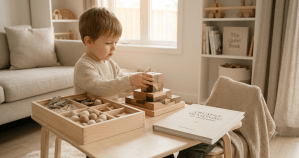
What counts is constant watching. Pay attention to what your child focuses on when the room is silent, not just what they do when ordered to. Does your toddler repeat patterns, sort by color, or mimic adult routines? Such behaviors can expose more intrinsic strengths than checking off a series of milestones. Notice what pulls them back stacking blocks, tracing shapes, lining up cars. These markers of focus and repetition are the foundational elements of attention and sequencing. These aren’t incidental habits.
A child who lines up cars in a row, then rearranges them by size, then starts again unprompted is doing something significant. They’re practising sustained attention and pattern recognition in the most natural way possible: through play that feels satisfying to repeat. That repetition is where the capability actually develops.They count as much as talking or arithmetic.
Checklists are great for monitoring general progress. The true magic lies in understanding your child’s individual flow. Certain children shun boisterous play; others have trouble with transitions, and some balk at solo activities. These aren’t red flags; they’re signals. Many times, it’s the child’s nervous system controlling sensory input or dealing with new demands. Parents who listen and respond, providing soothing, orderly options, give their kid the greatest opportunity to calm down and participate in their toddler milestones.
Teachers view your kid differently. Some regular, open conversations with your teachers or caregivers can bring to light patterns you might miss at home. They might observe your child flourishing in small groups or faltering with new endeavors. These common notes help create a holistic image. They provide direction on when to give your child space and when to intervene with support.
The early years are a particularly active period for brain development. It is important to monitor early. Yet not one measure alone forecasts future achievement or difficulty. Other times, a child will avoid certain play or retreat during group time. These actions count. Early intervention, if necessary, can alter the trajectory, but don’t substitute it for everyday, undistracted parenting. Screening tools are valuable, but they cannot substitute for your insight or your bond with your child.
Key Preschool Skills by Age

Preschool years are characterized by quick changes in focus, language, and autonomy. They transition from parallel play to cooperative group play, from scribbles to pre-writing, and tantrums to emerging self-regulation. Each age has unique skills and pressure points for parents, particularly in those sticky moments post school, screen transitions, or pre-bedtime.
A calm, structured environment supports this development, particularly when predictable, low-stimulation activities are consistently available.
1. The Curious Three-Year-Old
At three, imagination is flourishing. Kids engage in hours of pretend play, giving toys a voice or inventing tales. They begin to draw circles, stack blocks and finish simple puzzles, developing early pattern recognition and motor control.
Fine motor skills develop. Most can manipulate large crayons, flip pages and, under watchful eyes, cut paper with scissors. Language blooms as well. Most 3-year-olds speak in short sentences, ask “what” and “where” questions, and are understood by family and familiar adults 75 to 80% of the time.
Socially, they start sharing toys and playing beside others, but not necessarily cooperating. This is where a serene, organized play environment can really help direct this exploration. Picture-matching, guided tracing and easy two-step games aid focus and sequencing.
Short, repeatable activities like matching colored objects or sorting shapes give three-year-olds a sense of mastery.That sense of mastery matters more than it appears. A child who completes a simple sort and starts again on their own is not just busy, they are experiencing the satisfaction of finishing something. Over many repetitions, that experience builds the self-direction and persistence that formal learning later asks of them. Browse activities for age 3–4 for structured options at this stage . As parents, we know that snappy, tactile input calms the nervous system a lot quicker than any digital option.
2. The Confident Four-Year-Old
Four year olds are hungry for independence. They need to pick their clothes, choose their snacks, and make little decisions. This is the age where fine motor leaps are clear: children draw squares, build towers, and start manipulating small buttons or zippers.
A lot can wield scissors with greater control. Speech is clear enough for strangers to understand and children ask ‘why’ questions incessantly. They enjoy retelling stories, completing two or three step directions, and playing simple group games that foster social rules.
Emotion regulation is a work in progress. Four-year-olds can name feelings and attempt to manage frustration. Counting games, simple math with blocks, and sorting activities familiarize your child with basic numeracy.
Many parents find that quiet, simple activities work well after busy days or during transition-heavy moments.Structure is important. For fours, predictable routines, definite choices, and easy visual cues assist our four-year-olds in settling and focusing, especially after a long day or during hyperactive transitions.Browse activities for age 4–5 for structured options at this stage.
3. The Capable Five-Year-Old
By five, they’re storytellers and budding problem solvers. Literacy skills take off. They recognize letters, write their name, and identify sounds in words. Drawing stick figures and basic shapes comes naturally now.
A lot can write some letters and numbers, retell familiar fables and confidently discuss the past. Five-year-olds love responsibility. Little tasks, such as preparing the table and sorting toys, encourage self-confidence and autonomy.
Open-ended questions, like “What happens next?” ignite deeper thinking and help kids connect ideas. This is one of the clearest signs of cognitive development in this age range not that a child knows the answer, but that they can hold the question in mind and work toward it. That capacity, to stay with something unresolved and keep thinking, is one of the most transferable skills a child can develop before school begins.Socially, teamwork blooms. They grasp group rules, share more generously, and team up on projects, such as constructing a block tower or mapping out a group story.
Physical coordination improves with jumping, climbing, and catching balls with direction. Calm, tactile activities such as puzzles, gentle sequencing games, and pattern tracing help reset focus when energy spikes or transitions are hard These schedules assist kids in navigating transitions, from waiting rooms to bedtimes.
4. The Independent Six-Year-Old
Six-year-olds are primed for even bigger challenges and sustained focus. Self-regulation comes online. They can control emotions, handle multi-step directions, and stay on task for longer.
Academic readiness grows, with structured learning activities matching school expectations. These include reading short passages, writing full words, and doing simple math problems. Goal-setting kicks in whether it’s to complete a project or to master a new skill.
Children know how to tell time using terms like “yesterday” and “tomorrow,” count past 10, and identify written numbers. Physical ability develops to include jumping forward with both feet, standing on one foot, and confidently exploring playgrounds.
Physical exercise and outdoor play are crucial for both concentration and wellness.Browse activities for age 6–7 for structured options at this stage.
The Power of Play

Play is the primary motor in early childhood skill building. It’s not simply a time filler. Play is how preschool kids structure the universe, process their experiences and cultivate the attention and autonomy that will carry them through adulthood. Whether a child is stacking blocks solo, swapping a puzzle with a buddy, or working through steps to finish a simple pattern, every form of play directly nurtures attention, memory, and self-control.
These playful moments are not chance. They are organized occasions for the brain to rehearse sequencing, emotional control, and problem-solving skills, all in a relaxed, low-stress environment.
Layered development in the preschool years includes various types of play. There’s idle play, observing the world or their own hands. There’s solitary play constructing silently, oblivious to their surroundings. Then, as skills develop, comes parallel play, two kids sitting next to each other, each doing their own thing.
As they get older, children shift to associative and cooperative play, sharing, negotiating, and story-building together. Each phase is intentional. Unstructured and solo play cultivate ease with autonomous attention. Cooperative play initiates the slow labor of learning patience, turn-taking, and how to solve conflict without adult intervention.
The most robust basis for attention and regulation is always developed through slow, predictable play, never fast or chaotic input. It’s a safe, supportive environment that allows kids to try out ideas and take small risks. Calm, clear boundaries provide space for exploration without the fear of shame or failure.
When kids know what’s coming – a clean space, easy supplies, and repeating routines, they calm down faster and focus longer. Mistakes are in the mix, not something to avoid. For instance, if a kid is stacking blocks, they quickly learn that towers fall. Every collapse is data, not failure. Frustration tolerance is born here.
Play teaches life skills in a more direct way. When kids play, they negotiate rules, come to disagreement resolutions, and learn to empathize. Even the most basic games rolling a ball between you, matching pairs, co-creating a train track require collaboration and offer an opportunity to practice coping with impulse and disappointment.
This is the basement level of social-emotional learning.
Examples of play activities that build skills include:
- Sorting objects by size or color (attention, pattern recognition)
- Matching cards or memory games (working memory)
- Simple board games (turn-taking, sequencing, counting)
- Building with blocks or connecting toys (fine motor, planning)
- Pretend play with figures or kitchen sets (imagination, negotiation)
- Tracing lines or dot-to-dot pages helps develop fine motor skills and focus.
- Cooperative building or shared puzzles (teamwork, patience)
Tiny Thinks turns ordinary quiet moments into thinking practice children come back to on their own. The Free Calm Pack is a simple starting point structured activities for after school, mealtimes, or waiting rooms that children can pick up independently. The Pre-Seven Learning Method identifies the capabilities that underpin all of this sustained attention, persistence, pattern recognition, and independent thinking and names the years before seven as when they develop most readily through exactly this kind of play. A child who plays a matching game three days in a row not because they were asked, but because they wanted to is demonstrating something that checklists rarely capture: the habit of returning to something because it feels satisfying and achievable.
That habit is the root of independent learning. It forms well before a child sits in a classroom, in the quiet, repeated moments of early childhood.
When to Seek Guidance
Knowing when to seek advice is a pragmatic exercise, not a reason for panic. In general, most parents just know when something feels off, particularly if their child isn’t keeping up with his or her peers in multiple areas. Comparing milestones is not about judging; it’s about identifying trends that may require additional assistance.
For instance, a 4-year-old who isn’t yet speaking in simple sentences, or a 5-year-old who consistently struggles to follow two-step instructions, may benefit from a professional opinion. Children who don’t respond to their name or rarely engage with peers are also worth discussing with a doctor not as cause for alarm, but as a prompt to seek a clearer picture.
Developmental delays can manifest in a number of different areas: physical, social, language, or daily living tasks. The table below summarizes some common signs and suggested next steps to address toddler milestones.
| Observable Delay | What to Do Next |
| Not sitting, crawling, or walking on time | Consult a doctor for assessment |
| No response to name or lack of eye contact | Ask about social communication screening |
| Not speaking or not understanding simple instructions | Request a language evaluation |
| Trouble making friends, high anxiety, aggression | Seek social-emotional support |
| Repetitive movements or intense fixations | Discuss with a developmental specialist |
| Struggles with dressing, feeding, or toileting | Contact an occupational therapist |
| General uncertainty or concern | Err on the side of caution, seek guidance |
Developmental screening tools, commonly offered by your pediatrician or early years teacher, can help you understand what is normal and what needs extra focus. These aren’t tests that determine pass or fail; they are tools to help parents identify strengths and gaps in their child’s growth.
For most, screenings are offered regularly at health visits or community centers. Parents can request them anytime; they’re particularly useful when milestones are fuzzy or behaviors shift abruptly.
While resources and intervention services differ, early assistance is generally available for a minimal fee or free in many areas. Speech and language therapists, occupational therapists, and early intervention coordinators are all trained to preemptively spot subtle delays and coach families towards increased regulation and skill-building.Educators and caregivers supporting early childhood development in group settings can find structured resources at Tiny Thinks for Educators.
Proactive action before frustration strikes really helps. Even if it just results in reassurance, it helps clear next steps.
Nurturing the Whole Child

Holistic means nurturing the whole child not just academic milestones. It’s the continual accretion of emotional, social, and cognitive development that forms a child’s life foundation. Early learning is not always swift; a child could name numbers but not share a truck, construct block castles but not participate in a circle game. This is natural. Growth is lumpy and capacities fluctuate from one day to the next, particularly for kids aged 3 to 7. Not to make the pace even, but to nurture every domain in a balanced rhythm.
Play is at the heart of development, not as a diversion but as the key mechanism for thinking, relating, and self-regulation. Symbolic play, such as pretending a block is a phone, reinforces imagination and language. Rough-and-tumble play educates us in boundaries and physical confidence. Simple pattern games, matching cards, and quiet sorting activities develop working memory and frustration tolerance.
Outdoor play provides for motion and risk-taking, whereas quiet, tactile play indoors resupplies attention following hectic or overstimulating periods. Each type of play does heavy lifting; it grows vocabulary, teaches problem-solving, and builds the first friendships.
Emotional development runs through all of this. Preschoolers discover how to label emotions, take turns and work through minor disputes. These skills evolve in the moment over spilled juice or a friend swiping a beloved crayon. Only in the context of steady routine, not one-off lessons, do kids learn to regulate themselves.
A caring, consistent environment from caregivers and teachers wraps the child in a safe, predictable world. For kids dealing with trauma, these connections become even more important as they mitigate stress and help the brain relearn that the world can be trusted.
Supporting the whole child means making sure no domain of development is overlooked and that every child feels capable and included. This can be as easy as providing books and toys that represent different cultures or embracing every child’s language and heritage.
All domains are nurtured by a balanced routine. Kids require rough-and-tumble play and stillness, conversations with other children and conversations with adults, time to be wild and time to quietly observe. Family meals, bedtime stories, and shared chores establish peaceful, regular rhythms that form emotional security and attention.None of this is about academic preparation. A child who learns to wait their turn, try again after frustration, and finish something small on their own is building the thinking habits that formal learning depends on, not because they were drilled, but because the conditions of their daily life made it possible. That’s what the early years are for.
Parents don’t need to fill every moment. Kids rest easiest with easy, replicable rhythms and hands-on, screen-free experiences that encourage autonomous thought.
Checklist for Nurturing the Whole Child:
- Foster active and calm play daily, inside and outside.
- Support friendships, sharing, and gentle conflict resolution.
- Offer language-rich activities: stories, songs, picture books, and conversation.
- Offer hands-on, minimal-audio thinking assignments that develop focus and recall.
- Create routines with balanced play, rest, and family time.
- Ensure learning spaces reflect all children’s backgrounds and identities.
- Maintain caring, consistent relationships, especially during hard moments.
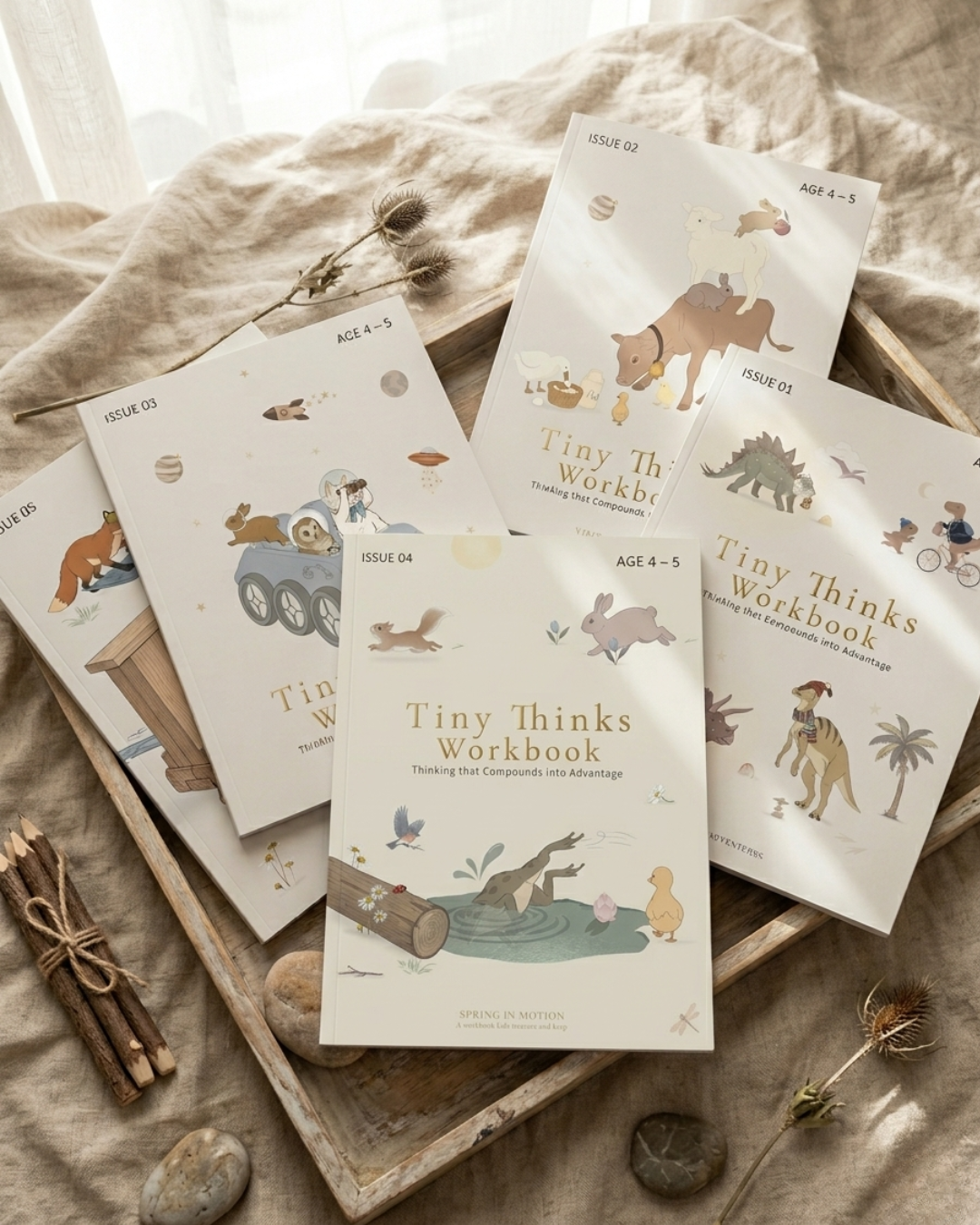
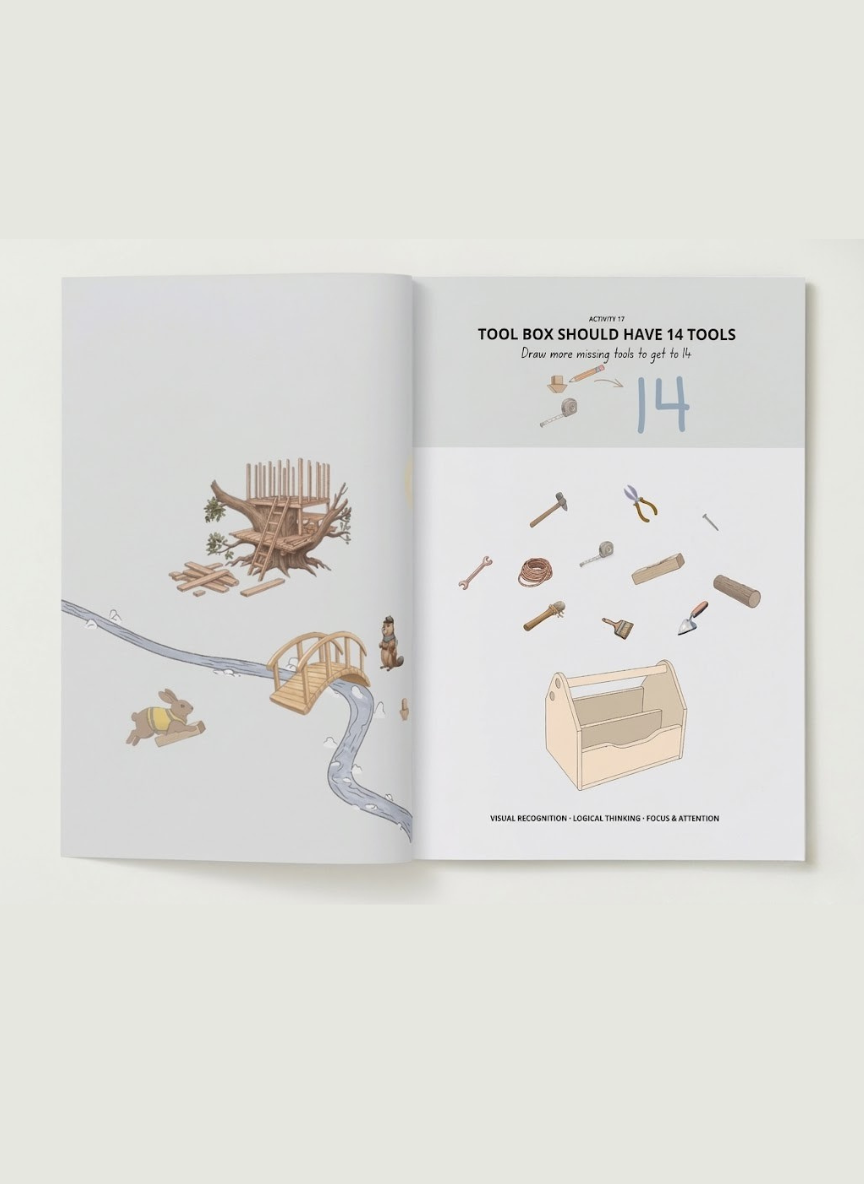
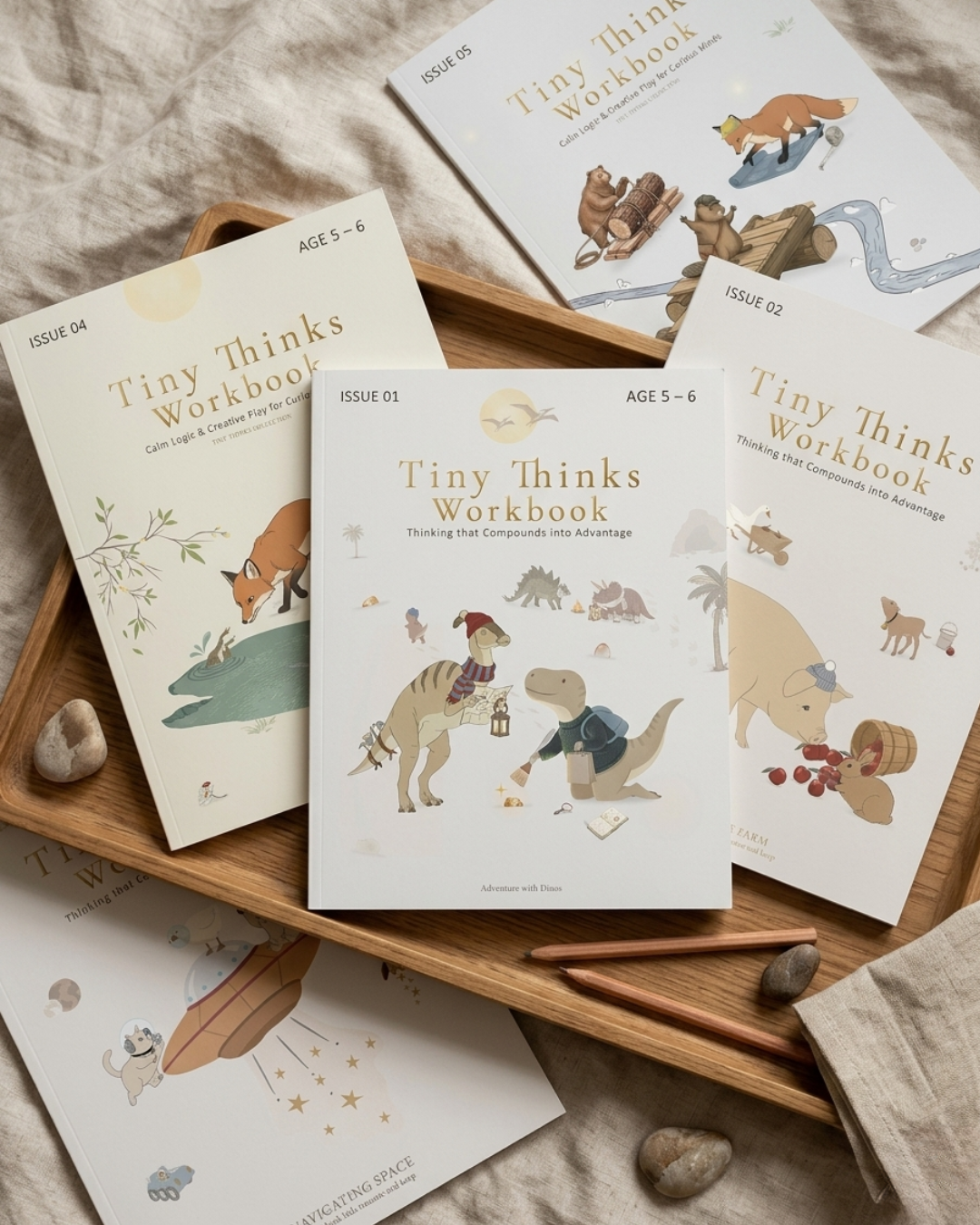
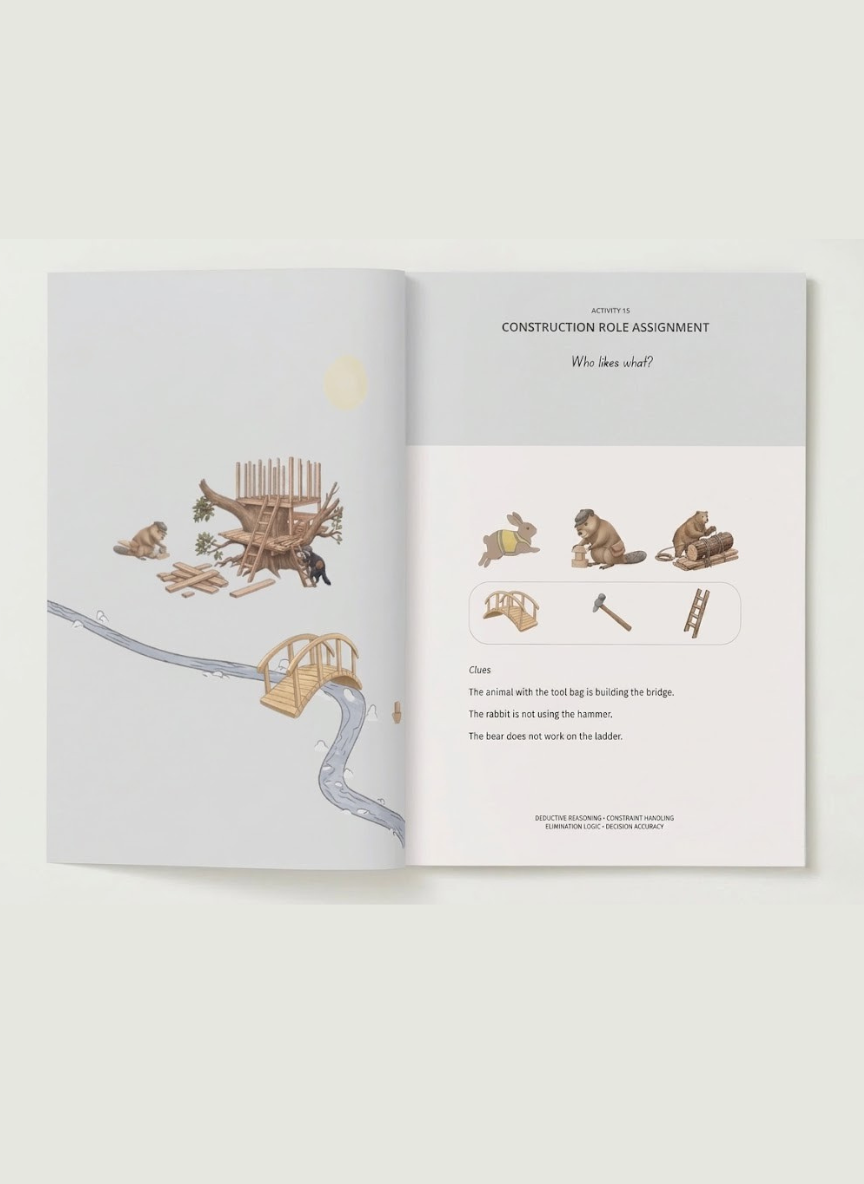
Age-based Tiny Thinks Workbooks offer calm, sequenced thinking practice the kind children return to on their own, in the ordinary quiet moments of family life.
A Calmer Path Forward
Supporting a calmer path forward means helping children settle into the stretches of balance that allow them to focus, play independently, and move through transitions with less friction. For preschoolers, these times typically come in the wake of natural developmental cycles, where restless, irregular periods of disequilibrium are replaced by sweeps of assuredness and steadiness.
Around age four, many children move into a more cooperative, settled phase more able to engage calmly and take turns, at least for stretches . These cycles are not the same for all; some kids are naturally more active, persistent, or cautious, and that dictates their road ahead. What aids in steering things into calmer waters is not a miracle hack, but obvious, repeatable structure throughout daily life.
Simple mindfulness practices can be woven into ordinary moments, no special vocabulary or routine needed. It’s as easy as saying ‘hey, kiddo, let’s take a breath before lunch’ or lingering together in silence to hear the stillest noise in the room. These mini-resets assist kids in developing emotional regulation, allowing their nervous system a moment to calm after overstimulation.
It’s not about teaching a script, but about quietly modeling calm attention and helping kids return their focus to the moment. With time, these practices enable children to identify their own moments of equilibrium and disequilibrium, extending the calm stretches.
Regular routines are the source of reliability for preschoolers. Kids do best when they know what’s next, and that’s particularly crucial during those high-friction moments after school, before bed, or on the road. With ambiguous routines, kids waste mental resources trying to figure out what’s actually expected instead of turning their focus toward learning or playing.
These schedules don’t have to be strict; even a picture sequence or a basic “first-then” soothes the day. This consistency promotes self-regulation and provides kids a place to establish new competencies.
By openly talking about feelings and daily experiences, young kids begin to acquire social and emotional intelligence. It’s not about coaxing a child into long talks, but creating space for simple, honest moments: naming feelings, sharing small stories, or asking, “What was tricky today?” This assists kids in linking language to feeling and more easily ride out frustration or excitement.
Kids with clear, open lines of communication are more likely to navigate phases of disequilibrium with less turbulence. Calming techniques, deep breaths, quiet, gentle tactile stimulation give you real tools when your kid is spiraling.
Slow, tactile, structured input something with a clear start and finish that a child can do on their own tends to help more in these moments than anything fast or reactive.The families who notice the most consistent progress are usually not the ones who found the perfect activity or the most structured routine. They’re the ones who made one or two simple, familiar things consistently available and let their child return to them on their own terms. That return, unprompted, is the signal that something is working.
Conclusion
Preschool years zip by, and the temptation to monitor every milestone is powerful. Most parents simply want to know their child is developing in the right direction emotionally, socially, and cognitively. True strides are unique to each little one. Some catch on fast, while others take their time. Calm, structured play provides children with a pressure-free environment to hone their attention, sequencing, and independent thinking skills. Patterns and routines are more important than perfection. When the day feels hectic, it can make all the difference to go back to something simple and predictable.
The aim isn’t early mastery; it’s consistent growth and confidence. Nurturing the whole child mind, body, and emotions, lays the groundwork for authentic readiness for preschool and beyond.Built for the years before seven, when the thinking habits that last attention, persistence, working it out first take shape.
The children who settle most readily into learning at home and eventually at school are often the ones who’ve had the most consistent experience of finishing things on their own. Not impressive things. Small things: a puzzle completed, a pattern matched, a sequence followed to the end. Accumulated across ordinary days, those experiences are what build the attention and independence that everything else depends on.
Preschool skills by age are a useful guide but not a rigid checklist development is uneven, and children often show strengths in some areas before others. The Free Calm Pack is a simple starting point, structured activities for after school, mealtimes, or waiting rooms that children can pick up independently
What children do in quiet, unprompted moments the patterns they notice, the activities they return to reveals as much about development as any milestone measure.
Calm, structured play (sorting, matching, sequencing, building) builds the attention, working memory, and persistence that formal learning later depends on.
Early conversations with teachers and caregivers often surface patterns parents miss at home, these are worth having regularly, not only when concerns arise.
If delays are observed across multiple areas, early professional guidance is worth seeking, it is most useful before frustration sets in for child or parent.
Tiny Thinks Workbooks give children calm, structured thinking practice the kind they return to on their own in everyday quiet moments at home. Browse age-based workbooks.
Frequently Asked Questions
What preschool skills are important for each age?
Skills develop at varying rates in children. Foundational preschool skills include social, motor, language, and cognitive skills. By age three, they may follow simple instructions and play with other kids. By age five, they are typically talking in full sentences and becoming more independent.
How does play help preschool skill development?
Play nurtures problem-solving, communication, and creativity, helping children ages develop essential toddler milestones, social skills, and coordination for preschool preparedness.
When should parents seek guidance about skill development?
If your child is exhibiting profound delays in reaching developmental milestones or having difficulty communicating, moving, or interacting with peers, consulting a pediatrician can assist. Early help frequently means early success.
Can preschool skills be taught at home?
Parents and caregivers can foster preschool skills by engaging in daily activities that nurture child development through reading, talking, and playing, which support important toddler milestones.
Why is nurturing the whole child important?
By covering emotional, social, physical, and cognitive areas, you’re promoting well-rounded development. This makes them bold and flexible learners.
Are checklists enough to track preschool readiness?
Milestone checklists are great for tracking toddler milestones. Every kid is different, and understanding child development in various contexts gives you a fuller picture of their growth.
What is a calm approach to preschool preparation?
A patient strategy involves nurturing your child’s development milestones at his or her own speed, appreciating minor successes in gross motor skills, which decreases anxiety and instills reassurance for kids and parents alike.